
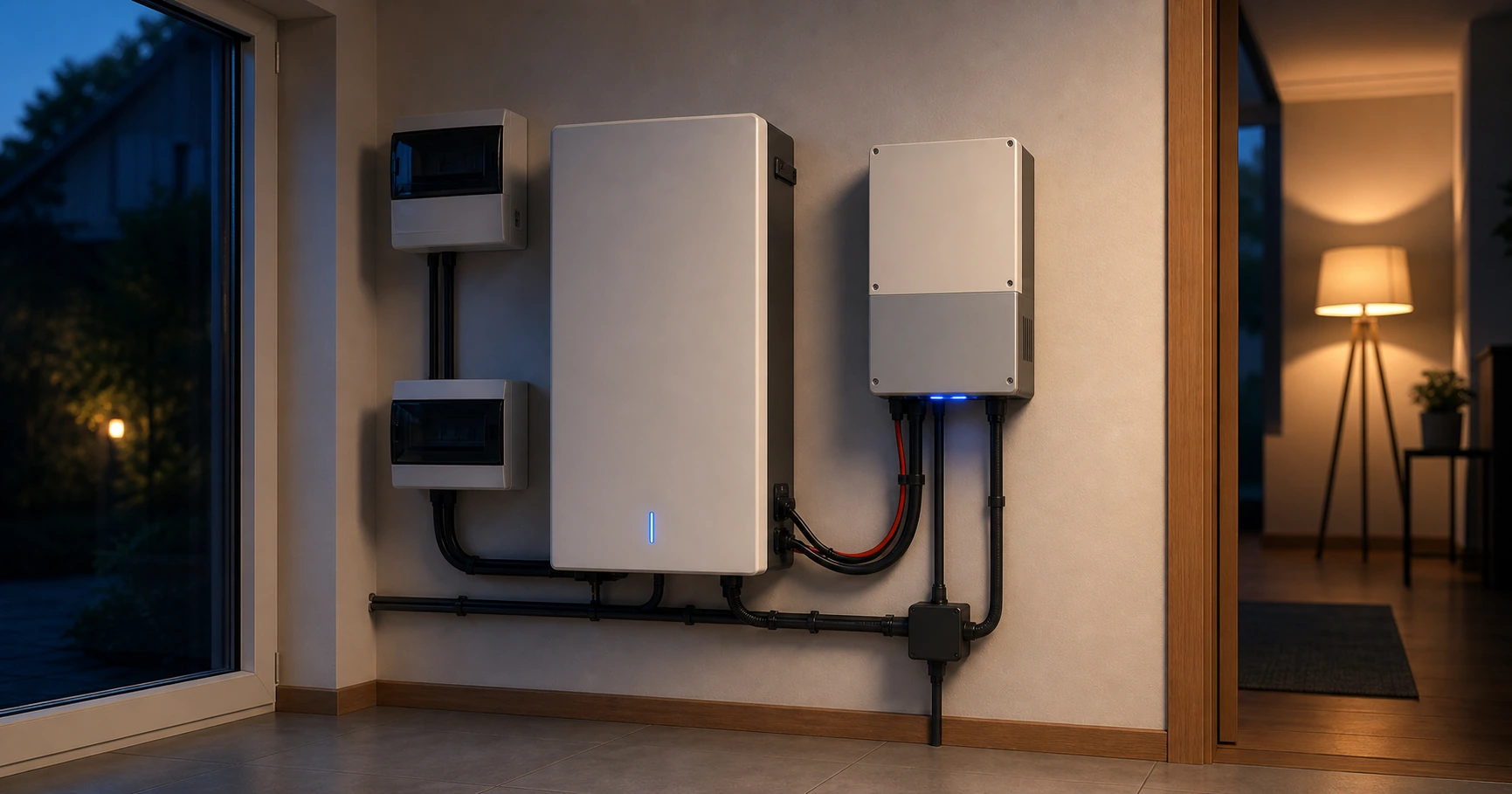
A home backup power system stores electricity in a battery and uses an inverter to supply selected appliances when the grid fails. Solar panels are optional. Backup operation requires compatible equipment, a safe means of separating the backup circuits from the utility, and professional commissioning. Runtime depends on usable battery energy and the loads you keep running.
The short answer
Think of the system as three jobs: store energy, convert it into household power, and supply the right circuits safely. A battery handles storage; an inverter handles conversion; the installation determines which circuits receive backup power. A solar input can add daytime charging, but neither a solar panel nor the word “hybrid” on a product label guarantees operation during an outage.
The US Department of Energy explains that solar-plus-storage can operate without grid support when its inverters and system are designed for that function. Confirm the backup capability of the exact equipment, not just the product category. Source
The components and what each one does
Battery: stored energy, not unlimited power
The battery stores energy for later use. Capacity in kilowatt-hours describes energy, while the inverter’s kilowatt rating describes output power. They answer different questions: how long the loads may run, and how much can run at once.
Start with measured consumption and a required backup duration. Do not assume a particular battery capacity will cover an entire night. For the calculation and its assumptions, use our battery runtime guide.
Battery management system: monitoring and protection
A battery management system, or BMS, monitors the pack and controls charging or discharging within its design limits. It is an important protection layer, not a replacement for correctly selected protective devices, installation, or the manufacturer’s instructions. Our BMS explainer describes its role in more detail.
Follow the battery’s specified temperature limits. Do not charge an ordinary lithium-ion battery below freezing unless the manufacturer explicitly supports the conditions and the required temperature-control system is operating. A heated room or enclosure is not proof that the cells themselves are ready to charge. Source
Inverter: converting and managing power
The inverter converts battery DC into AC for the supported household loads. Depending on the model, it may also charge the battery from the grid, accept solar input, and manage an approved backup output. Check its continuous output, startup capability, supported battery voltage, and communication requirements.
For the device-level explanation, see how a hybrid inverter works. For a buying decision, use the home inverter selection guide. This article explains the system rather than repeating those selection guides.
Solar panels and MPPT: optional daytime generation
Solar panels add another energy source. An MPPT controller manages the operating point of a compatible solar array; it may be integrated into the inverter or supplied separately. Array design, voltage limits, and charging settings must match the equipment documentation.
Adding solar does not make a system independent of weather. Generation changes with the site and conditions, and charging during an outage must be supported by the particular system. Australian government guidance likewise distinguishes having a battery from having a system configured for blackout backup. Source
Backup circuits and transfer equipment
An installer may provide a separate essential-loads panel or another approved arrangement to keep the backup demand within the system’s limits. The transfer and isolation design must prevent the backup source from energising utility lines during an outage. The precise arrangement belongs to a qualified electrician, not a copied wiring diagram.
Confirm the backup boundary before buying
Ask the installer to identify, in writing, the circuits that will remain powered, those that will turn off, the supported load and startup demand, and how isolation and protection will be verified. Do not connect an inverter output to a wall socket to energise the building.
Our inverter connection safety overview explains what to ask the professional without providing a DIY mains-wiring procedure.
How energy flows: three scenarios
Grid available
The grid supplies the home’s loads. Depending on its configuration, the system may charge the battery from the grid or from available solar generation. A reserve setting can preserve energy for a later outage instead of using all stored energy immediately.
Export is a separate design and approval question. Do not assume that installing a hybrid inverter automatically permits selling electricity or feeding surplus power into the utility network.
Blackout without solar generation
A backup-capable system separates the protected circuits from the utility and supplies them from stored energy. Circuits outside that backup arrangement remain off. Available runtime then depends on the battery’s usable energy, its reserve setting, conversion losses, and actual demand.
Transfer is not automatically interruption-free. Check the documented transfer behaviour against the needs of your appliances. Equipment that cannot tolerate a break in supply may require a separately specified UPS or other approved continuity arrangement.
Blackout with solar generation
A system designed to support solar while islanded may use available generation for loads and battery charging. If generation is lower than demand, the battery supplies the difference. If the battery reaches its limits, the system may curtail solar or stop supplying loads according to its controls.
Do not plan outage coverage on an ideal sunny-day assumption. Ask how the proposed system behaves during poor weather, low battery charge, and restart after shutdown.
Island mode versus grid-connected mode
Island mode means the backup system supplies its local loads while safely separated from the utility. Ordinary grid-following solar equipment generally cannot provide this function on its own. Grid-forming and backup capability must be confirmed for the system. The DOE describes both the benefits and the control requirements of islanded operation. Source
| Question | Grid available | Backup island operation |
|---|---|---|
| What supplies the loads? | Grid and any configured local sources | Supported local sources |
| Which circuits receive power? | Normal building circuits | Only circuits included in the backup design |
| Can energy reach the utility? | Only under the applicable connection arrangement | The backup island must remain separated |
| Can solar charge the battery? | If supported and generation is available | Only if the system supports it in backup mode |
| Is transfer interruption-free? | Not a transfer condition | Depends on the equipment and load requirements |
Choosing the essential loads
List the appliances that matter during an outage, their actual running demand, and any startup requirement. A refrigerator, router, lighting, and boiler controls are common planning categories, but their names alone do not establish their consumption or compatibility.
Use the dedicated guides for refrigerator backup, router and ONT power, and gas-boiler backup when checking those loads. Size the inverter separately using the inverter power calculation.
Do not treat ordinary household backup as an approved supply for life-support equipment. For medically essential devices, follow the equipment provider’s backup requirements and agree a separate contingency plan with the responsible professional.
Planning an installation in Ukraine
Check your local outage information and plan around the loads and duration that matter to you. Historic nationwide outage figures are not a schedule for your address.
Ask a qualified electrician and your distribution system operator which connection, protection, commissioning, and documentation requirements apply. A power rating alone does not establish an exemption from permission or approval. All hardwired connections require professional design and installation.
For an assembled-package checklist, see our home backup kit guide. For the wider purchase decision, see backup systems for Ukrainian homes. If you are comparing alternatives, the battery versus generator guide and UPS alternative overview explain the different roles.
For battery chemistry, use our LiFePO4 versus lead-acid comparison. Current equipment information is on the product page; dealers and installers can use the partners page to discuss a project.
Frequently asked questions
Does a home backup system need solar panels?
No. A compatible battery-and-inverter system can be charged from the grid if the equipment supports it. Solar adds another charging source but requires separate design and does not guarantee coverage in poor weather.
Will a hybrid inverter keep every appliance running?
Not necessarily. Backup capability, supported circuits, continuous power, startup demand, and available battery energy all matter. Confirm the exact backup output and installation plan.
Will my computer stay on during the changeover?
Do not assume so. Compare the inverter’s specified transfer behaviour with the device’s tolerance. If continuous supply is essential, ask for a suitable UPS or other approved continuity solution.
Can solar panels charge the battery during an outage?
Only if the system is designed for solar operation while islanded and conditions permit generation. Confirm low-charge startup and shutdown behaviour as well as ordinary operation.
Does a small non-export system automatically avoid permits?
No blanket exemption is established here. Ask your distribution operator and qualified installer which rules and documents apply to the property and proposed system before work begins.
What should I prepare before asking for a quote?
Prepare the essential-load list, measured demand where available, required backup duration, supply phase, proposed location, and any existing battery or solar equipment details. Ask for a written compatibility and commissioning scope.