
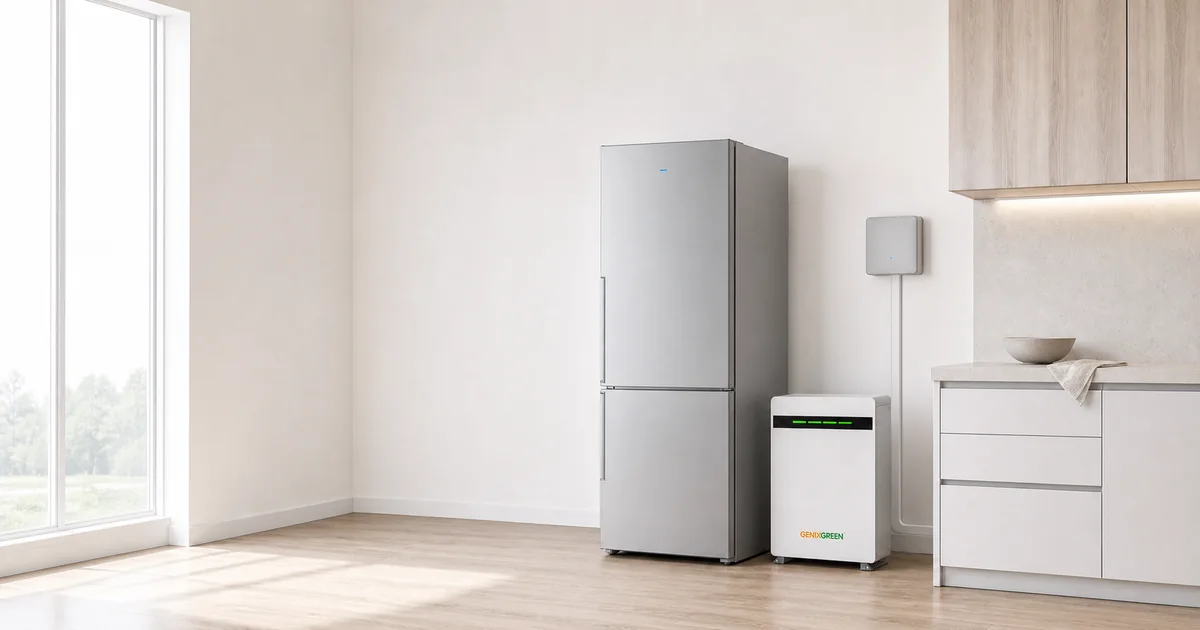
The short answer
A voltage stabilizer corrects sustained undervoltage or overvoltage while the grid is live, protecting your compressor from slow damage, but it does nothing once the power cuts out completely. A UPS or portable power station keeps the fridge running through a blackout, but a basic unit does not fix chronic undervoltage while the grid is present, and a cheap model’s output waveform can itself stress a compressor motor over time. A hybrid inverter paired with a battery does both jobs from one device: once it switches to backup mode, it generates its own regulated, clean output, completely decoupled from whatever the grid is doing, so undervoltage and blackouts stop being two separate problems. Which option fits depends on how often your area sees undervoltage, how often it loses power outright, and whether you want one device instead of two.
Why fridges struggle in Ukraine: two problems, not one
Understanding the two failure modes separately makes it obvious why a single cheap fix rarely covers both.
Problem 1: unstable voltage damages the compressor
A search for a voltage stabilizer for a refrigerator is, by a wide margin, the most common way people in Ukraine look for help with this topic, and for good reason. Grid voltage that sags well below the standard nominal band, defined by IEC 60038 as 230 V with a tolerance of roughly plus or minus 10 percent, forces a compressor motor to draw more current for the same output, since power equals voltage times current. That extra current shows up as heat in the windings. Repeated undervoltage over months can shorten the compressor’s working life, and in the worst case a motor that cannot generate enough starting torque at low voltage will stall on startup, a locked-rotor condition where current stays high with no rotation, one of the fastest ways to overheat a small motor. Ukraine’s grid has been under sustained strain since 2022, and voltage quality in many areas has suffered as a result. Check with your own provider or a local electrician for conditions specific to your building, since they vary by region and even by street.
A stand-alone stabilizer, sometimes called an AVR, is built for exactly this problem. It monitors incoming voltage continuously and automatically taps a transformer winding, or drives a servo motor across one, to push the output back toward the target voltage, boosting undervoltage or bucking overvoltage in real time. It is purely reactive: it only works while grid power is present, and adds no backup capability of its own.
Problem 2: the blackout itself
A stabilizer, no matter how good, cannot generate power from nothing. When the grid goes down entirely, whether on a planned schedule or after unplanned damage, a stand-alone stabilizer goes dark along with everything plugged into it. This needs a separate answer: some form of battery that can take over the load the instant the grid disappears. Handled well, it is a short-term problem; handled poorly, it becomes a food-safety problem, covered further down.
How much power a fridge really needs (and the startup surge)
Sizing any backup solution starts with knowing your fridge’s actual electrical behavior, which is less obvious than it sounds.
Running wattage. Two different numbers describe a fridge, and mixing them up is where sizing goes wrong. The first is the rating-label figure, often 300 to 800 W: this is close to the appliance’s peak or nameplate draw, and it is roughly what the fridge pulls while the compressor is actually running. The second is the daily average, which is much lower, because a thermostat cycles the compressor on and off (or ramps it up and down, on inverter-compressor models) rather than running it continuously. Averaged across a full day, off periods included, the draw commonly works out to around a third of the running figure. Keep the two apart: size any backup device for the higher running draw plus the startup surge below, but expect the daily energy total to track the lower cycled average. A modern refrigerator with a high-efficiency compressor produces less heat and uses less energy than an older single-speed unit, which helps on both counts.
The startup surge. The number that catches people out is not the running wattage but the instant of startup. Like any motor, a compressor draws far more current the moment it starts than once it is up to speed, since there is no back electromotive force yet to oppose the applied voltage. Industry rule-of-thumb guidance for sizing standby power around motor loads puts a typical motor’s starting current at roughly six times its full-load running current, drawn from NEMA-based sizing standards used across the standby power industry. Refrigeration and HVAC references describe the same rule of thumb, commonly citing a factor of three to six times full-load current. As an illustrative example only, not a guarantee for your specific unit: a fridge running at roughly 150 W might draw a brief surge of 450 to 900 W or more for a second or two the instant the compressor kicks in. This is why a small charging device with a low continuous rating and no surge headroom, the kind sold as a phone power bank, cannot start a compressor even though its stated capacity looks sufficient on paper; it simply cannot supply that instantaneous multiple, however briefly.
Your three options: stabilizer, UPS, or hybrid inverter
If you search for an inverter for a fridge, you will find three genuinely different device categories, each solving a different piece of this puzzle.
A stand-alone voltage stabilizer: fixes voltage, not blackouts
A dedicated stabilizer is a narrow, purpose-built tool. It is often the least expensive of the three options, and it does one job well: keeping sustained voltage within a safe band while the grid is live. Its blind spot is total: the instant the grid fails, a stand-alone stabilizer goes as dark as the wall socket behind it. If undervoltage is your only issue and outages are rare or short, a stabilizer alone can be a reasonable, narrowly scoped fix. If both problems apply to you, it solves one of them.
A UPS or backup battery: fixes blackouts, but check the wave shape
A UPS or a portable power station keeps your fridge running when the grid drops out entirely, the piece a stabilizer cannot touch. Two details matter here. First, many budget backup units output a stepped or modified waveform rather than a true sine wave. Compressor motors are induction motors, and induction motors run less efficiently, generate more heat, and lose life expectancy when fed harmonic-rich, non-sinusoidal power instead of a clean sine wave, a well-documented effect in industrial motor applications generally. A pure sine wave output avoids this stress entirely. Second, a basic unit typically only engages its battery once the grid fails; while grid power is present but undervoltage, most budget units simply pass that poor-quality power straight through, so Problem 1 often stays unaddressed even with a UPS plugged in. Check the spec sheet for both the output waveform and whether the unit regulates voltage while running on grid power.
A hybrid inverter does both jobs at once
This is where the two problems collapse into one answer. A hybrid inverter paired with a LiFePO4 battery does not simply pass grid power through when present and switch to battery when it fails. In its inverter or backup mode, it generates its own regulated pure sine wave output from the battery, entirely independent of whatever voltage the grid happens to be delivering at that moment. Practically, that means two things at once: the fridge always sees clean, correctly regulated power whenever the system carries the load, so chronic undervoltage never reaches the compressor, and the battery keeps that same clean power flowing straight through a full blackout with no separate device needed. Instead of a stabilizer for the voltage problem and a separate battery backup for the blackout problem, one properly sized hybrid inverter and battery system covers both. For a full walkthrough of how a hybrid inverter and battery work together as a whole-home system, see our guide on how a home backup power system works, and for the shorter, internet-only version of the same logic, see our piece on backup power for a router.
Keeping food safe while you sort out backup power
However you solve the electrical side, food safety runs on its own clock, and it is worth knowing the real numbers rather than guessing. Per USDA and FDA guidance, a refrigerator keeps food safely cold for about four hours after the power goes out, provided the door stays closed. A full freezer holds a safe temperature for roughly 48 hours, or about 24 hours if half full, again with the door kept shut. Target refrigerator temperature is 40 F (4 C) or below, freezer 0 F (minus 18 C). Between 40 and 140 F sits what USDA calls the “danger zone,” where bacteria can double in number in as little as 20 minutes. Two habits cost nothing: keep the freezer as full as practical, and keep both doors closed as much as possible. An appliance thermometer in each compartment is the only reliable way to know, after the fact, whether food stayed in range; when in doubt, the standard guidance is simple: throw it out.
Frequently asked questions
Which stabilizer does a fridge need?
Match the stabilizer’s continuous rating to your fridge’s running wattage with headroom for the startup surge, not just the label number. Look at the correction type (relay-tap or servo-motor, both work; servo types correct more gradually and quietly), the voltage range it can handle, and whether it is rated for inductive, motor-driven loads rather than purely resistive ones. If outages are also frequent, remember a stabilizer alone will not keep the fridge running once the grid fails; it only addresses voltage quality while the grid is live.
Will a UPS keep my fridge running in a blackout?
Yes, if it is sized for both the running wattage and the startup surge and will not stall the compressor at every restart. Confirm the output is a pure sine wave, since compressor motors run hotter and less efficiently on a stepped or modified waveform, and check that the transfer time (the gap while it switches to battery) is short enough that the compressor does not immediately trip.
Can I run a fridge on a power bank?
No. A typical phone or laptop power bank has a low continuous output rating and essentially no surge headroom, so it cannot supply the brief but large current spike a compressor draws at startup, even if its stated capacity looks sufficient on paper. This is a startup-current problem, not a total-energy problem, and extra battery capacity alone does not fix it.
Do I still need a stabilizer if I have a hybrid inverter?
Generally, no, for the fridge circuit specifically, once it runs through the inverter’s regulated output; the inverter replaces the job a stand-alone stabilizer would otherwise do for that load. Other circuits not connected to the inverter still see raw grid voltage and could benefit from separate protection; ask an installer to review your wiring.
Is a modified sine wave inverter safe for a fridge?
It will often run, but “runs” and “runs well long-term” are different claims. A modified or stepped-wave output is harmonic-rich compared with a true sine wave, and induction motors, including compressor motors, tend to run hotter and less efficiently on that kind of power over time. For a load you expect to run for years, a pure sine wave output is the safer choice, and it is standard on hybrid inverter systems.
The right next step
A voltage stabilizer and a battery backup solve two different problems, and knowing which one (or both) you actually need starts with an honest look at your local grid: frequent undervoltage, frequent blackouts, or both. For a broader look at sizing a whole-home backup system, including your fridge alongside lighting and other essentials, see our complete backup power system guide for Ukraine; to understand how to estimate runtime once you have a battery in place, our guide to calculating battery runtime in hours walks through the method step by step. Ready to compare systems side by side? Browse our backup power product range. If you distribute or install backup power systems in Ukraine, our partners page explains how to work with us. And if a UPS-style approach for a specific device is more what you need, our guide to UPS alternatives covers the smaller-scale options.