
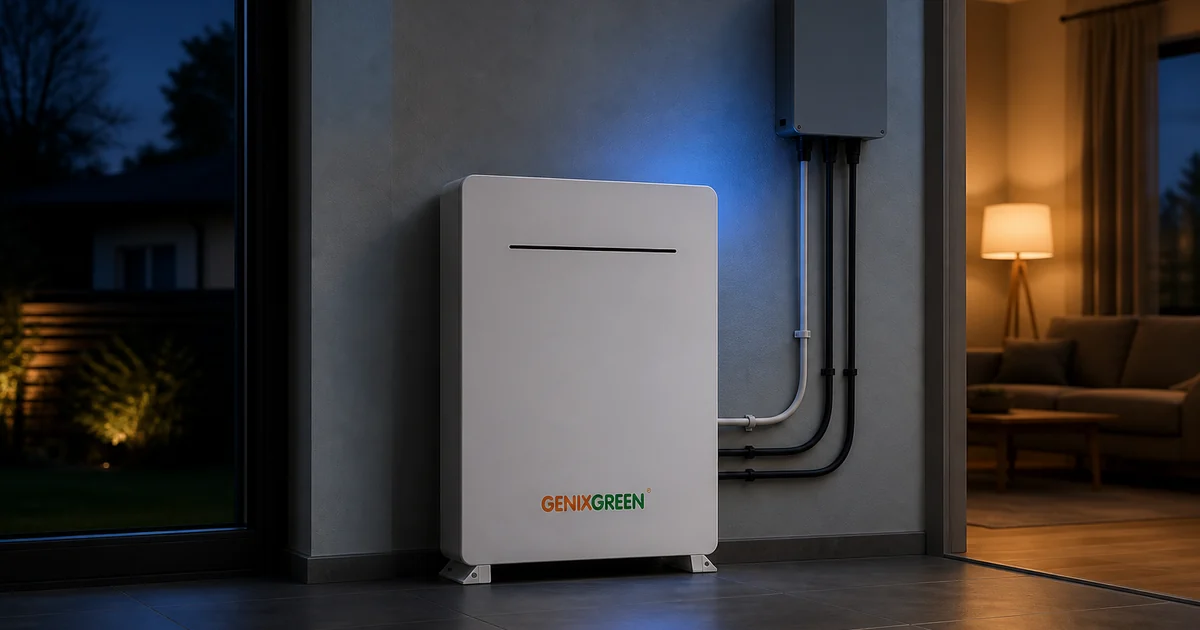
Choosing a backup power system that lasts through Ukraine’s blackouts comes down to four things: the battery chemistry, the sizing, the supplier, and the certifications. Use LiFePO4 (LFP), which is rated for around 6,000 charge cycles and tolerates daily cycling far better than lead-acid; size the system around the loads you actually run at the same time, with headroom rather than a round number; pick a supplier who is still reachable for service after the sale; and check that the equipment carries the right safety certifications. Get those four right and the system outlives the crisis it was bought for.
This guide explains how a backup power system works, why LiFePO4 batteries suit Ukrainian conditions, how to size a system to your actual loads, and how to choose a supplier you can rely on after the sale. Genixgreen has built LiFePO4 storage systems in our own factory since 2011, ships to distributors in 100+ countries, and holds stock for the Ukrainian market locally. The advice below is written so a dealer can reuse it with customers, and so a homeowner can make a sound decision before spending money.
Why backup power became essential infrastructure in Ukraine
Backup power moved from “nice to have” to “must have” because Ukraine’s grid damage is structural, not seasonal. Repeated strikes on generation and substations have left a permanent capacity gap, so outages recur regardless of weather or time of year. Households and businesses now plan around when power will be off, not whether.
The scale of the grid problem (2024–2025)
The numbers explain the demand. In the summer of 2024 Ukraine’s generation fell 2.3 GW below a peak demand of about 12 GW, and across 2024 the country lost roughly 9 GW of capacity in total.
Roughly 9 GW lost in 2024: about half of peak winter consumption
That 9 GW gap equals close to half of peak winter electricity use, which is why scheduled outages of 8–16 hours became normal by late 2025. For a household, that is the difference between a full freezer and a spoiled one; for a shop, the difference between trading and closing.
What this means for homes and businesses
A backup system keeps the loads that matter running while the grid is down. For most homes that means lights, internet, a fridge, phone charging, and a heating pump or boiler controller through the winter. For a small business it means card terminals, refrigeration, and a few tools stay live, so the outage costs hours instead of a day’s revenue.
Why a diesel generator is not the whole answer
Diesel generators cover the gap but carry real costs. Fuel runs out during long or widespread outages, generators are noisy, they need regular servicing, and they cannot run safely indoors because of exhaust fumes. A battery system runs silently, needs little maintenance, and switches on automatically; many owners keep a generator for extreme cases and rely on a battery for the daily 8–16 hour cuts.
How a backup power system actually works
A backup power system stores electricity in a battery and switches your circuits over to it the moment the grid drops, then recharges when power or sunlight returns. The transfer happens automatically, usually within milliseconds, so equipment like routers and computers keeps running without a manual restart.
The four core components
Every system is built from the same four parts, whatever its size.
- Battery: stores the energy. LiFePO4 is the standard chemistry for home and commercial backup.
- Hybrid inverter: converts stored DC into household AC and manages charging from grid or solar.
- Solar array (optional): recharges the battery during long outages so you are not limited to one charge.
- Automatic transfer switch: detects the outage and moves your loads to the battery without you touching anything.
These components connect to your home’s wiring and should always be installed and commissioned by a qualified electrician: this guide is for choosing a system, not for wiring one yourself.
Battery-only vs solar plus battery
The right architecture depends on how long your outages last.
| Setup | Best for | Limit |
|---|---|---|
| Battery only | Short, predictable cuts (a few hours) | One charge: recharges only when the grid returns |
| Solar + battery | Long or multi-day outages | Higher upfront cost, needs roof or ground space |
For Ukraine’s pattern of repeated long cuts, pairing a battery with even a modest solar array is what turns “a few hours of backup” into “power most of the day, every day.”
Single-phase vs three-phase
Most homes run on single-phase 230 V supply and pair with a single-phase hybrid inverter. Larger homes, farms, and commercial sites often run three-phase and need a three-phase inverter sized to the building. Matching the inverter to your supply type is a basic compatibility check your supplier should confirm before you order.
Why LiFePO4 is the right chemistry for Ukrainian conditions
LiFePO4 (lithium iron phosphate, or LFP) is the right battery chemistry for backup because it lasts longer and runs cooler than the alternatives. LFP cells are rated for around 6,000 charge cycles as a product specification, and they stay thermally stable under stress, a safety property that quality cells demonstrate against industrial standards such as IEC 62619. Both matter when a battery is cycled hard every day through a long outage season.
Cycle life and lifespan
Cycle life is where LFP pulls ahead of older options. A LiFePO4 battery sustains 6,000+ cycles before it drops to 80% of its original capacity, roughly 15 years of daily cycling, while a typical lead-acid battery manages 500 to 1,000 cycles under the same use. Over a backup system’s life that difference means one LFP battery instead of several lead-acid replacements.
Cold-weather behaviour (the Ukrainian winter question)
The winter question deserves a careful, honest answer: LiFePO4 discharges well in the cold but must be charged with care below freezing. A quality LFP system delivers power down to around −20 °C, so it keeps your home running on a cold night. Charging is different: charging lithium cells below 0 °C can damage them, so good systems either heat the battery or block charging until the cells warm up.
Buy a system with low-temperature charge protection
The practical rule is simple: choose a battery whose BMS (battery management system) includes a low-temperature charge cut-off or self-heating, and install it somewhere it will not sit at deep sub-zero temperatures for long. Our engineers specify low-temperature protection as standard on systems destined for Ukraine, precisely because the winter charging window matters. This is a buying criterion, not a do-it-yourself fix: confirm it on the datasheet before you order.
Safety
LFP is the safest mainstream lithium chemistry for occupied buildings. The cells resist thermal runaway better than older lithium types, and a proper system adds a BMS with four core protections: over-charge, over-discharge, over-temperature, and short-circuit. Look for cells certified to IEC 62619 for industrial lithium safety and UN 38.3 for safe transport.
How to size a backup power system without overpaying
Size a backup system by the loads you must keep running and for how long, not by buying the biggest battery on the shelf. A focused “essentials” backup for a home usually needs around 5–10 kWh of storage, while whole-home or business backup needs more. Oversizing wastes money; undersizing leaves you dark before the grid returns.
Step 1: list your critical loads
Start with what genuinely must stay on, and add up the watts.
| Load | Typical power |
|---|---|
| LED lighting (whole home) | 100–300 W |
| Wi-Fi router + ONT | 15–30 W |
| Refrigerator | 100–200 W (cycling) |
| Gas-boiler controller / circulation pump | 50–150 W |
| Phone + laptop charging | 50–150 W |
| Water pump (well/booster) | 400–1,000 W |
Most homes find their true critical load is a few hundred watts most of the time, spiking when a pump or kettle runs. That base figure, not the spike, drives how much storage you need.
Step 2: decide how many hours of autonomy you need
Match the battery to your local outage pattern. If your region runs 8–16 hour scheduled cuts, size for the longer end so you are not caught out. Rather than promise a fixed number of hours (run-time always depends on the loads you actually run), work backwards: critical watts × target hours gives the usable kWh you need, then add headroom so you never deep-discharge to empty.
Step 3: add solar if your outages run long
Add solar when single-charge backup is not enough. During a multi-day outage, a battery on its own empties and waits for the grid; a battery paired with solar recharges each day from sunlight, so essential loads keep running indefinitely. Even a small array changes the math from “hours of backup” to “power every day.”
How to choose a backup power supplier in Ukraine
Choose a backup supplier on six things: local stock, certifications, inverter compatibility, in-country warranty service, lead time, and after-sales support. The hardware matters, but the supplier behind it decides whether a fault in January is a phone call or a shipment back to China.
The 6-point evaluation checklist
| # | Check | Why it matters |
|---|---|---|
| 1 | Local stock in Ukraine | Days to deliver and restock vs weeks from abroad |
| 2 | Certifications (UN 38.3 · CE · IEC 62619) | Proof of safety and legal import |
| 3 | Inverter compatibility | The battery must talk to your inverter over CAN/RS485 |
| 4 | Warranty serviced in-country | Claims handled locally, not sent back to the factory |
| 5 | Clear lead time | A quoted date you can plan around |
| 6 | After-sales and technical support | Sizing help, manuals, and someone to call |
Red flags to avoid
Walk away from these. Grade-B cells sold as Grade-A shorten lifespan invisibly. Missing UN 38.3 documentation means the goods should not have shipped. “No-name” BMS boards skip the protections that keep a battery safe. A supplier with no warranty presence inside Ukraine leaves you stranded on a faulty unit. And any vendor that promises an exact number of backup hours without asking about your loads is guessing: real autonomy always depends on what you run.
Local stock versus waiting on China
Local stock is the difference between selling now and losing the customer. A supplier holding inventory in the region can deliver and replenish in days, while a direct factory order from China typically runs around 45 days including production and shipping. Genixgreen is opening its own warehouse in Odesa in 2026 to hold stock inside Ukraine; until that stock lands we ship factory-direct with a clear lead time quoted up front, so partners always know when an order will arrive.
Certifications and standards to look for
For the Ukrainian market, prioritise three certifications: UN 38.3 for transport safety, CE for EU-market conformity, and IEC 62619 for industrial lithium battery safety. These are the baseline a serious backup product clears; ask for the certificate pack before you commit to a supplier.
What each certification proves
| Standard | What it proves |
|---|---|
| UN 38.3 | The battery passed the tests required to ship lithium cells safely |
| CE marking | The product meets EU health, safety, and environmental requirements for sale |
| IEC 62619 | The cells meet international safety requirements for industrial lithium batteries |
FAQ: backup power in Ukraine
How much backup power does a typical home need?
A focused essentials backup (lights, internet, fridge, heating controller, phone charging) usually fits in around 5–10 kWh of LiFePO4 storage. Whole-home backup that also covers a water pump, kitchen appliances, or electric heating needs more. The honest answer depends on your loads and how many hours you want to cover, so size from a critical-load list rather than a round number.
Will a LiFePO4 battery work in the Ukrainian winter?
Yes for discharge, with care for charging. A quality LFP system delivers power down to around −20 °C, so it runs through cold nights. Charging below 0 °C can damage lithium cells, so choose a battery whose BMS includes low-temperature charge protection or self-heating, and place it where it will not sit deep below freezing.
Battery only, or solar plus battery?
Battery only suits short, predictable cuts; solar plus battery suits the long and repeated outages Ukraine now sees. Adding even a modest solar array lets the battery recharge during the day, turning a few hours of backup into power that lasts through multi-day cuts.
How long do these systems last?
A LiFePO4 battery sustains 6,000+ charge cycles, about 15 years of daily cycling, before dropping to 80% capacity, compared with 500–1,000 cycles for lead-acid. Exact warranty terms are confirmed per product and order; larger volumes are agreed separately.
Can I get stock and service inside Ukraine?
Genixgreen holds stock for the Ukrainian market and supports partners locally, with warranty serviced in-country rather than sent back to China. We are opening our own Odesa warehouse in 2026; until that stock lands we ship factory-direct with a clear lead time quoted up front.
Talk to the people who build the systems
Genixgreen designs and builds LiFePO4 batteries and matched hybrid inverters in our own factory, and we back partners across Ukraine with local stock and support. If you are a dealer or installer, become a partner and we will help you stock the right mix for your customers. If you want to see the range, explore our energy storage products, or read more answers on our FAQ page.