
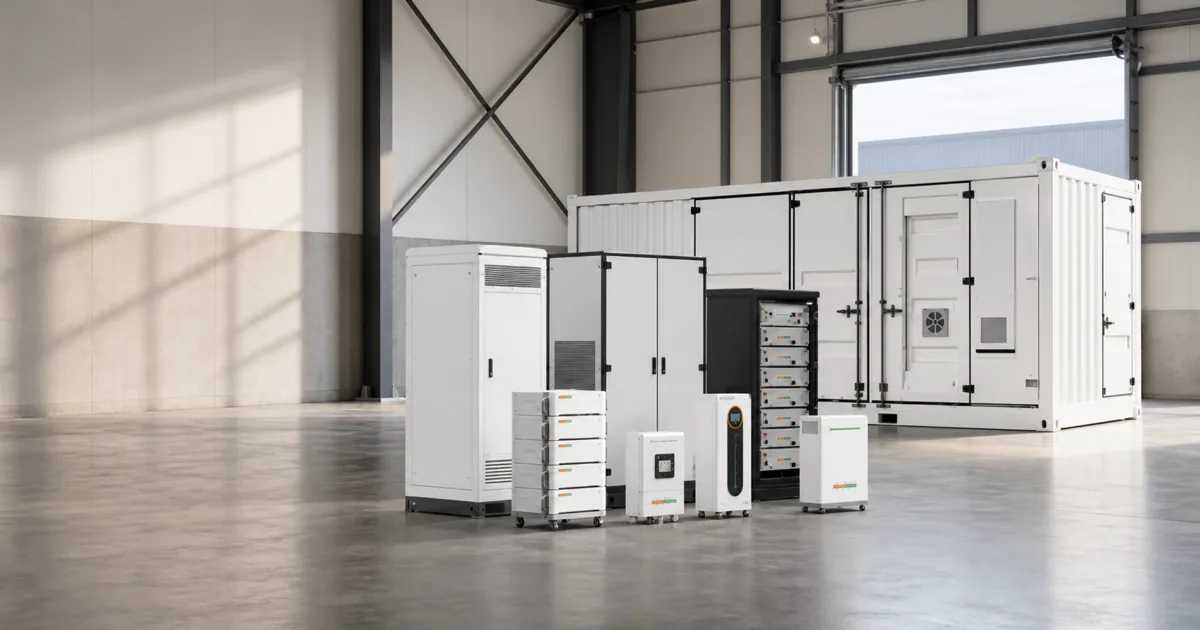
For a business, a power cut is not a dark evening; it can stop trade at the till, put cold storage at risk, interrupt a clinic workflow, or drop a server mid-transaction. Start with the loads that are genuinely critical, the interruption each load can tolerate, and the electrical service already on site. Only then can an EPC or qualified installer select the phase architecture, inverter power, battery capacity, protection and commissioning scope. A commercial backup power system is a professionally designed pairing of LiFePO4 storage and a hybrid inverter, but it is not a standard 16 kWh box: the right capacity follows the load schedule and continuity target. This guide is for business owners, facility managers, EPC companies, and installers. It explains how to frame the project, size it from operational loads, verify certification, and request a comparable proposal. Genixgreen has manufactured LiFePO4 storage systems in its own 12,000 m² factory since 2011 and supplies distributors in 100+ countries through its factory network.
The short answer
A commercial backup power system is a matched, professionally designed package of LiFePO4 battery storage and a hybrid inverter, built around the loads a business cannot lose. There is no universal starting capacity: first separate critical loads from deferrable loads, set the acceptable interruption and outage duration for each, and confirm whether the premises is single- or three-phase. Those inputs determine the inverter, battery, protection and project scope. Insist on full certification (IEC 62619 for the battery, IEC 62109 for the inverter, CE with a signed Declaration of Conformity, UN 38.3 for transport), and have the system designed, installed and commissioned by a qualified electrician or licensed contractor who handles the required grid paperwork with the operator (DSO).
Why a business system is different from a home system
The fundamentals carry over from the home side. A backup system is still a battery, which stores the energy in kilowatt-hours (kWh), paired with a hybrid inverter, which delivers the power in kilowatts (kW) and switches your premises onto battery within milliseconds when the grid fails. If you want those basics, the kit contents, the difference between power and energy, and the household sizing method, our home backup kit guide covers them step by step, and this page builds on top rather than repeating them. What changes for a business is not the physics; it is the consequence of getting it wrong and the scale at which you are working.
The loads a business cannot afford to lose
Start by naming the loads whose failure actually costs you money or trust. For a shop or supermarket it is refrigeration and freezers, where an outage threatens an entire stock of perishables, plus the tills and point-of-sale system without which you cannot transact, plus lighting and security. For an office or a data-dependent business it is the servers, the network switches, and the routers, where an unclean shutdown can corrupt data or drop customers mid-session. For a clinic or pharmacy it is medical equipment and the cold chain for medicines, both of which are genuinely safety-critical. For a workshop or small industry it is the motors: pumps, compressors, and tools that draw a heavy startup surge and cannot tolerate dirty power. Each category has a different tolerance for interruption, and that tolerance, not a single headline number, is what your system must be designed around.
Continuity is the real specification, not just backup
A home asks for backup: keep the lights and the fridge on through the evening. A business asks for continuity: keep trading, keep serving, keep the data intact, with no gap that customers or processes can feel. That shift changes how you specify the system. It puts weight on transfer time, because a server or a card terminal can drop on a gap that a light bulb would never notice, so sensitive commercial loads often justify a near-zero-transfer design or a small dedicated battery on the critical rack. It puts weight on capacity sized to operating hours rather than a token lifeline. And it puts weight on the system being engineered as a whole, because the cost of an unplanned outage to a business is usually far larger than the difference between a cheap system and a properly designed one.
Single phase or three phase: the commercial question
Most homes and small premises run on a single-phase (230 V) supply, and a single-phase system is simpler and often sufficient. Many businesses, by contrast, have a three-phase (400 V) connection, because they run motors, larger air-conditioning, refrigeration plant, or workshop machinery that needs it. This is the first commercial fork in the road, and the rule is simple: match the system to the service the premises already has, and verify it rather than assume it.
Why three-phase changes the design
A three-phase backup system has to support all three phases in a balanced way, either with a three-phase inverter or with a coordinated set of single-phase units, so that the load is shared correctly and motors see clean, balanced power. Some heavy commercial equipment will only start and run properly on three phases. This is not a configuration to improvise on site; it is a design decision that a qualified engineer makes from your single-line diagram and your load schedule, which is one of the central reasons professional design matters more at commercial scale than it does for a plug-and-play home kit. Get the phase architecture wrong and the symptoms range from nuisance tripping to equipment that will not start to premature wear on motors.
Stacking and expanding capacity as the business grows
Commercial LiFePO4 storage can be built to scale. Where a home might settle on a single battery, a business project can add battery modules in parallel when the approved architecture supports it, allowing the system to grow from one critical-load group to a larger site without replacing every component. Plan practical headroom early: specify an inverter and enclosure that can accept future expansion when the load forecast justifies it. Treat any capacity figure as the output of a load schedule, not as a universal minimum or a price list. The expandable design can also make solar integration possible later, subject to the site design and approvals.
How to size a commercial system from your operational loads
The right system is calculated, not guessed, and at commercial scale the calculation is best done by your installer or EPC partner from a proper load schedule. The method runs in order. First, list every load you intend to back up and note its running power and, for anything with a motor, its startup surge; a refrigeration compressor or a pump can draw several times its running wattage for a few seconds at startup, and the inverter’s surge rating has to cover the largest of these. Second, add the loads that can run at the same time to find the continuous power (kW) the inverter must sustain, then add headroom. Third, decide the continuity each load needs and multiply the average power your loads actually draw by the hours you want to ride through; that energy figure sets the battery capacity (kWh). Two honest cautions apply here exactly as they do at home. Average draw is lower than peak, because compressors cycle and not everything runs at once. And usable capacity is below the nameplate: you do not run a battery flat, and a shallower discharge prolongs cycle life, because the smaller the discharge, the longer the battery lasts, so size on the usable figure, not the label. Decide your hours from your own regional outage schedule rather than a fixed assumption. One Ukraine-specific point carries into the design: a LiFePO4 battery must not be charged below 0 °C without integrated heating, because charging below freezing causes permanent lithium plating, so the system is specified for a heated indoor plant room or supplied with battery heating.
Why professional design and commissioning matter at commercial scale
A home kit can be a fairly standard install. A commercial system is a piece of electrical infrastructure, and it has to be treated like one. It is hardwired into the premises distribution board and a critical-loads panel; it is not a plug-in appliance, and at three-phase or larger sizes the wiring, protection, and earthing are well beyond do-it-yourself. The installation must be carried out by a qualified electrician or a licensed contractor, both for safety and to meet the electrical rules that apply to commercial premises. Beyond the install, two steps separate a professional job from a risky one. The first is design: a competent partner produces a single-line diagram, a load schedule, the phase balancing, the protection coordination, and the cable sizing before anything is mounted. The second is commissioning: once installed, the system is tested under load, the inverter’s settings and the closed-loop battery communication are verified, the transfer to battery is proven, and the results are documented and handed over. There is also a grid step that is easy to overlook: any system that can interact with the grid needs a connection agreement with your local grid operator (the DSO), covering anti-islanding and voltage and frequency behaviour, and your licensed contractor files that paperwork. Treat design, installation, commissioning, and the grid filing as one professional package, not as four afterthoughts.
Certification at commercial scale
At commercial scale, documentation is part of the equipment, and you should treat a missing certificate as a missing component. The battery should meet IEC 62619, the safety standard for secondary lithium cells and batteries in industrial and stationary applications, and ship under UN 38.3 transport testing. The inverter or power conversion system should meet IEC 62109, the safety standard for power converters used in photovoltaic systems. A CE mark only means something when a signed Declaration of Conformity sits behind it, so request the document, and an independent third-party test mark is good evidence the testing was not pure self-certification. Two more figures belong on a commercial specification. Ask for the inverter’s weighted efficiency, the CEC or EU figure that averages across load levels, not the single best-case peak, because a system that cycles every day pays for every lost percentage point over its life. And confirm the warranty terms, both the years and any cycle or throughput limits, in writing, because at commercial scale these are negotiated by project and volume rather than printed on a web page.
Working with an EPC or installer, and local project supply
Most businesses do not buy a commercial system as a box; they buy it as a project, delivered by an EPC company (engineering, procurement, construction) or a specialist installer who designs it, supplies the hardware, installs it, and commissions it. Choosing that partner is as important as choosing the hardware, and the supplier-side checks (certification, lead time, the closed-loop battery-and-inverter match, after-sales presence, and the red flags) are the same ones set out in our guide on how to choose a LiFePO4 supplier in Ukraine. Local supply is decisive on a project timeline. Genixgreen holds stock in an Odesa-region warehouse, which means an EPC or installer can take delivery and schedule a commissioning date inside Ukraine rather than waiting on a slow import with support in another time zone. If your business is currently weighing storage against a fuel generator on running cost, refuelling, noise, and maintenance, our companion guide on battery storage versus a diesel generator makes the comparison for commercial duty. And if you are an EPC company or installer looking to source and resell commercial systems for your own clients, our partners page explains how to work with us, from a single project to stocked inventory.
What to include in an EPC enquiry
Send the same brief to each EPC or installer so the proposals can be compared on scope, not just a headline capacity. Include: the critical-load list with running power and motor start-up demand; the longest outage and allowable interruption for each load; the existing supply and any single-line diagram; the proposed battery location and temperature conditions; and whether later expansion or solar integration is in scope. Ask the partner to state the design, protection, installation, commissioning, grid paperwork and after-sales scope separately, and to identify any assumptions that need a site survey. For a structured way to compare ownership cost rather than only the purchase line, see our backup power cost and payback guide.
How a commercial system fits the wider backup picture
A commercial system is the business-scale form of the same idea explained from first principles in our complete guide to backup power systems for Ukraine. It shares the chemistry and the control logic with a home system, the LiFePO4 battery for safety and long cycle life and the hybrid inverter so the system is solar-ready, and it differs mainly in scale, phase, and the discipline of the engineering around it. If your need is domestic rather than commercial, the home backup kit guide is the right starting point, and the deeper component detail lives in the battery buyer’s guide and the hybrid inverter buyer’s guide. For a business, the through-line is continuity: name the loads you cannot lose, size the system to carry them, and have professionals design and commission it.
The right next step
Choosing a commercial backup power system comes down to one question answered properly: what does this business need to keep running, and for how long? From there, a qualified partner sizes the inverter to your simultaneous loads, sizes and stacks the battery to your hours of continuity, matches the phase to your supply, and certifies and commissions the result. To see the matched battery and inverter systems we hold in our Odesa-region warehouse for fast local project supply, visit our product range. And if you are a business owner planning a project, or an EPC company or installer serving clients across Ukraine, our partners page explains how to work with us, from a single commercial installation to stocked inventory for your pipeline.
Frequently asked questions
What is a commercial backup power system?
A commercial backup power system is a matched, professionally designed package of LiFePO4 battery storage and a hybrid inverter, built to support the loads a business cannot lose. It starts with a critical-load list, each load’s acceptable interruption, the outage duration and the premises supply, then sizes the inverter, battery and protection from those inputs. It may be single- or three-phase and may be expandable, but capacity is a project-specific result rather than a universal starting figure. It is designed, installed and commissioned by a qualified electrician or licensed contractor.
How is a commercial system different from a home backup kit?
The physics is the same, but three things change. The loads are business-critical, so the goal is continuity (no interruption customers or processes can feel) rather than a domestic lifeline. The existing supply may be three-phase rather than single-phase, which changes the inverter architecture. Capacity and expansion are set from the load schedule and continuity target, not from a generic threshold. A commercial system is also hardwired infrastructure that requires professional design and commissioning, not a plug-in kit.
Do I need a three-phase system for my business?
Match the system to the electrical service your premises already has, and verify it rather than assume. Many businesses have a three-phase (400 V) connection because they run motors, larger refrigeration, or workshop machinery, and these need a three-phase inverter or a balanced set of single-phase units so the load is shared correctly. Smaller premises on a single-phase (230 V) supply can use a single-phase system. Your installer or EPC partner confirms the phase architecture from your load schedule.
How do I size a commercial backup system?
Size it from your operational loads, not a headline figure. List every load you intend to back up with its running power and startup surge; add the loads that run at the same time to set the inverter’s continuous power, with headroom for the largest motor’s startup; then multiply the average power your loads draw by the hours of continuity you need to set the battery capacity, allowing for usable capacity being below the nameplate. Decide the hours from your regional outage schedule. At commercial scale this is best done by your installer or EPC partner from a proper load schedule.
Who should install and commission a commercial system, and can I work with an EPC?
A commercial system must be installed by a qualified electrician or licensed contractor, because it is hardwired into the distribution board and, at three-phase or larger sizes, the wiring and protection are well beyond do-it-yourself. A proper project includes design (single-line diagram, load schedule, phase balancing, protection), commissioning (testing under load and verifying the battery-and-inverter communication), and the grid-connection filing with your operator (the DSO). Many businesses deliver this through an EPC company or specialist installer who designs, supplies, installs, and commissions the system as one project.
What certification should a commercial system have?
Treat documentation as part of the equipment. The battery should meet IEC 62619 (safety of stationary and industrial lithium batteries) and ship under UN 38.3 transport testing; the inverter should meet IEC 62109 (safety of PV power converters). A CE mark must have a signed Declaration of Conformity behind it, and an independent third-party test mark is good evidence the testing was not self-certified. Ask for the inverter’s weighted (CEC or EU) efficiency rather than the peak figure, and confirm the warranty terms, including any cycle or throughput limits, in writing.