
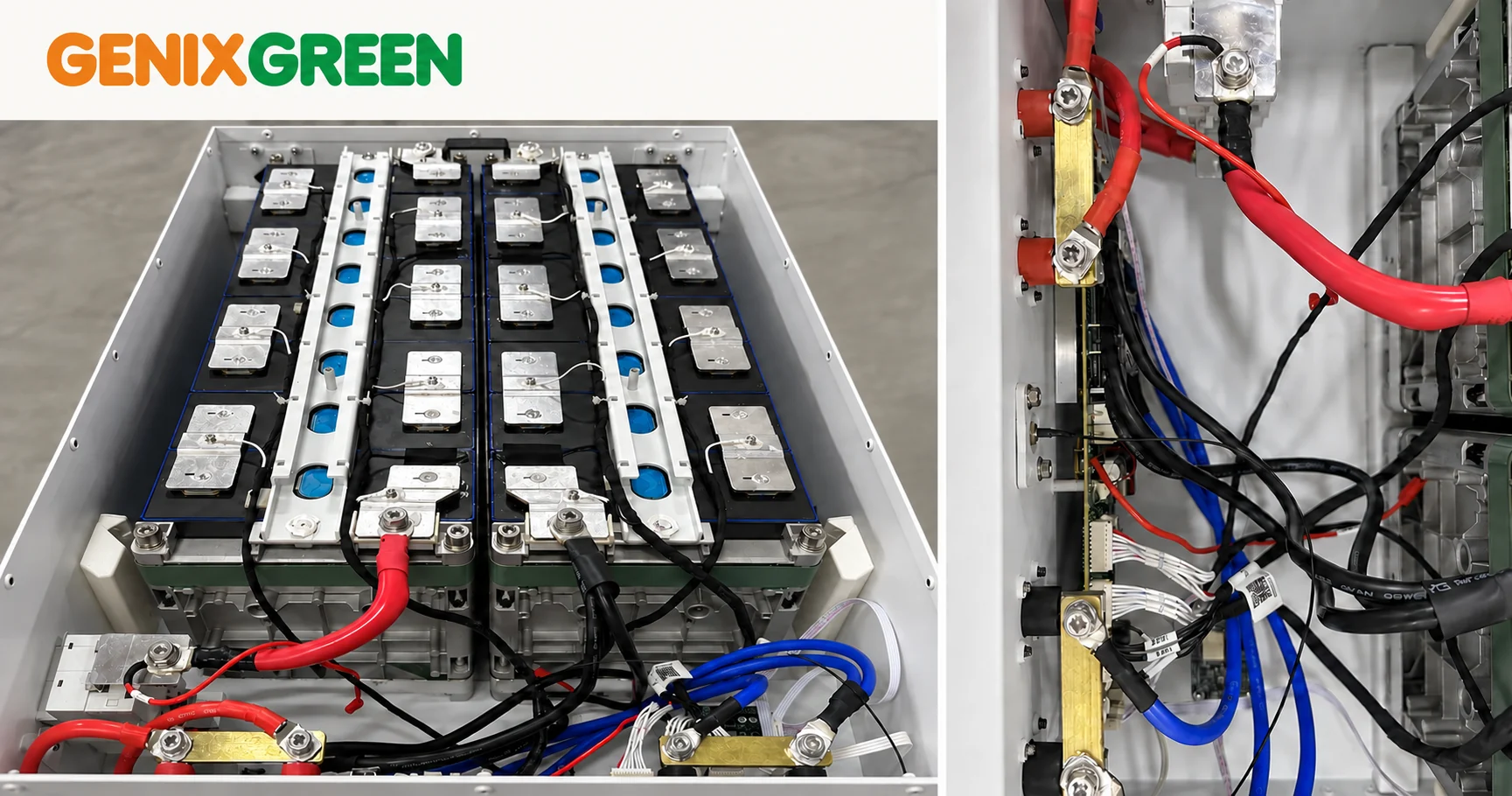
A battery management system (BMS) monitors and controls a lithium battery’s voltage, current, temperature, and state of charge. It reduces preventable electrical and thermal risks, but it does not make a battery fireproof, replace a certified system, or make it safe to open or modify a sealed battery pack. This guide explains what a BMS does and what to check when comparing home batteries. For the rest of the selection process, see our guide to choosing a LiFePO4 battery.
The short answer
A battery management system is the electronic supervisor inside a lithium battery. It monitors cells and manages charge, discharge, temperature, and balancing functions within design limits, as a Sandia National Laboratories reference explains. It can disconnect or limit operation when measured values cross the thresholds specified for that pack, but it cannot prevent every failure mode or guarantee that a battery will never fire. Do not open, bypass, or modify a sealed lithium battery to inspect its BMS. Choose a complete, documented battery system instead.
What a battery management system actually does
The word “management” undersells it. A BMS runs several protective jobs at once, each guarding against a different way a lithium cell can be damaged or become dangerous.
Cell balancing
A home battery is not one big cell; it is many small cells wired in series to reach the working voltage, and no two cells are ever perfectly identical. They drift apart in charge level over time through small differences in manufacturing and aging. Without correction, the highest cell hits its voltage limit first on charge and the lowest hits its floor first on discharge, so the whole pack is throttled by its weakest member and that member is stressed hardest. A BMS performs cell balancing to hold the cells at matching charge levels, which is why balancing hardware, sold on its own as a “balancer,” exists at all. Balancing is what lets a pack use its full capacity and age evenly rather than being limited by one drifting cell.
Voltage, current and short-circuit protection
Each lithium chemistry has a safe voltage window, and LiFePO4’s is well defined: a nominal 3.2 volts per cell, a maximum charge of 3.65 volts, and a discharge cutoff around 2.5 volts. Push a cell above the ceiling and you overcharge it; pull it below the floor and you over-discharge it, and both damage the cell and can create a safety risk. The BMS enforces those limits on every cell and, as Battery University puts it, “disconnects the battery if set limits are exceeded or if a failure occurs”. The same protection covers current: if the load draws more than the pack is rated for, or a short circuit sends fault current surging, the BMS cuts the connection before the cells overheat. These are the protections a homeowner never sees working, precisely because they are working.
Temperature protection and the freezing-charge cutoff
Temperature is where a BMS earns its keep in a Ukrainian winter. Lithium chemistry has an absolute rule: it must not be charged below 0 degrees Celsius, because charging a cold cell plates metallic lithium onto the anode and causes permanent damage to performance and safety.
Cold-weather charging needs an automatic cutoff
A person cannot enforce that rule by hand, so the BMS does it: it reads cell temperature and blocks charging until the battery is warm enough, while lithium-ion’s healthy charging range sits roughly between 0 and 45 degrees Celsius. It also guards the top end, since a battery sitting above about 30 degrees Celsius is under thermal stress that shortens its life. This function lets the system enforce temperature limits automatically during unattended operation, provided the battery is installed and used within the manufacturer’s manual and rated environment.
State of charge: knowing how much is left
The BMS is also what tells you how much energy is left. It estimates state of charge from measured current, voltage, temperature, and a model of the pack rather than acting as a perfect fuel gauge. That estimate is useful for planning, but actual backup time still depends on the load, temperature, battery age, and inverter losses. See how battery runtime is calculated before treating a percentage display as a promise.
Why LiFePO4 batteries in particular need a good BMS
Every lithium battery needs protective controls, but LiFePO4 leans on the BMS in a specific way. LiFePO4 has a relatively flat discharge curve, so state of charge cannot be inferred reliably from voltage alone across much of its operating range. The BMS combines measurements to estimate it. LFP chemistry can offer a wider thermal safety margin than NMC in comparative testing, but a BMS and chemistry together still do not guarantee a fire-free outcome. The complete battery system, its enclosure, protection devices, installation, and operating instructions all matter, as a comparative ACS Energy Letters study shows.
A BMS also protects your investment, not just your safety. Cycle life on lithium is tied tightly to how the battery is charged: every 0.10 volt per cell of reduction below the maximum charge voltage roughly doubles the number of cycles the battery will deliver. A well-designed BMS manages that charge behavior so the pack reaches the service life it was sold on, which is a large part of why LiFePO4 is worth its higher upfront price. Our gel and AGM vs. LiFePO4 guide covers that cost-over-life comparison in full.
The safety standards a BMS helps meet
You do not have to take a manufacturer’s word that a BMS is doing its job, because the protections above are exactly what international safety standards for stationary batteries require. LiFePO4 batteries for stationary and industrial use are covered by IEC 62619, the international standard for the safe operation of secondary lithium cells and batteries, and in North America stationary storage batteries are certified to UL 1973. Both standards test for the failure modes a BMS is built to prevent: overcharge, over-discharge, over-current, and thermal problems. When you compare batteries, a unit certified to a recognized standard is telling you its BMS and cell protection have been tested against those cases, rather than merely claimed. Where and how that certified battery is then installed matters just as much, which our guide to safely installing a home battery covers on the placement, ventilation, and electrical side.
What a weak or missing BMS looks like
The clearest way to value a BMS is to picture a battery without properly specified protective controls. Cell imbalance can limit usable pack capacity. Inadequate low-temperature charge control can permit damaging lithium plating. Poor documentation can also leave a buyer unable to verify over-current, over-voltage, under-voltage, or temperature limits. These are reasons to ask for the complete system documentation and certification, not reasons to dismantle a battery or attempt a DIY BMS repair.
Frequently asked questions
What does a BMS do in simple terms?
A battery management system is the electronic supervisor inside a lithium battery. It watches each cell’s voltage, the current, and the temperature, disconnects the battery if any of those goes out of the safe range, keeps the cells balanced so they age evenly, blocks charging when the battery is too cold, and reports how much charge is left.
Does a LiFePO4 battery need a BMS?
Yes. Every lithium battery needs a BMS, and LiFePO4 relies on it especially for tracking state of charge, because its flat voltage curve makes charge level hard to read any other way, and for enforcing the no-charging-below-freezing rule. A reputable LiFePO4 home battery always has one built in.
What is cell balancing and why does it matter?
The cells in a battery are wired in series and slowly drift apart in charge level. Without balancing, the weakest cell limits the whole pack and gets stressed the hardest, cutting capacity and life. A BMS balances the cells so they stay matched, letting the pack use its full capacity and age evenly.
Can I charge a lithium battery in freezing weather?
Not directly. Charging a lithium cell below 0 degrees Celsius plates metallic lithium and permanently damages it, so a proper BMS blocks charging until the battery warms up. This is a key reason a LiFePO4 home battery is designed to live in a heated indoor space.
How does a BMS know the state of charge?
It counts the energy flowing in and out, measured as coulombs, and compares it against the battery’s rated capacity to build a digital estimate of how full the pack is. On LiFePO4, this coulomb counting matters more than on other chemistries because the flat voltage curve makes state of charge hard to read from voltage alone.
Is a cheap lithium battery without a good BMS worth it?
Do not decide from price or a claim about the BMS alone. Ask for the complete battery documentation, protection limits, compatibility information, and applicable certification, then have a qualified installer assess the system. Do not open a sealed pack or try to add or bypass a BMS yourself.
The right next step
A BMS is an important layer of a complete lithium battery system, not a promise of absolute safety. When you compare batteries, ask what limits it monitors, how it communicates with the inverter, what documentation supports its protection functions, and what standard applies to the complete system. Read our LiFePO4 home battery guide for the rest of the checklist, browse our home battery range for complete systems, and use a qualified installer for any electrical work.