
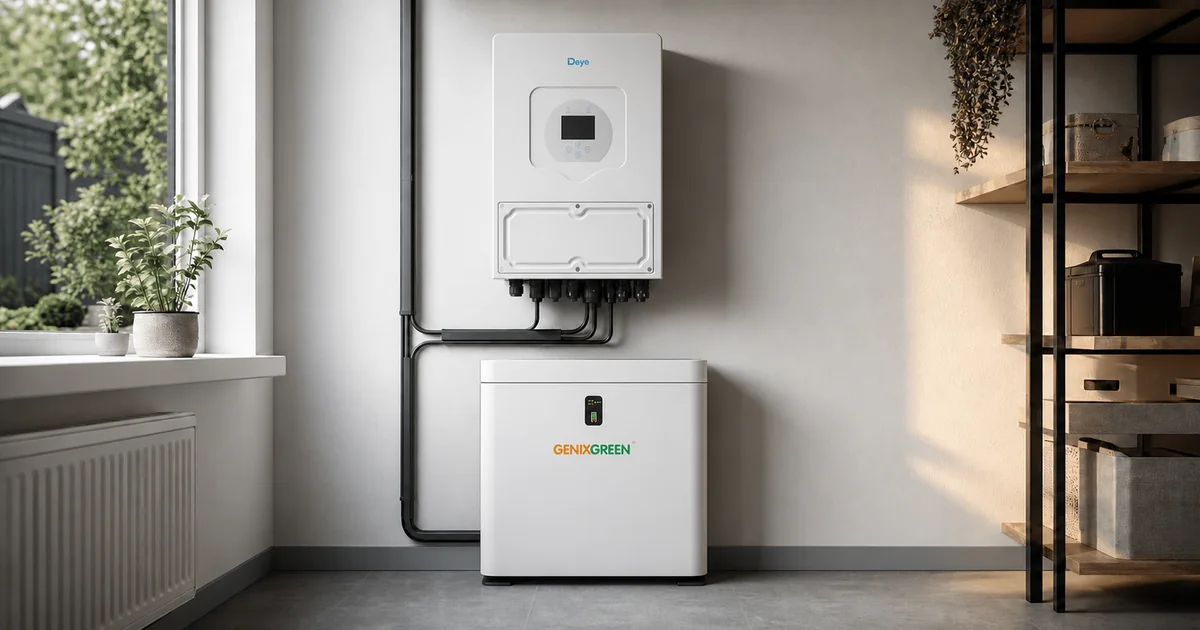
To choose a home inverter, start with the loads that must run together and their motor startup surge, then match the battery voltage and BMS protocol, your single-phase or three-phase service, the switching need of sensitive equipment, and the certification and installation boundary. A hybrid inverter coordinates solar, battery, and grid power, but its headline kW rating alone does not make it suitable for a Ukrainian home. Genixgreen has manufactured LiFePO4 storage systems in its own factory since 2011 and supplies distributors in 100+ countries.
The short answer
To choose a home inverter, follow this order: simultaneous loads and motor surge, battery voltage and BMS communication, phase, switching behaviour, then certification and installation. For daily multi-hour outages, a hybrid inverter combines a solar charge controller, battery charger, and grid-interactive inverter, but it must match your real loads and 48 V / 51.2 V battery system. Have the final design installed by a qualified electrician who handles the grid-connection process.
What a hybrid inverter is and why it became the standard
An inverter converts the direct current (DC) stored in a battery or produced by solar panels into the alternating current (AC) your appliances use, and back again to charge the battery. A hybrid inverter does three jobs that used to need three separate boxes: it runs a solar charge controller (the MPPT), it charges and discharges the battery, and it acts as a grid-interactive inverter, all under one automatic controller that prioritises among solar, battery, and grid.
That single-box design is why it became the default for home backup in a country with daily outages. A household wants one device that runs the home from the battery the moment the grid drops, recharges that battery from solar or the grid whenever power is available, and switches over fast enough that a router or a desktop does not reboot. A hybrid inverter does all of this. A plain grid-tie inverter does none of the backup jobs: by law it disconnects the instant the grid fails, so it cannot keep your home running. The market has moved to hybrid for exactly this reason; this guide explains what separates a good hybrid unit from a weak one.
Eight specifications every buyer must understand
Buying an inverter without these numbers is like buying a car on the colour alone. Sellers rely on that gap, so these definitions remove the advantage.
Continuous power and surge power
Continuous power (in kW or kVA) is the load the inverter sustains indefinitely; it is the headline rating. Surge or peak power is the brief overload the inverter tolerates to start a motor, often around 1.5 to 2 times continuous for a few seconds. This second number matters more than buyers expect, because a fridge compressor, a water pump, or a borehole pump draws a large inrush current at the moment it starts, several times its running wattage. An inverter sized only to running watts will trip when the compressor kicks in. Size the continuous rating to the sum of your simultaneous running loads, and make sure the surge headroom covers your largest motor’s startup.
MPPT count and voltage window
MPPT stands for Maximum Power Point Tracker, the circuit that keeps solar panels near their most productive operating point as light changes. The conversion loss in a good MPPT is only about 0.5 to 1.5 percent.
First, check the number of MPPTs. Two independent trackers let two panel strings on different roof faces, for example east and west, work without one dragging the other down. A single MPPT forces one orientation.
Second, check the voltage window, including Vmpp and maximum input voltage. Too few panels in series may not reach the inverter’s start voltage on a dull winter morning. Too many can exceed the maximum on a cold day and damage the unit. Cold weather raises panel voltage, so size the string for the coldest expected morning, not the average.
Battery voltage compatibility (48 V / 51.2 V)
Home storage has standardised on 48 V nominal, which for LiFePO4 is 51.2 V, based on 16 cells in series at 3.2 V each. Higher voltage means lower current for the same power, so cabling stays smaller, cheaper, and more efficient.
The inverter’s battery-voltage rating has to match the battery’s. A 48 V inverter pairs with a 48 V / 51.2 V battery, while some larger systems use high-voltage string batteries instead. The two classes do not interconnect.
Closed-loop communication also matters. A good hybrid inverter talks to the battery management system over CAN or RS485, so it respects real-time charge and discharge limits, temperature, and state of charge. Confirm the communication protocol matches before ordering.
The LiFePO4 battery the inverter charges must not be charged below 0 °C without integrated heating, because charging below freezing causes permanent lithium plating. The inverter’s charge logic should respect that cutoff, as Battery University (BU-410) explains. Read the LiFePO4 battery buyer’s guide for the full battery-matching picture.
Efficiency
Efficiency describes a specific conversion path and operating point. For backup runtime, compare battery-to-AC discharge efficiency at the expected load. For solar generation, a weighted CEC or EU figure can help compare PV DC-to-AC conversion under that test method. Neither a maximum figure nor a solar weighted figure establishes battery-backup efficiency at every load. Check the documented conversion path and operating mode before comparing products.
Transfer time and UPS function
Transfer time is the interval an inverter states between grid loss and load takeover. It is a topology and product-data-sheet attribute, not a marketing label. IEC 62040-3 provides classification context for UPS performance and transfer behaviour in the standard. Ask for the stated millisecond value for the specific model, then have a qualified installer check that value against the tolerance of the intended critical loads. Do not infer performance from a generic “UPS function” claim.
Single phase versus three phase
Single-phase (230 V) service covers most apartments and many houses, and a single-phase inverter is simpler and sufficient for typical home loads. Three-phase (400 V) service is found in larger houses, properties with a three-phase connection, or homes with heavy motor loads such as some pumps or workshop tools; these need a three-phase inverter (or a balanced set of single-phase units) that spreads the load across the phases. The rule is simple: match the inverter to the service your home already has, and do not assume which one you have, check it.
IP rating
The IP (Ingress Protection) rating describes how well the enclosure keeps out solids and water, with the first digit for dust and the second for water. IP21 suits a clean indoor utility room; IP65 allows an outdoor or wet location. In a Ukrainian winter there is a strong argument for mounting the inverter indoors, because a heated space also keeps the battery in its safe operating range, but if the inverter has to sit outdoors it needs a high enough IP rating and a rated temperature range that covers your local extremes.
Certification
Treat documentation as part of the product. A CE mark is only meaningful with a signed Declaration of Conformity, so request the paperwork. IEC 62109-1 and IEC 62109-2 cover safety requirements for power converters used in photovoltaic systems. Separately, any inverter that can export to or interact with the grid must meet your grid operator’s connection rules. In Ukraine, check your DSO’s current requirements with the licensed installer handling the connection paperwork.
| Specification | What it tells you | What to ask for |
|---|---|---|
| Continuous power | The load it sustains all day | kW / kVA matched to your simultaneous running loads |
| Surge / peak power | Whether it can start motors | The surge figure and duration, sized to your largest motor |
| MPPT count and voltage window | How well it handles your roof and winter | Number of MPPTs; Vmpp and max input voltage for cold mornings |
| Battery voltage compatibility | Whether it pairs with your battery | 48 V / 51.2 V (or HV) match; closed-loop CAN / RS485 protocol |
| Efficiency for the relevant conversion path | Conversion losses under stated test conditions | Battery-to-AC data for backup; CEC or EU data for PV DC-to-AC conversion |
| Transfer time | The stated grid-loss-to-takeover interval | Milliseconds for the specific model, checked against critical loads |
| Phase | Whether it fits your service | Single phase (230 V) or three phase (400 V) to match |
| IP rating | Where it can be mounted | IP21 indoor or IP65 outdoor, plus rated temperature range |
| Certification | That it is safe and legal | CE with signed DoC; IEC 62109; DSO grid-connection compliance |
Inverter types at a glance
There are three families of inverter, and only one of them gives you backup. This is a quick orientation; the inverter type comparison provides a deeper walk-through of each type, including AC-coupled versus DC-coupled retrofits.
| Type | Uses solar | Uses a battery | Runs your home in a blackout | Best for |
|---|---|---|---|---|
| Grid-tie | Yes | No | No (it shuts off on grid loss) | Export-only solar, no backup need |
| Off-grid | Yes | Yes | Yes, but not grid-interactive | Sites with no grid connection at all |
| Hybrid | Yes | Yes | Yes, using grid, solar, and battery together | Homes with a grid plus outages (Ukraine) |
The reason a grid-tie inverter cannot give you backup is a safety rule called anti-islanding: it is required to disconnect the moment the grid fails, so that it never feeds power into a line that utility workers believe is dead. That same rule is what makes it useless during an outage. An off-grid inverter runs a home from battery and solar but is built for places with no grid at all, so it does not manage a grid connection. For a Ukrainian home that has a grid but loses it for hours, the hybrid is the type that fits.
How a hybrid inverter works, in brief
In normal operation, with the grid present, the hybrid inverter passes grid power through to your home, charges the battery, and sends any surplus solar to your loads or, where the rules permit, to the grid. When the grid fails, it disconnects from the grid for safety, inverts the battery’s DC into AC, and runs your home from the battery and any available solar, completing the switch in milliseconds. When grid power returns, it reconnects and recharges the battery. That is the whole cycle in outline. The guide to how a hybrid inverter works explains how the switching, the MPPT, and the battery management coordinate step by step.
How to choose a home inverter: a method, not a fixed number
The selection order matters because each later choice depends on the earlier one. Start with the real simultaneous load, then check surge, battery compatibility, phase and transfer behaviour, and only then compare data sheets and installation proposals. This hub routes each decision to its supporting page rather than replacing the power calculation or connection-safety guidance.
Choose continuous power and surge capacity first
Continuous power covers what runs together; surge capacity starts the largest motor. A 3 kW or 5 kW label is therefore not a universal recommendation, it is a route into a load calculation and a startup check.
Use your appliance nameplates before comparing 3 kW and 5 kW
List the outage loads from their own labels, add the watts that run together, then check the largest motor’s startup against the inverter’s surge specification. Read the 3 kW hybrid inverter guide for a smaller essential-load profile, or the 5 kW hybrid inverter guide for a broader household profile. Then use the inverter power calculation for the full method. Do not treat this hub as a substitute for either calculation.
Match battery voltage and BMS communication
Match a 48 V / 51.2 V battery system to an inverter in the same voltage class, then confirm CAN or RS485 compatibility in writing. The battery-side matching guide covers usable capacity, BMS limits, and the questions that determine how long the selected inverter can run a given load.
Match phase and switching behaviour to the home
Choose single phase or three phase only after confirming the home’s existing service. Then set the transfer-time requirement from the most sensitive load: lights, a fridge, and a router have different tolerance from a desktop or control system. The transfer-time figure belongs on the data sheet, not in a seller’s generic UPS claim.
Check certification and the installation boundary
Before purchase, request the CE Declaration of Conformity, IEC 62109 evidence, and the information your DSO and licensed installer need for grid interaction. For a safety-first explanation of what a qualified electrician verifies, read the inverter connection safety overview. It deliberately explains the boundary and does not provide mains wiring steps.
Installation: hardwired, by a qualified electrician
A hybrid inverter is not a plug-in appliance. It is hardwired into your home’s mains supply and into a critical-loads panel, and that work must be carried out by a qualified electrician, both for safety and to meet local electrical rules. There is a second step that is easy to overlook: any inverter that can interact with the grid also requires a grid-connection agreement with your local grid operator, covering anti-islanding and voltage and frequency behaviour. Your licensed installer handles this filing with the DSO, so treat the electrician and the grid paperwork as part of the purchase, not an afterthought. For the safety boundary and acceptance checks, read the connection and acceptance safety guide, not a DIY wiring instruction. Finally, keep the system, and especially its battery, in a heated indoor space where possible, so the battery stays within its safe charging range through the winter.
Three checks before comparing inverter offers
- Motor startup: give the installer the appliance model and startup requirements, together with the loads that will already be running. Compare both surge power and its permitted duration; a peak number without a duration is not enough.
- Light-load backup: ask for battery-to-AC efficiency at the intended load and self-consumption in the intended operating mode. Do not substitute a solar-to-grid efficiency figure, or assume that standby consumption applies while the inverter is supplying appliances.
- Monitoring: list the information you need to see and the settings you need to control. Confirm the required module, app, internet connection and any fees for the exact model. Backup operation, local data access and cloud monitoring are separate capabilities; WiFi alone does not prove offline monitoring or Home Assistant support.
Send the same load list, battery model and monitoring requirements with every enquiry so that offers can be compared on the same basis. Ask for written confirmation of any capability that is not stated in the model documentation.
A practical buying checklist for Ukraine
Ask for documentation on every item; a reputable supplier provides it without hesitation.
- Power: continuous rating matched to your simultaneous running loads, with surge headroom for your largest motor’s startup.
- Solar: enough MPPTs for your roof faces, and a voltage window sized for the coldest expected morning.
- Battery match: the inverter’s voltage class matches your battery (48 V / 51.2 V or HV), with closed-loop CAN or RS485 confirmed.
- Efficiency: compare the conversion path and load relevant to your use, including battery-to-AC operation for backup.
- Transfer time: stated in milliseconds for the specific model, with critical-load tolerance checked by the installer.
- Phase: single or three phase to match your home’s service, verified not assumed.
- Mounting: an IP rating and temperature range suited to the location, with indoor mounting preferred.
- Certification: CE with a signed Declaration of Conformity, IEC 62109, and confirmation that the unit meets your DSO’s grid-connection rules.
- Warranty and service: confirm the warranty terms (both years and any cycle or throughput limits) and that service is available inside Ukraine, in writing.
- Installation: hardwiring and grid connection carried out by a qualified, licensed electrician.
Frequently asked questions
What is a hybrid inverter, and why do I need one for blackouts?
A hybrid inverter combines a solar charge controller, a battery charger, and a grid-interactive inverter in one device, and it switches your home onto battery power within milliseconds when the grid fails. A plain grid-tie inverter cannot do this: by law it shuts off the instant the grid drops. For a home facing daily scheduled outages, the hybrid is the type that keeps the lights, fridge, and internet running while recharging the battery from solar or the grid whenever power returns.
What size hybrid inverter do I need?
Size it from your loads, not from a box rating. Add up the running watts of everything that must run at the same time during an outage; that sum is your minimum continuous rating, and you should add headroom. Then check that the surge rating covers the startup inrush of your largest motor, such as a fridge compressor or a water pump. Match the inverter’s battery-voltage class to your battery and its phase to your home’s service.
What does transfer time mean, and does it matter?
Transfer time is the interval stated between grid loss and load takeover. It is a product-data-sheet and topology attribute, not a generic UPS label. Ask for the millisecond value for the specific model, then have a qualified installer verify that it matches the tolerance of the intended critical loads. If a UPS function is advertised with no stated transfer-time value, ask for the data sheet.
Single phase or three phase: which do I need?
Match the inverter to the electrical service your home already has. Most apartments and many houses are single phase (230 V), and a single-phase inverter is simpler and sufficient. Larger houses, properties with a three-phase connection, or homes with heavy motor loads need a three-phase inverter or a balanced set of single-phase units. Check which service you have rather than assuming.
Can I install a hybrid inverter myself?
No. A hybrid inverter is hardwired into your home’s mains and into a critical-loads panel, so it must be installed by a qualified electrician for safety and to meet local rules. There is also a grid-connection agreement to file with your local grid operator, which your licensed installer handles. This is not a plug-in device.
Does the inverter or the battery decide cold-weather behaviour?
The battery does, and the inverter must respect it. The LiFePO4 battery a hybrid inverter charges must not be charged below 0 °C without integrated heating, because charging below freezing causes permanent lithium plating. A good inverter works in closed-loop with the battery’s management system and stops charging when the battery signals it is too cold. Keeping the whole system in a heated indoor space is the simplest way to avoid the problem.
The right next step
Choosing a hybrid inverter comes down to matching its power, its solar inputs, and its battery compatibility to your home, then having a qualified electrician install it. The inverter and the battery are bought as a pair, so read this alongside our battery buyer’s guide. To see the matched inverter and storage range, including the systems we hold in our Odesa-region warehouse for fast local supply, visit our product range. For the wider backup picture, start with the whole-home backup power guide, and if you are weighing a battery system against a fuel generator, see battery versus diesel generator. If you are a dealer or installer serving customers in Ukraine, our partners page explains how to work with us.