
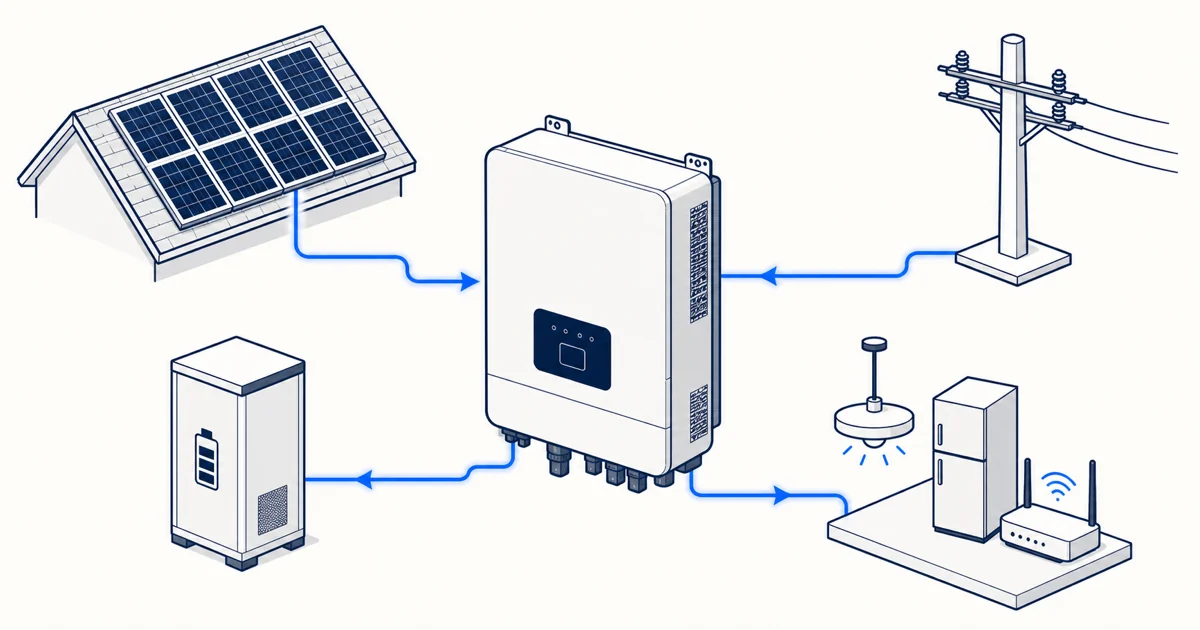
Size a home inverter from four inputs: the appliances you need, which of them run at the same time, the largest motor startup surge, and enough headroom above the calculated load. The continuous rating must cover the simultaneous running load; the surge rating must cover the worst startup event. If the data sheet uses kVA, convert it to real kW with the stated power factor. This calculation sizes power, not battery runtime.
The short answer
To size an inverter, list the appliances that will run at the same time and add up their running watts; that sum is your minimum continuous rating, and you add headroom on top. Then find the single appliance with the largest startup surge, usually a motor such as a fridge or a water pump, and make sure the inverter’s surge (peak) rating covers that startup on top of the running load. If a rating is given in kVA rather than kW, multiply by the power factor to get the real working power. Size power this way; size runtime separately with the battery.
| Input | What to record | What it determines |
|---|---|---|
| Appliance list | Nameplate watts or volts × amps | Candidate loads |
| Simultaneous load | Appliances that may run together | Minimum continuous power |
| Startup surge | Highest motor or compressor starting watts | Required peak power |
| Headroom and power factor | Planned margin; kW = kVA × PF | Final inverter rating |
Want to check your numbers before comparing models? Open the backup power calculator and enter the appliances that need to run together.
The one number that catches everyone: continuous versus surge power
Every inverter has two power numbers, and buyers read only the first.
Continuous power (stated in kW or kVA) is the load the inverter sustains all day, every day. It is the headline rating, and it has to cover the sum of everything running at one moment.
Surge or peak power is a brief overload the inverter tolerates for a few seconds to get a motor turning, often around 1.5 to 2 times its continuous rating. This is the number that decides whether your fridge actually starts, and it is the one the marketing keeps quiet about. The reason it matters is physical: a fridge compressor, a water pump, or a borehole pump draws a large inrush of current the instant it switches on, several times its running draw, as this professional engineering course on motor inrush explains. An inverter sized only to running watts will see that spike and shut down to protect itself. So you size two things at once: the continuous rating to your running load, and the surge headroom to your largest motor’s startup.
How to size an inverter in four steps
Step 1: build your load list
The calculation starts with a list, not a guess. Write down every appliance you want the inverter to run during an outage, and next to each one its running watts.
You find an appliance’s wattage two ways. The simplest is the nameplate: the wattage of most appliances is stamped on the bottom, the back, or a label, and you can also calculate it by multiplying the voltage by the current draw in amperes (for example a “230 V, 2 A” label means about 460 W), as US Department of Energy FEMP guide describes. Always prefer your own device’s nameplate; the figures below are only typical ranges to orient you.
| Appliance (illustrative) | Typical running watts |
|---|---|
| LED lighting (per room) | 10 to 60 W |
| Wi-Fi router and ONT | 8 to 25 W |
| Television | 50 to 400 W |
| Laptop | 30 to 90 W |
| Refrigerator (running, not starting) | 100 to 800 W |
| Microwave | 600 to 1,200 W |
| Electric kettle | 1,500 to 2,200 W |
| Washing machine | 400 to 1,400 W |
| Water or borehole pump (running) | 250 to 1,100 W |
The critical word is simultaneous. You do not add up everything you own; you add up only what realistically runs at the same time. The kettle and the microwave rarely run together with the washing machine at full heat, so be honest about your real pattern. The sum of the loads that genuinely overlap is your minimum continuous requirement.
Step 2: the startup surge, the motor problem
Now handle the number that trips inverters. Anything with an electric motor is an inductive load, and inductive loads do not draw their running watts at the instant they start. They draw a brief inrush. In engineering terms this is the locked rotor current: the surge a motor pulls the moment it is switched on, before it spins up, and for standard induction motors it can be in the region of 6 to 10 times the full-load current, as a professional engineering course on motor load documents. Modern compressors and soft-start designs soften this, so the figure you size to, the surge watts on the appliance plate, is usually smaller than the raw current multiple, commonly around 2 to 3 times the running watts for the split second of startup, in line with published running-versus-starting watt figures.
The appliances that do this in a home are the ones with motors or compressors:
- refrigerators and freezers (compressor),
- water pumps, borehole pumps, and circulation pumps,
- washing machines (drum motor),
- power tools and workshop motors.
Purely resistive loads (LED lights, a kettle, most electronics) have effectively no startup surge; their running watts are their full demand.
The sizing rule that comes out of this is simple and is the same rule used to size backup generators: add up the running watts of everything that runs together, then add the startup surge of the single largest motor on top. You add only one startup surge, because the odds of two large motors starting in the exact same instant are low, and sizing for every motor starting together would oversize the inverter badly. The inverter’s surge (peak) rating has to clear that one worst-case startup; its continuous rating only has to carry the running sum.
Step 3: power factor, and kVA versus kW
One more number changes the arithmetic when an inverter is rated in kVA instead of kW. The two are not the same. Real power, in kilowatts (kW), is the power that does the work. Apparent power, in kilovolt-amperes (kVA), is voltage multiplied by current, and it is always equal to or larger than the real power. The link between them is the power factor: power factor equals real power divided by apparent power, so kW equals kVA multiplied by the power factor, as Fluke sets out.
In practice this means that an inverter advertised as, say, 5 kVA does not necessarily deliver 5 kW of working power. If its rated power factor is 0.8, its real output is 5 kVA times 0.8, which is 4 kW. Inductive loads (those same motors) pull the power factor down, which is exactly why the kVA figure can flatter a data sheet. The defensive habits are two: check whether a rating is stated in kW or kVA, and when it is in kVA, multiply by the stated power factor before you compare it against your load list in watts. Compare like with like.
Step 4: headroom and future loads
The calculated minimum is a floor, not a target. An inverter run permanently at its full rating has no margin for a load you forgot, a hot day that derates it, or the appliance you buy next year. Add headroom above the running sum so the inverter normally operates comfortably below its ceiling. If you already know you will add an air conditioner, a second pump, or solar charging later, fold those into the list now; it is far cheaper to size once than to replace an inverter that has become too small.
The sizing formula, with a worked example
Putting the four steps together gives a method you can run on paper:
Step A. Continuous rating needed
  = (sum of running watts of all simultaneous loads) x headroom factor

Step B. Surge rating needed
  = (running-watts sum, less the starting appliance's own running watts)
    + (that one largest appliance's startup surge watts)

Step C. If the data sheet is in kVA
  usable real power (kW) = kVA x power factor
  (so required kVA = required kW / power factor)
A worked illustration, using generic round figures (use your own nameplate numbers in place of these):
| Load running at the same time | Running watts | Startup surge watts |
|---|---|---|
| LED lighting, several rooms | 200 | 200 |
| Wi-Fi router and ONT | 20 | 20 |
| Television | 150 | 150 |
| Refrigerator | 200 | 600 |
| Water pump | 800 | 2,000 |
| Running total | 1,370 W |
Step A, continuous: the running total is about 1,370 W. With headroom, a continuous rating of roughly 2 kW comfortably carries this everyday load.
Step B, surge: the largest single startup is the water pump, jumping from 800 W running to about 2,000 W starting, an extra 1,200 W over its running figure. The worst instant is the rest of the load running (1,370 W) while the pump starts, which lands near 1,370 + 1,200, about 2.6 kW for that fraction of a second. The inverter’s surge (peak) rating must clear that, which a unit with a continuous rating around 2 to 3 kW and the usual 1.5 to 2 times surge headroom will do.
Step C, units: if the inverter you are comparing is labelled in kVA at a 0.8 power factor, a 3 kVA unit delivers about 2.4 kW of real power, which sits sensibly above the 2 kW continuous requirement.
The numbers above are an illustration of the method, not a recommendation for your home. Run the same three steps with the wattages from your own appliance labels, and the right power rating falls out.
What this calculation does not cover
This guide sizes power, the kilowatts the inverter can deliver at one moment. It deliberately does not size two other things, because mixing them up is the most common newcomer mistake:
- How long the system runs (runtime) is a different number entirely. Runtime is measured in hours. Battery energy is measured in kilowatt-hours (kWh), while power (kW) describes how much you can run at once. Runtime depends on usable energy, load, and losses. Size the runtime side with our LiFePO4 battery buyer’s guide, which is the companion to this article.
- Which type of inverter you need (hybrid, off-grid, or grid-tie) is a separate decision; our inverter type comparison walks through it.
- How it is connected safely is covered in our inverter connection safety overview.
- The full selection overview, the eight specifications beyond power that decide quality, lives in our hybrid inverter buyer’s guide, which this sizing article sits under.
A closing safety line that applies to all of the above: a hybrid inverter is hardwired into your home’s mains and into a critical-loads panel, so the installation, and the grid-connection paperwork with your local grid operator, must be carried out by a qualified, licensed electrician. Size the power yourself; leave the wiring to a professional.
Frequently asked questions
How do I calculate what size inverter I need?
List every appliance you want to run during an outage and write down each one’s running watts, taken from the nameplate or from volts multiplied by amps. Add up only the ones that run at the same time; that sum, plus headroom, is your minimum continuous rating. Then find the single appliance with the largest startup surge, usually a motor such as a fridge or a pump, and make sure the inverter’s surge rating covers that startup on top of the running load. If the rating is in kVA, multiply by the power factor to get real kW.
Why does my inverter trip when the fridge or pump starts?
Because a motor draws a large inrush of current the instant it starts, several times its running watts, for a fraction of a second. An inverter sized only to running watts sees that spike and shuts down to protect itself. The fix is to size the inverter’s surge (peak) rating to cover your largest motor’s startup, not just the running load. This is why the surge number on a data sheet matters as much as the continuous number.
What is the difference between continuous power and surge power?
Continuous power is the load the inverter sustains all day, the headline kW or kVA rating. Surge or peak power is a brief overload, often around 1.5 to 2 times continuous, that the inverter tolerates for a few seconds to start a motor. You need enough continuous power for your everyday running load and enough surge power for your biggest motor’s startup. A unit can have plenty of one and not enough of the other.
What is power factor, and why does kVA not equal kW?
Real power (kW) is the power that does work; apparent power (kVA) is voltage times current and is always equal to or larger than it. Power factor is the ratio between them, so kW equals kVA times the power factor. An inverter rated at 5 kVA with a 0.8 power factor delivers about 4 kW of real power. When you compare inverters, check whether the rating is in kW or kVA, and convert kVA to kW with the power factor before matching it to your load list.
Does the inverter size tell me how long my home will run in a blackout?
No, and this is the most important thing to keep separate. The inverter’s power rating (kW) tells you how much you can run at one moment. Runtime is measured in hours and depends on usable battery energy (kWh), load (kW), and system losses, not the inverter’s power rating alone. Size the inverter for power here, and size the battery for runtime separately.
Should I just buy the biggest inverter to be safe?
No. An oversized inverter costs more, and many inverters are least efficient when running at a small fraction of their rating, so a very large unit carrying a small load wastes energy. Size to your real simultaneous load plus sensible headroom plus your largest motor’s surge. That is enough to be safe without paying for capacity you never use.
The right next step
Sizing an inverter is a short calculation: sum the running watts of what runs together, add the largest motor’s startup surge, convert kVA to kW with the power factor, and add headroom. Do that with your own appliance labels and the right power rating is no longer a guess. Open the backup power calculator to check the load list, then compare the result with the continuous and surge ratings on the model data sheet. Remember that this sizes power only; the battery sizes runtime, so read this alongside our battery-side runtime guide. For the full selection picture, the hybrid inverter buyer’s guide is the hub this article sits under. To see matched inverter and storage systems, including the units we hold in our Odesa-region warehouse for fast local supply, visit our product range. For the wider backup picture, start with the whole-home backup power guide, and if you are weighing a battery system against a fuel generator, see battery versus diesel generator. If you are a dealer or installer serving customers in Ukraine, our partners page explains how to work with us.