
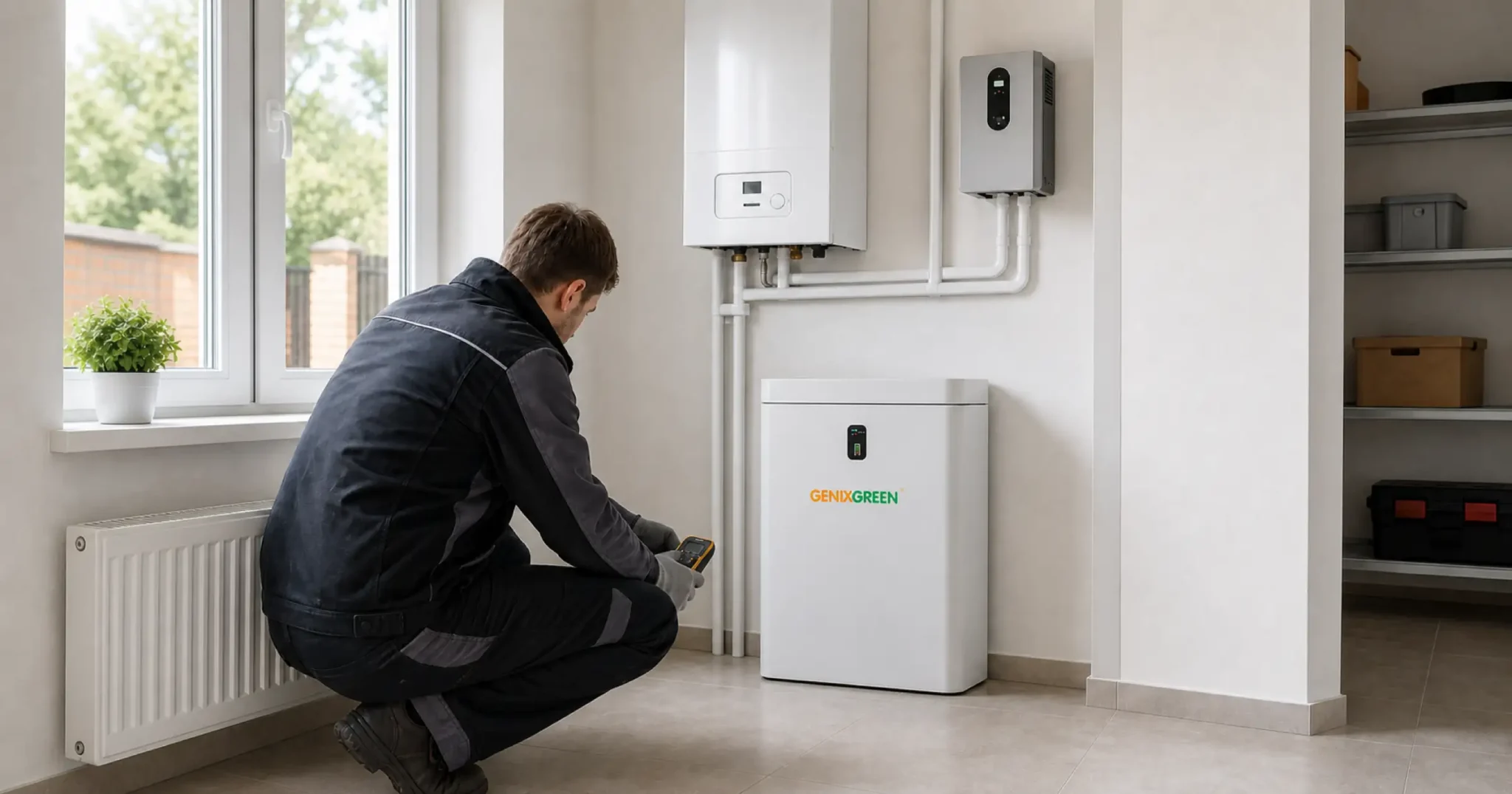
A gas boiler burns fuel, not electricity, so it feels like it should keep running through a blackout. It does not. The gas valve, the ignition module, the circulation pump, and the safety circuit that proves a flame is actually burning all run on mains power, and the moment that power disappears, or drifts too far off spec, the boiler shuts down, sometimes into a locked-out fault state that needs a manual reset before it will fire again. Less well known: a boiler is one of the pickier loads in a house, because its control board and flame-sensing circuit care about the shape of the power, not only the voltage. Genixgreen has built LiFePO4 energy-storage systems in its own factory since 2011, and this guide covers what actually keeps a boiler running through grid trouble: clean power first, then the right backup device. For the wider picture, see our whole-home backup power guide.
The short answer
Keeping a gas boiler running through unstable voltage or a full blackout means protecting a small but electronics-heavy load: the control board, the flame-sensing circuit, and the circulation pump. Two separate problems call for two separate tools. A voltage stabilizer corrects bad grid voltage while the grid is still present. A UPS or an inverter-plus-battery system takes over completely once the grid goes down, and for a boiler it must output a pure sine wave, because the ignition and flame-detection electronics can misread a modified or square-wave signal as a fault and lock the burner out even though gas is actually burning correctly. The boiler’s own electrical load is small, so even a compact backup device can carry it for hours once it is matched to the right waveform.
Why a gas boiler needs clean power, not just any power
A boiler is a combustion appliance, but almost everything that keeps it safe to run unattended is electronic: a control board that sequences ignition, a fan or draft motor, a circulation pump, and a flame-sensing circuit that has to prove combustion is real before it lets the gas valve stay open. None of that is a simple on/off load, which is why the wrong kind of backup power causes problems a light bulb or a phone charger would never reveal.
The circulation pump and control board
The electrical side of a residential condensing boiler is modest. One residential boiler manufacturer’s own installation and operating manual lists control-system and fan power draw of roughly 54 to 100 W at full fire, not counting the circulation pump. A typical domestic circulation pump adds another 25 to 80 W, with older or less efficient units running higher. Together, a boiler’s steady running load sits around 80 to 180 W, similar to a couple of LED floor lamps. Ignition draws a brief, higher spike while the igniter and fan spin up, but the sustained load stays small.
That is good news for sizing a battery. The complication is not the size of the load but its type: many modern high-efficiency circulation pumps use electronically commutated (variable-speed) motors instead of the simple fixed-speed motors of older systems, and their onboard electronics are more particular about the quality of the incoming waveform. So the real design question for boiler backup is not how many watt-hours you need, which is modest, but whether the backup source delivers power the boiler’s electronics will accept. That is where the waveform comes in.
Pure sine wave, phase and grounding
What makes a boiler genuinely different from most household electronics is how it proves a flame is present. Almost all modern gas appliances use flame rectification: a small electrode sits in the flame, an AC voltage is applied across it and a grounding reference, and because a flame conducts current more easily in one direction than the other, the circuit tells combustion is real by checking whether the returning current has been rectified into a clean, one-directional signal. A leading manufacturer of flame-safeguard controls explains the mechanism directly: “the alternating current (AC) has to be rectified to direct current (DC) in order to be accepted as flame signal,” and this is only reliable with a proper low-impedance earth-ground path back to the burner and control panel.
Two things follow. First is the waveform. The flame signal is tiny, on the order of a few microamps, and the control board judges it against a threshold the manufacturer calibrated using clean grid power, a smooth sine wave. A modified or square-wave inverter approximates that sine wave with stepped transitions and abrupt zero-crossings, and its harmonic content and switching noise ride on the same circuit that carries the delicate flame measurement. The physics of rectification works on any waveform, but the control electronics were not tuned for a distorted one: the added noise can push the measured signal outside the narrow window the board accepts as a valid flame, and the safety logic then does the conservative thing and reports no flame, locking the burner out even though it is lit. This is a nuisance lockout driven by measurement, not a claim that the burner cannot physically run. It is why makers of similar combustion appliances with electronic ignition tell owners to use clean power. One pellet-appliance manufacturer states it directly in its own manual: “Any generator, UPS, or battery backup system must have a Pure Sine Wave power signature. (Partial or modified sine waves can damage electronics, or cause component failures)”. A gas boiler with its own electronic ignition and flame-sensing board sits in the same category, so the safe assumption for boiler backup is a genuine pure sine wave unless the boiler manufacturer says otherwise.
Second, because the flame signal is a rectified current referenced to ground, correct line and neutral polarity and a real, low-resistance earth connection are not optional extras. A reversed hot and neutral, or a missing or high-resistance ground, degrades the same weak signal a distorted waveform degrades, with the identical symptom: the board reads “no flame” and locks the boiler out even though the burner is lit.
This is why a boiler that keeps tripping into a fault code on backup power, or right after an outage, is not automatically a broken boiler. Very often it is a power-quality problem: a modified-sine device, a reversed connection, or a weak ground, feeding a circuit designed to be strict about exactly those things.
Two threats: unstable voltage and blackouts
Ukrainian grids under strain create two different problems, and it is worth separating them before choosing hardware. The first is unstable voltage: the power stays on, but it sags, spikes, or drifts outside the range the boiler’s electronics were designed for. The second is a full blackout: no grid power at all. A device built to solve one does not automatically solve the other.
A voltage stabilizer
A voltage stabilizer, a mains-side automatic voltage regulator (AVR), watches the incoming grid voltage and boosts it when it sags or trims it when it spikes, so the boiler always sees something close to its rated voltage. As the general reference on the technology describes it, automatic voltage regulators work “to maintain a constant voltage” and compensate for changes on the line. Two limits follow from what a stabilizer actually does. First, it corrects voltage but does not store or create power, so it cannot help once the grid goes fully dark. Second, it does not by itself solve the pure-sine-wave problem: an electromechanical mains stabilizer boosts or trims the amplitude of the grid’s own sine wave rather than synthesizing a new waveform the way a battery-based inverter does, so on grid power the boiler still sees a real sine wave, just corrected in level.
A stabilizer suits a boiler on a line with chronic under-voltage or over-voltage, common on stressed or thin rural feeders, without regular full outages. Size it for the boiler’s real running load plus the brief ignition spike, and favor smooth, fast correction over a rough single-step tap change, which can itself look like a momentary disturbance to a sensitive control board.
A UPS or inverter with a battery
A stabilizer cannot do anything once the grid is actually down. For that, the boiler needs a UPS or an inverter-plus-battery system that switches to stored energy the instant the outage starts, and for the reasons covered above, that backup device has to output a genuine pure sine wave, not a modified or stepped approximation. Because the boiler’s load is small, a compact UPS or inverter sized for a few hundred watts is usually enough; the constraint is waveform quality and reliable grounding through the backup path, not raw capacity. Our UPS alternatives guide compares the device categories that can carry small, sensitive loads like this one through a blackout.
Some households already have a whole-home backup system installed for lights, a fridge, and other essentials. If that system’s inverter is pure sine wave and the boiler is wired onto its protected circuit, no separate device is needed; the boiler simply rides through the outage along with everything else. Any hardwired connection into your mains wiring, including tying a boiler onto a protected circuit, must be done by a qualified electrician. Our guide to how a home backup system works covers how that kind of setup is put together.
Sizing backup for a boiler (a small but fussy load)
Once the waveform and grounding requirements are met, sizing the battery itself is the easy part, because the load is genuinely small. Use a method rather than a number pulled from a listing.
Runtime (hours) = (Battery Wh x DoD x Efficiency) / Load (W)- Battery Wh: the rated capacity of the backup device.
- DoD (depth of discharge): how much of the battery can be safely used, commonly around 0.80 for LiFePO4.
- Efficiency: roughly 0.90 for a device with an AC inverter stage.
- Load (W): the boiler’s control board, fan, and circulation pump combined, read from the equipment labels rather than assumed.
Illustrative example (use your own boiler’s numbers). A control board and fan at roughly 80 W plus a pump at roughly 60 W gives a combined load of about 140 W. A 500 Wh battery works out to roughly 500 x 0.80 x 0.90 / 140, or about 2.6 hours; a 1,000 Wh unit gives roughly 5 hours for the same load. These are illustrations, not promises: real runtime depends on your equipment’s labels, true usable capacity, and temperature. Our battery runtime guide covers the full method.
Battery choice: gel vs LiFePO4
Two chemistries commonly show up in boiler backup setups, and they trade off differently. Gel batteries, a type of valve-regulated lead-acid (VRLA) battery, cost less upfront and tolerate cold-weather charging somewhat better than lithium chemistry: lead-acid can generally be charged down to about minus 20 degrees Celsius at a reduced rate, while lithium chemistries should not be charged below 0 degrees Celsius at all. That tolerance does not remove the ventilation requirement: even sealed VRLA and gel batteries can release small amounts of hydrogen and oxygen under overcharge, and manufacturer guidance is explicit that they must never sit in a fully sealed container or enclosure. Gel batteries also carry a shorter usable cycle life than LiFePO4 and lose capacity faster under repeated deep discharges.
LiFePO4 costs more per watt-hour upfront but offers a longer cycle life, a higher thermal-runaway threshold, and a design that suits an appliance most households want to forget about for years, which matters for something as unglamorous as boiler backup. LiFePO4 stationary-application safety is covered by the international IEC 62619 standard, and the same cold-charging limit applies: it must not be charged below 0 degrees Celsius without a battery management system that blocks charging until it warms up, which is why keeping the battery indoors and heated matters through a Ukrainian winter. For a boiler that has to restart reliably through an entire heating season, most households lean toward LiFePO4 for the longer service life and simpler indoor placement, while gel stays a reasonable lower-cost option where the space is ventilated and deep cycling stays infrequent. The full chemistry trade-offs are covered in our LiFePO4 vs. lead-acid guide.
Boiler not working on inverter power: what to record
A symptom alone cannot identify the cause. Before requesting service, record the boiler model, the displayed error code, the inverter model and operating mode, and whether the problem also occurs on grid power.
- The boiler does not start: note whether its display is on and whether the inverter shows an alarm.
- The burner ignites and then stops: record the error code and the sequence you observed. Do not infer a wiring fault from this symptom alone.
- The boiler restarts during transfer to backup power: note when the restart occurs and which other appliances were running at the time.
Give this information and both equipment manuals to a qualified boiler technician and electrician. Checks involving phase, neutral, earthing or protective devices require professional assessment. Do not alter wiring, add a neutral-to-earth link or bypass a safety device based on a forum reply.
Frequently asked questions
How do I choose a voltage stabilizer for a gas boiler?
Match its continuous power rating to the control board, fan, and circulation pump combined, with headroom for the ignition spike, then check its correction range against how far your local grid actually sags or spikes. A stabilizer only corrects voltage; it cannot power the boiler through a full outage, so if outages are frequent, pair it with a pure-sine UPS or inverter-plus-battery system.
Will a modified sine wave inverter damage my boiler?
It can. A boiler’s flame-sensing circuit relies on a clean AC waveform to tell a real flame apart from a false signal, and manufacturers of similar combustion appliances with electronic ignition state directly that partial or modified sine waves can damage electronics or cause component failures. The more common outcome is a nuisance fault lockout rather than physical damage, but either way a pure sine wave device is the reliable choice.
Does my boiler need a UPS if I already have a voltage stabilizer?
Only if it also needs to survive a full blackout. A stabilizer corrects bad voltage while the grid is still on; it cannot power anything once the grid is fully down. Genuine blackouts call for a UPS or an inverter-plus-battery system with a pure sine wave output, not a stabilizer.
Why does my boiler lock out after a power flicker even though the flame was fine?
This is a common symptom of a flame-rectification circuit misreading its reference signal, which can happen from a brief voltage disturbance, a poor or missing earth ground, or reversed line and neutral wiring, not only an actual loss of flame. If lockouts repeat after power events, have a qualified technician check the ground and polarity at the boiler’s supply first.
Can I run a gas boiler on a portable generator?
Only if the generator produces a genuine, low-distortion sine wave. Older or simpler portable generators often output a rougher waveform that can trip the same faults described above. Check the generator’s rated total harmonic distortion or a pure-sine-wave spec before connecting a boiler, and have any generator-to-mains connection installed by a qualified electrician.
Do I need to back up the circulation pump separately?
No. The control board, flame-sensing circuit, and circulation pump all need power together for the boiler to run at all, so one backup device sized for the combined load, on the boiler’s own circuit, covers all three.
The right next step
A boiler is a small load with a strict list of requirements: real voltage correction when the grid is unstable, a genuine pure sine wave and a solid ground when it goes down, and a battery chosen for how it will actually be used through a Ukrainian winter. Get those three right and boiler backup becomes one of the simplest, most reliable pieces of home resilience to install. Browse our backup power product range, or read the whole-home backup power guide for how boiler backup fits a larger system. Dealers and installers in Ukraine can find how to work with us on our partners page.