
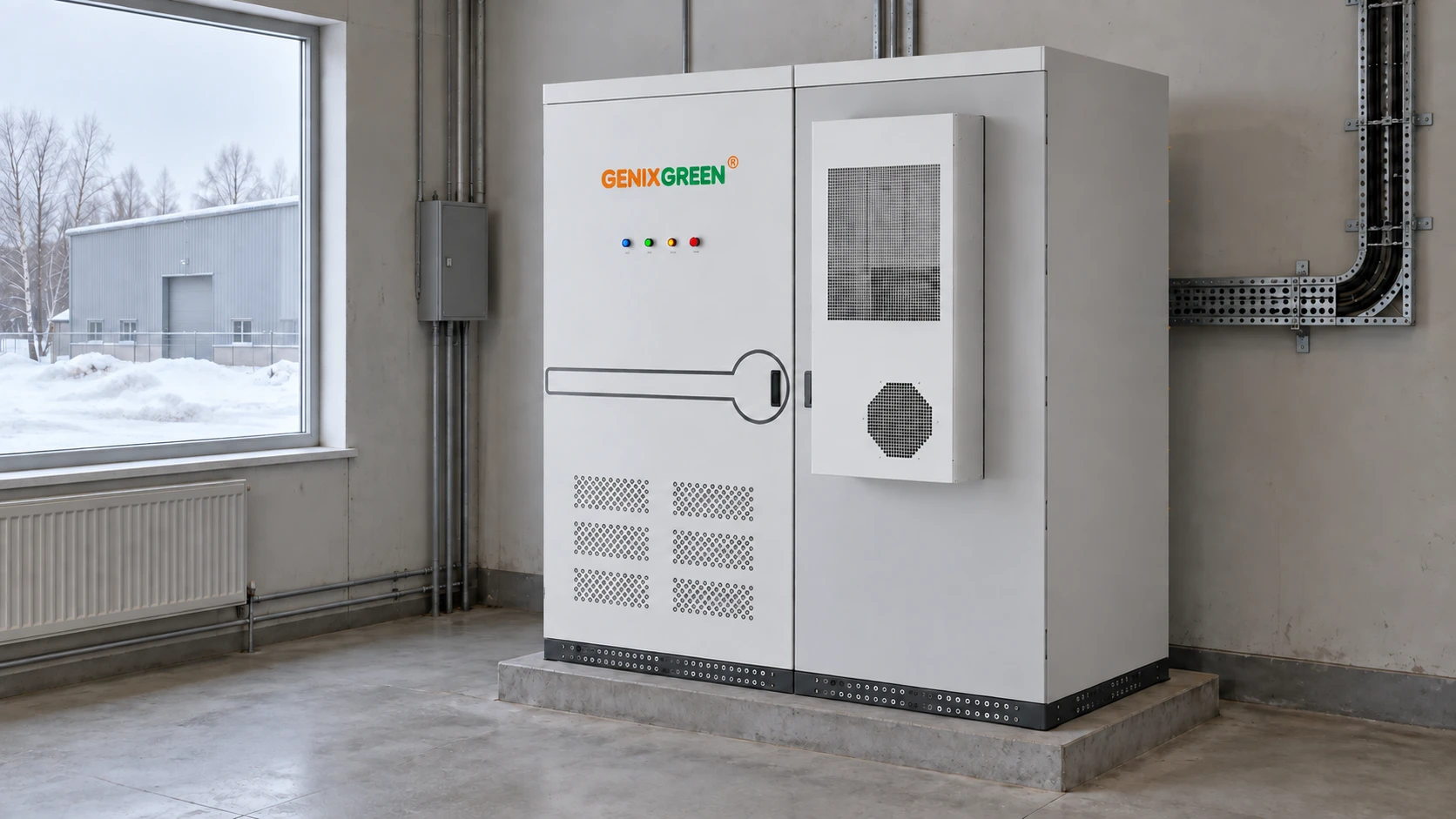
LiFePO4 charging in winter may be permitted only within the charging-temperature range stated for the exact battery, using the battery temperature its controls measure. Cold charging can contribute to lithium plating and cell aging Source: Lin et al. (2024). Follow the manual, not an outdoor forecast or another model's data.
For a Genixgreen HV-BOX5, the public charging range is 0 °C to 55 °C Source: Genixgreen HV-BOX5 specifications. It is a product-specific example, not a rule for every LiFePO4 battery. Check the current manual, approved inverter profile, and battery temperature. See what a BMS does.
The short answer
LiFePO4 batteries may be able to discharge in cold weather while being unable to accept a charge at the same temperature. Check three separate specifications in the exact manual: charging, discharging, and storage. Use the battery or cell temperature used by that product's controls, rather than assuming the outdoor temperature is the same. A low-temperature charge block protects the battery; it is not proof that the battery heats itself.
Why winter charging is different from winter discharge
The phrase "works in winter" can hide two different questions. A battery can deliver energy to an inverter, and it can receive energy from a charger. Those are different electrochemical conditions, so they must be checked separately.
Cold charging can damage a cell
At low temperature, lithium ions move and enter the graphite negative electrode less readily. During charging, that can create conditions in which metallic lithium deposits on the graphite surface instead of being stored as intended. The 2024 study of commercial graphite/LiFePO4 pouch cells observed this lithium-plating behavior around 0 °C and links extensive deposition with lost lithium inventory and cell aging Source: Lin et al. (2024).
The research does not create a universal consumer cut-off. It studied one commercial cell under particular conditions. It does explain why temperature limits and reliable temperature sensing belong in the battery documentation.
Temperature is also not the only variable. DOE and Idaho National Laboratory material on fast charging describes lower temperature and higher current density as factors that increase plating likelihood Source: DOE/INL fast-charge research. The safe practical conclusion is modest: use the manufacturer-approved charge profile, do not infer a safe current from a generic internet chart, and do not force a battery to charge because its nominal system voltage appears familiar.
Discharge can have a different published range
A battery may discharge during a winter outage while daytime solar or grid power tries to recharge the same cold pack. The conditions can differ. On its public HV-BOX5 page, Genixgreen lists charging at 0 to 55 °C, discharging at -10 to 55 °C, and storage at 0 to 35 °C Source: Genixgreen HV-BOX5 specifications. One "operating temperature" line is not enough.
Do not copy those values into a setting for another battery family. Other products may use different cells, sensors, firmware, and approved inverter communications. Read the data sheet and installation manual for the installed product.
Read the three temperature specifications separately
IEC 62619 covers safety requirements for industrial secondary lithium cells and batteries, including stationary applications. Its official material separates charging and discharging operating regions and includes temperature management Source: IEC 62619:2022. Use that distinction when reading a battery manual.
| Specification to find | What it tells you | What it does not tell you |
|---|---|---|
| Charge temperature | When the battery may accept energy under its stated conditions | Whether it may discharge at that same temperature |
| Discharge temperature | When the battery may supply energy | Whether charging can immediately resume |
| Storage temperature | Conditions for an unused or stored battery | The permitted temperature during active charging or discharge |
Charging temperature
This is the line that matters before an inverter, charger, solar controller, or grid-charge schedule begins putting energy into the pack. The applicable number comes from the current manual for the exact model. It may also be conditional on state of charge, charge rate, firmware, or communication with the inverter. A nominal voltage is an identifier for the battery architecture, not a universal CC/CV or absorption setting.
Discharging temperature
Discharge temperature tells you whether the battery can provide power in the cold. It should not be used as permission to recharge a battery that remains below its published charging range. Lower temperature can also affect available energy and power. For a realistic view of backup duration, use the battery runtime guide and calculate from the actual load instead of expecting a fixed number of hours.
Storage temperature
Storage describes a different state again. A battery that is switched off, transported, or held in inventory is not following the same thermal rules as a battery charging or discharging in service. If a system is seasonal or will be unpowered for a long period, follow the manufacturer's storage instructions, including state-of-charge and inspection guidance where provided.
Use the battery temperature, not just the weather forecast
Outdoor temperature and battery temperature are related, but not interchangeable. A sheltered indoor pack can remain warmer than the outside air, while an unheated-garage pack can cool toward the surrounding temperature.
Temperature sensors and thermal lag
The relevant measurement is the one specified by the product's protection and control system. That may be a cell-temperature sensor, a pack sensor, or another documented measurement point. Check the manual for its meaning. Do not decide that the pack is ready to charge from a wall thermometer, a weather application, or a guess based on when the room was last heated.
What to verify in the documentation
Confirm which temperature the product displays, which sensor its low-temperature protection uses, and whether a documented heating function changes the charging sequence. These details determine whether a battery has warmed enough after it was cold-soaked.
Insulation can slow heat loss or temperature swings. It does not create heat, raise a cold-soaked battery above its charging limit, or substitute for a documented heating function. Treat it as site protection only.
Protection, heating and charging control are different
A BMS monitors battery conditions and can block or limit operation when its measured values are outside the design limits. It is an important protective boundary, but it does not automatically include a heater. A low-temperature charge cut-off means the system can prevent unsafe charging under the conditions it detects. It says nothing by itself about whether the cells can be warmed.
What a documented heating function should answer
If a battery manual states that it has heating, it should make clear:
- Which series and revision include the function.
- Which temperature measurement controls activation.
- When charging may begin after warming.
- Any inverter profile and firmware requirements.
Do not open a sealed battery, add an improvised heat source, build a heated box, bypass a temperature block, or try to reset protection behavior. If the battery remains unable to charge at a site that should meet the manual, contact the installer or Genixgreen technical support with the model, serial documentation, temperature reading, and inverter information.
A winter site and documentation checklist
Prepare before an outage or cold spell. Use this checklist with current documentation and a qualified installer.
- Identify the exact battery. Record its model, series, and current manual version.
- Find all three temperature rows. Keep charging, discharging, and storage figures separate. Do not use a value from another Genixgreen series as a substitute.
- Identify the measured temperature. Confirm whether the system uses ambient, pack, or cell temperature.
- Check the installation location. Consider the lowest likely temperature, moisture exposure, clearance, and access for service.
- Confirm inverter compatibility. The manual and approved profile should agree on communication and charge-control behavior.
- Check heating claims in writing. Confirm whether the exact documentation specifies heating and how it operates.
- Plan for service. A persistent low-temperature block needs qualified support, not a protection override.
For the broader buying checklist, read how to choose a LiFePO4 battery. It helps separate the questions about usable energy, inverter compatibility, placement, and documentation that should be answered before purchase and installation.
Frequently asked questions
Can LiFePO4 batteries charge below freezing?
Only if the exact product documentation expressly permits it under stated conditions. Do not infer that permission from the LiFePO4 chemistry name, a discharge range, or a BMS label. The published HV-BOX5 example begins charging at 0 °C, but another model can differ Source: Genixgreen HV-BOX5 specifications.
Is outside temperature the same as battery temperature?
No. Outdoor or room temperature describes the environment; the battery can warm or cool more slowly. Follow the measurement and threshold defined by the battery manual, especially after the pack has been in an unheated location.
Why is charging a cold LiFePO4 battery a concern?
Cold conditions can reduce charge acceptance and contribute to lithium plating at the graphite negative electrode. The risk also depends on charging conditions such as current, so the correct response is to use the approved profile and temperature limits for the specific battery Source: Lin et al. (2024).
Does a BMS heat a LiFePO4 battery?
Not by itself. A BMS may sense temperature and block charging, but heating requires a separate, documented heating function and control logic. Check the product manual for the exact series rather than assuming the protection system warms the cells.
Does insulation heat the battery?
No. Insulation can slow heat loss, but it cannot heat a battery that is already cold or make it safe to charge outside the published range. It is part of location planning, not an active heating system.
What should I collect if cold protection stops charging?
Collect the exact battery model and manual version, the displayed battery or cell temperature, the inverter model and approved profile, any warning code, and when the charge block occurred. Give those details to the installer or technical support. Do not attempt to bypass or reset the protection function.
The right next step
Before the cold season, collect the manual, data sheet, inverter profile, and a record of the intended installation location. Compare the exact product's charging, discharging, and storage specifications with the temperature the battery will actually experience. When anything is missing or inconsistent, ask a qualified installer or Genixgreen technical support for written guidance before charging.
Sources
- Lin et al., Advanced Energy Materials (2024): commercial LFP/graphite-cell evidence on low-temperature charging and lithium plating.
- U.S. Department of Energy and Idaho National Laboratory, Aging and the Role of Fast-Charge Protocols: relationship between lower temperature, current density, and plating likelihood.
- IEC 62619:2022: safety standard context for industrial and stationary secondary lithium batteries.
- Genixgreen HV-BOX5 specifications: product-specific published charging, discharging, and storage temperature ranges.