
The best home battery brand in Ukraine depends on the inverter, critical-load profile, capacity target, documentation and local support. This guide compares ten residential battery brands by project fit, not a universal winner, and separates complete home batteries from cell makers and utility-scale BESS suppliers. Genixgreen has designed and built energy-storage systems since 2011, according to its About page. Disclosure: Genixgreen publishes this guide and is one of the compared brands. It is a transparent procurement starting point, not an independent lab test.
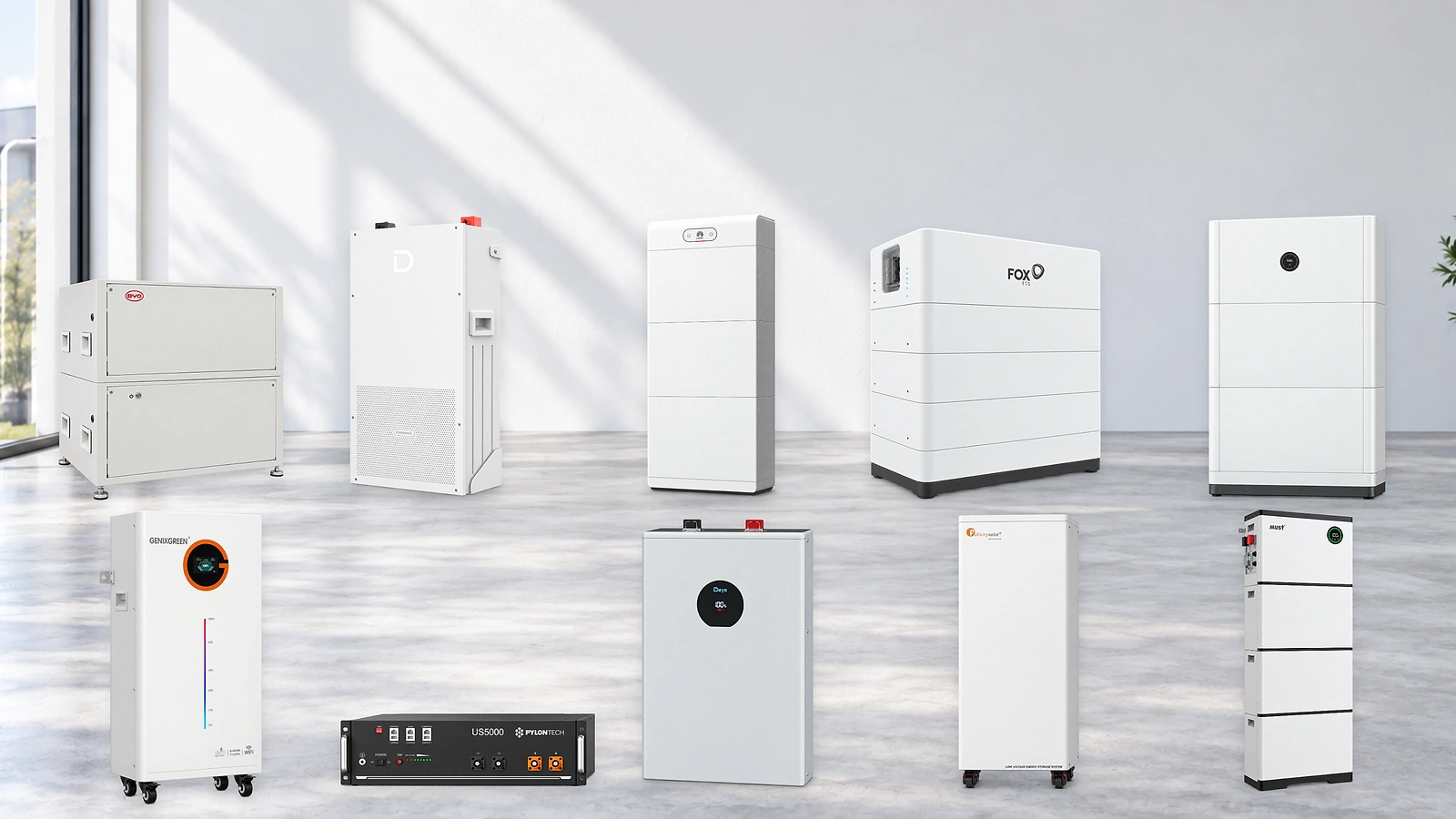
Featured-image note: the comparison image is an editorial montage of AI visual reconstructions based on official manufacturer product references. It is not an exact product-scale comparison or a field-installation photograph.
The short answer: match the brand to the project
The practical route is to start with the installed or proposed inverter, then narrow the list by battery voltage class, communication protocol, required energy, documents and current local support. A familiar logo or a high nameplate kWh figure does not establish a workable backup system.
No universal winner exists
Every serious shortlist should be tied to the project rather than an abstract league table. A home with a low-voltage retrofit, an installer with a defined inverter platform and a distributor building a mixed portfolio may each reach a different, defensible choice.
Inverter, load, capacity, documents and local support decide the shortlist
Ask each supplier for the exact battery model, inverter pairing or protocol reference, firmware requirements, applicable document set and current Ukraine availability. Start with the wider Genixgreen product catalogue if you are still comparing battery formats, then use this article to prepare a brand-level shortlist.
What this guide includes and excludes
The comparison includes complete residential batteries and home-energy-storage product lines. It does not use a cell-maker shipment list as a proxy for home-battery suitability, and it does not include utility-scale BESS integrators simply because they are well-known energy-storage companies.
Complete residential battery lines only, not cell makers or utility BESS suppliers
That boundary keeps the decision relevant to installers, EPCs, distributors and technically serious home-backup buyers. It also prevents false comparisons between a battery cell supplier, a rack battery, a high-voltage tower and a utility-scale container system.
How we selected and compared the ten home battery brands
Each brand has one official product or technical source and one Ukraine-local public source in the evidence ledger. The local source supports a Ukraine-facing public presence. It does not prove today’s stock for every SKU, an authorized-channel status, a fixed warranty term or universal compatibility.
Evidence rule for product and Ukraine presence
Manufacturer sources establish that a relevant residential product line exists. Ukraine-local pages establish that the brand has public local-market information. Both conditions are necessary before this guide says a brand has a Ukraine public presence.
One official source and one Ukraine-local public source for every brand
Pylontech, BYD Battery-Box, Dyness, Deye, Huawei LUNA, FoxESS, Growatt, Felicity Solar, MUST and Genixgreen all meet this threshold. The presentation order is not a quality, price or market-share ranking. Our evidence check recorded final HTTP 200 responses on 26 September 2026.
What a public listing cannot prove
Public product pages are useful procurement signals, but they are not a project approval. Commercial listings can become stale; product families can change; and a compatible-looking connector can still have the wrong protocol or firmware.
Current stock, warranty, protocol and certification remain model-level checks
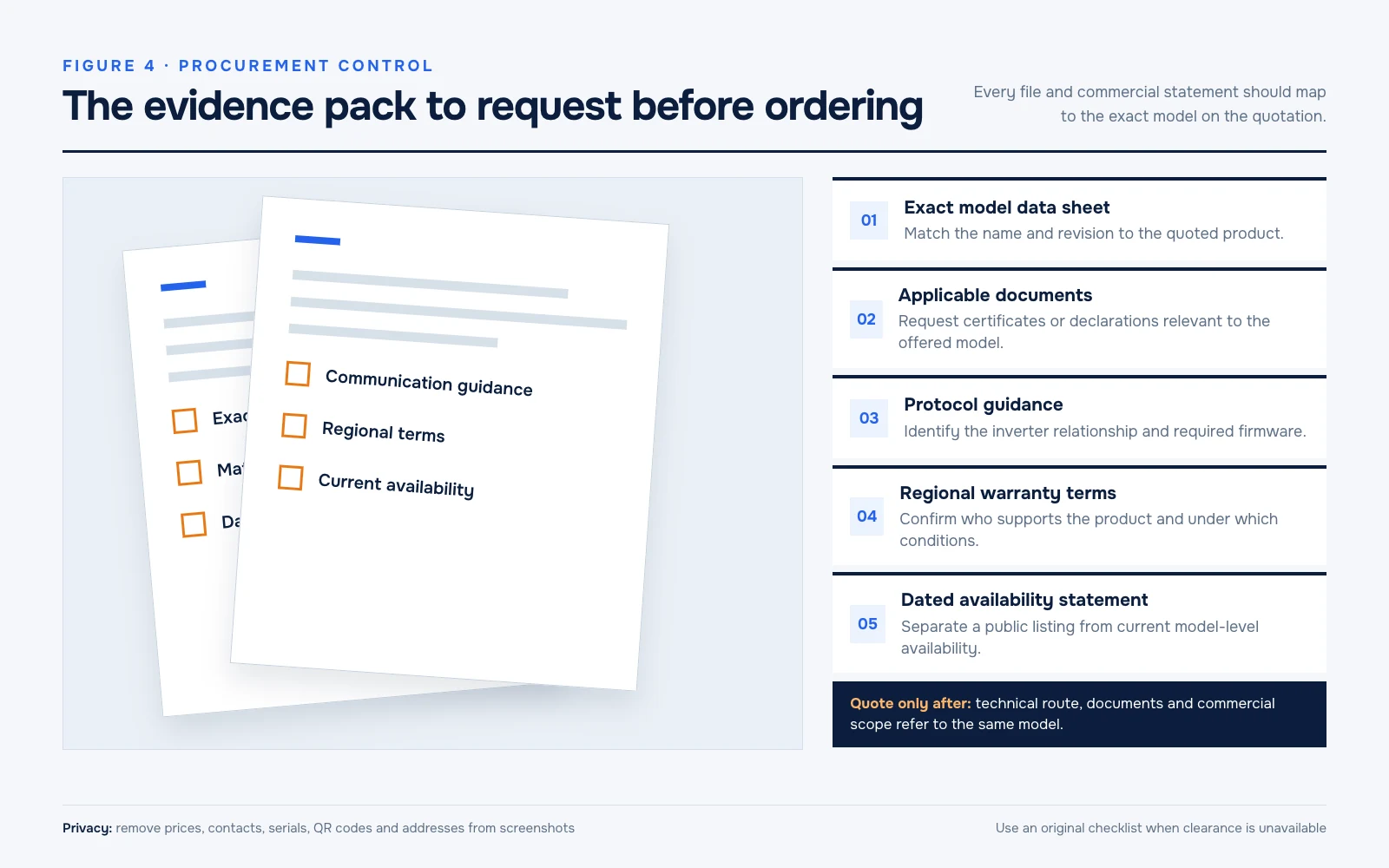
Before quotation, request the exact model, the matching data sheet, applicable documents, regional warranty terms, a dated availability statement and the manufacturer’s communication guidance. This disciplined check is more useful than relying on a generic ranking position.
Compare 10 home battery brands for Ukraine by project fit
The table gives a first screening view. It deliberately avoids normalising price, warranty duration, market share or cycle-life claims across different product generations and conditions.
Ten-brand comparison table
| Brand | Product route shown by official source | Ukraine public evidence | Good first-fit question | Verify before quotation |
|---|---|---|---|---|
| Pylontech | Low-voltage US5000 battery | XOLAR US5000 listing | Is a rack-format low-voltage battery appropriate? | Exact inverter protocol and current availability |
| BYD Battery-Box | Battery-Box LV product family | LV5.0+ listing | Does the project need a modular Battery-Box route? | Series, modules and approved pairing |
| Dyness | Residential energy-storage portfolio | Dyness Ukraine website | Which named product family matches the design? | Local support and model-specific documents |
| Deye | SE-F12 battery family | Deye Ukraine battery category | Is the project built around a Deye energy ecosystem? | Battery-inverter pairing and documents |
| Genixgreen | ES-BOX36 family | Genixenergy Ukraine catalogue | Is a factory-first quote and pre-check useful? | Capacity, protocol and current availability |
| Huawei LUNA | LUNA2000 storage system | Huawei Ukraine LUNA page | Is a FusionSolar ecosystem configuration planned? | LUNA generation and system configuration |
| FoxESS | High-voltage battery family | Ukraine supplier page | Does a high-voltage modular architecture fit? | Tower, accessories and inverter fit |
| Growatt | APX high-voltage battery family | Hope 5.0L-B1 listing | Which Growatt battery architecture is proposed? | Do not mix APX and Hope requirements |
| Felicity Solar | Low-voltage LFP battery line | Public product documentation | Is a low-voltage LFP route appropriate? | Exact model and inverter fit |
| MUST | Lithium battery line | Public product documentation | Is an integrated system being considered? | Exact model and system scope |
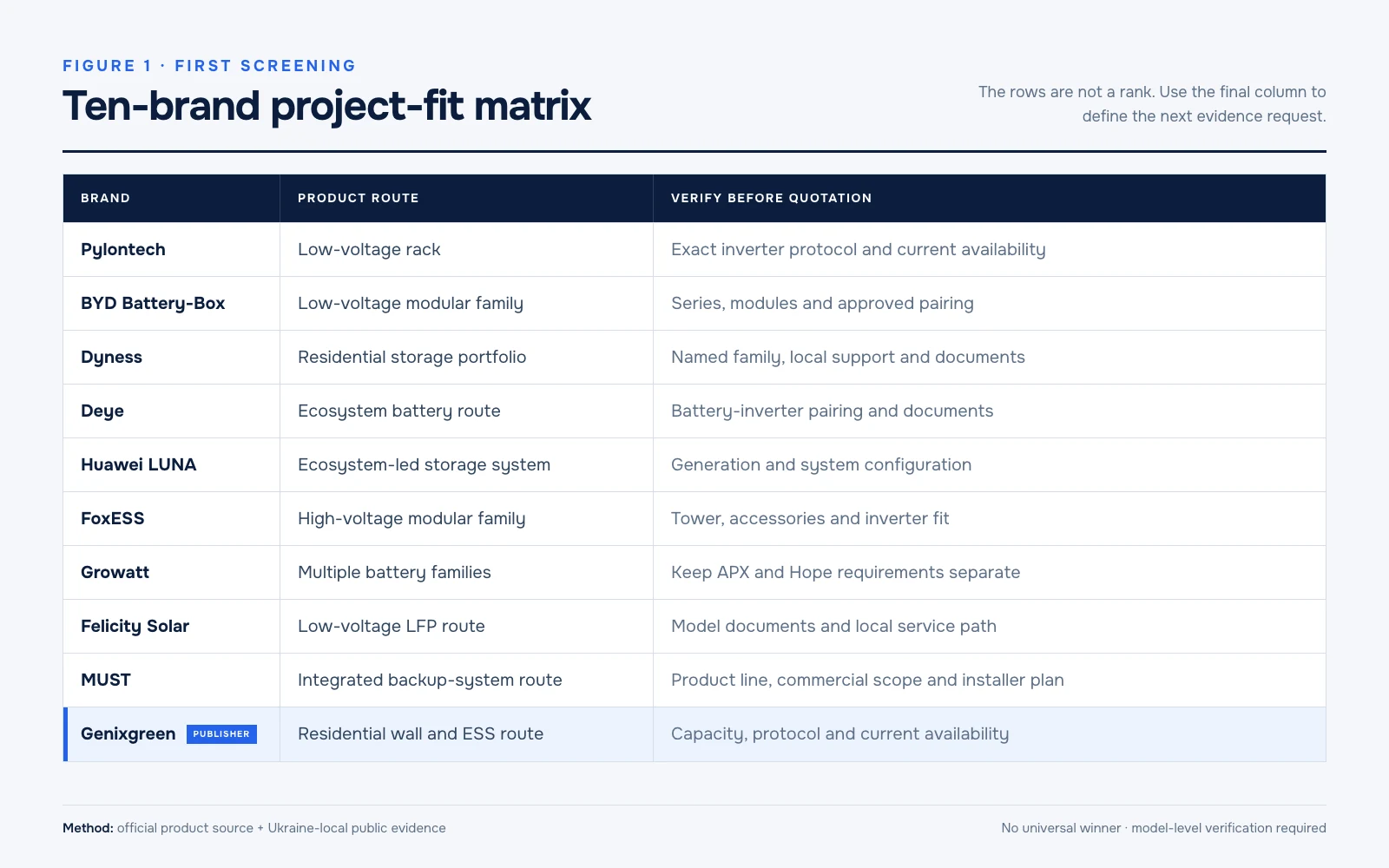
Product architecture and verification point explain fit without false ranking
The useful output from a comparison page is a defensible next question. A buyer who asks for a model-specific communication check, document pack and dated availability statement is less likely to receive an unsuitable substitution later in the project.
Use the table to request a model-level pre-check
If you are comparing batteries for an active project, send the exact inverter model, firmware, voltage class, capacity target, critical loads and required document set through the Genixgreen partners page. A useful response should identify a specific battery route, communication check, document pack and current Ukraine availability rather than repeat a brand-level claim.
Genixgreen competes on traceable model matching, not a generic number-one label
Genixgreen states on its About page that it designs and builds energy-storage systems, BMS and hybrid inverters in its own factory. In this guide, that capability is framed as direct technical clarification and a model-level pre-check. It does not replace installer approval or prove compatibility before the exact hardware, firmware and protocol are reviewed.
Brand-by-brand shortlist notes
Pylontech is a sensible starting point when a project is built around a low-voltage rack-format battery such as the US5000. Its official product page and a Ukraine listing provide the evidence basis. Confirm the exact inverter protocol before treating the format as compatible.
BYD Battery-Box fits a modular Battery-Box conversation. The official LVL datasheet and a Ukraine LV5.0+ page establish product and local public evidence. The series and approved pairing must still match the offered inverter.
Dyness is useful for installers and distributors who want to examine a wider residential-storage portfolio. Its official range page and Ukraine site support inclusion. Select a named model before comparing voltage, stacking and service terms.
Deye belongs on a shortlist when the project is already considering its residential energy ecosystem. The SE-F12 product page and Ukraine battery category are public sources. They do not remove the need to confirm the planned battery and inverter combination.
Genixgreen is included under the same evidence rule. The ES-BOX36 product page and Genixenergy Ukraine catalogue support its presence in this guide. The brand is assessed under the same model-level verification criteria as every other entry. Send the exact inverter and load brief for a capacity, communication and current-availability pre-check.
Huawei LUNA is an ecosystem-led option. The LUNA2000 product page and the Ukraine product page support a FusionSolar-focused shortlist. Check the LUNA generation, inverter configuration and commissioning requirements as a single package.
FoxESS can be considered where a high-voltage modular battery architecture matches the design. The manufacturer describes HV batteries, while a Ukraine supplier page shows public local-market information. Confirm the tower configuration, accessories and exact inverter relationship.
Growatt should be treated as a product-family decision, not one generic battery. The APX official page and a Ukraine Hope 5.0L-B1 listing show why the architecture must be named. Do not carry requirements or documents from APX to Hope without confirmation.
Felicity Solar is included as a low-voltage LFP option. Confirm the exact model, documentation and inverter fit before quotation.
MUST is included as a lithium-battery option. Confirm the exact model, system scope and inverter fit before quotation.
Each note points to a selection scenario, not a universal recommendation
The branded notes should trigger a technical question rather than an immediate order. They deliberately avoid unsupported language such as “best overall”, “works with every inverter” or “available everywhere in Ukraine”.
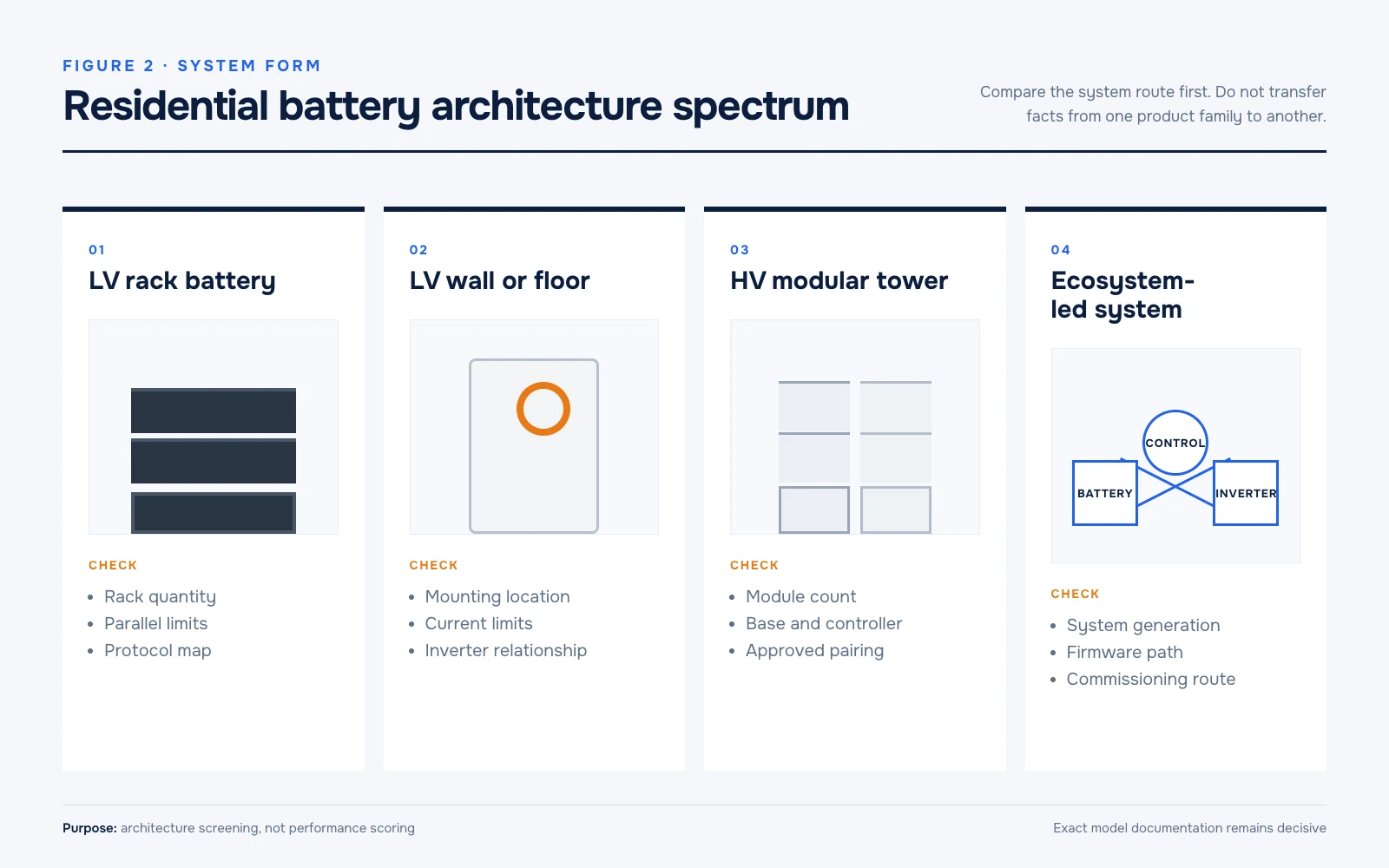
Build a procurement shortlist before asking for a quote
The quality of the enquiry determines the quality of the comparison. A supplier cannot reliably recommend a battery from capacity alone.
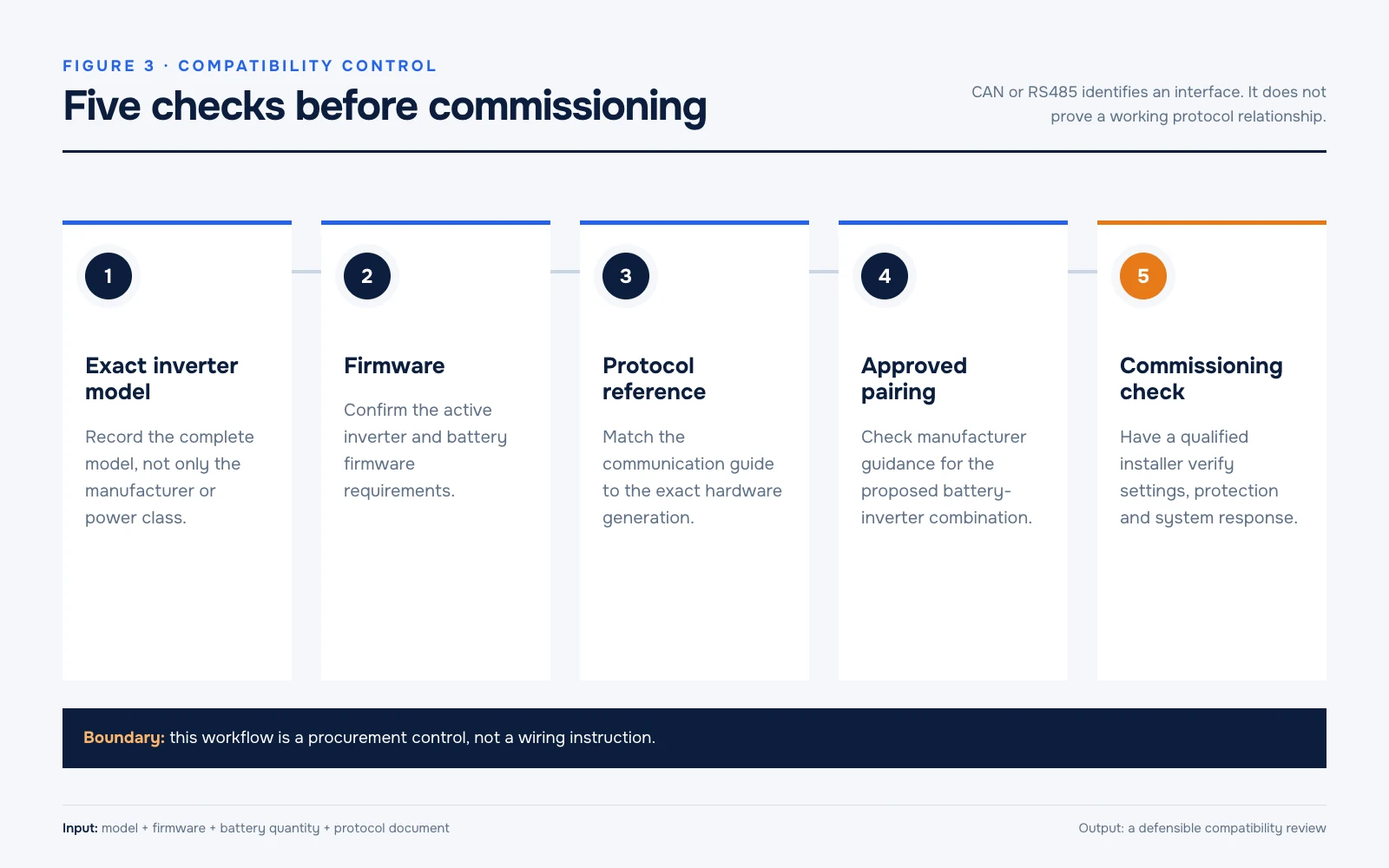
Check battery-inverter communication first
The battery and inverter form one controlled system. CAN or RS485 labels identify possible interfaces, but they do not prove a particular protocol map, firmware combination or approved pairing.
CAN and RS485 labels do not establish compatibility by themselves
Provide the inverter brand, exact model, firmware version, intended battery quantity and available protocol documentation. The BMS guide explains why control and protection logic matter. A qualified installer should verify the commissioned design, cabling, protection and local requirements.
Compare capacity and documents in the same brief
Capacity needs a load context. A 5 kWh, 10 kWh or larger battery is not a fixed number of backup hours because usable settings, inverter losses, load changes and temperature affect the outcome. Use the LiFePO4 buying guide to prepare a load-led capacity target, then request documents that correspond to the model offered.
A capacity number alone cannot establish backup hours or compliance
Request the current data sheet, applicable certificates or declarations, user documentation, warranty terms for the offered region, communication guidance and a dated availability statement. Do not treat a marketing badge or historic retailer listing as a substitute for the project document pack.
Keep the commercial comparison separate from the technical check
Price, payment terms, delivery timing and service arrangements can matter greatly, but they are not stable attributes of a brand. They change with the model, supplier, quantity, transport route and project scope. Discuss them only after the technical shortlist is valid.
A comparable quotation identifies the model and scope
Ask suppliers to state whether the quotation includes the battery only, a complete storage stack, required accessories, inverter integration, commissioning support or installation. This makes two offers comparable without publishing volatile pricing or implying that one commercial offer applies to every buyer.
Match the shortlist to common Ukraine project scenarios
The ten brands become more useful when the enquiry type is clear. Keep alternatives alive until communication, documentation and availability are checked.
Installer retrofit and distributor portfolio scenarios
An installer retrofit begins with the existing inverter. A distributor portfolio begins with which architectures, documents and support processes it can genuinely support. In both cases, retain at least two technically viable battery options until a protocol and availability review is complete.
Preserve at least two technically viable options until protocol review
This approach prevents a procurement decision from being made on branding alone. It also makes a stock change less disruptive because the project has a documented alternative rather than an improvised substitution.
Home-backup buyer scenario
Home-backup buyers should begin with critical loads, expected outage window, peak-starting loads and the physical installation location. The LiFePO4 battery hub covers chemistry context without duplicating it here.
Start with critical loads and expected outage window
Send a list of appliances that must remain powered, their approximate watts, expected simultaneous use, required backup duration and lowest site temperature. A professional design should translate that brief into an appropriate energy, power and protection plan.
Frequently asked questions
Is there one best home battery brand in Ukraine?
No. The strongest choice is the brand and model that matches the inverter, load profile, capacity target, document requirements and current support route for the actual project.
How do I verify whether a brand is available locally?
Use the local public pages in this guide as a starting signal, then ask for a dated confirmation of exact model, quantity, document pack and support path. Public availability is not a live-stock guarantee.
Can a battery with CAN or RS485 work with any inverter?
No. The communication interface is only one condition. Verify the inverter model, firmware, battery protocol and manufacturer guidance before commissioning.
What capacity should a home battery have?
Capacity should follow the critical-load list, simultaneous power demand, target backup duration, usable settings, inverter losses and site conditions. A nameplate kWh figure alone cannot establish backup time.
Which documents should I request before ordering?
Request the exact model data sheet, applicable certificates or declarations, protocol guidance, user documentation, regional warranty terms and a dated availability statement. Match every document to the model on the quotation.
Send a complete technical enquiry
The fastest useful response follows a complete brief, not a brand name alone. The Genixgreen partners page is available for installers and distributors that want to discuss an ongoing working relationship.
What to send Genixgreen or a shortlisted supplier
A useful first enquiry contains the electrical, operational and site information that turns a brand list into a real project comparison.
Inverter, loads, capacity target, location and document request form the minimum brief
- Exact inverter brand, model and firmware version.
- Critical-load list, expected simultaneous load and target backup duration.
- Preferred voltage class, installation location and lowest expected temperature.
- Required delivery timing and a request for current model-level availability.
- Request for the matching data sheet, protocol guidance, applicable documents and regional commercial terms.
This article is an information guide, not a completed electrical design or a substitute for a qualified installer. Reconfirm current model documents, protocol compatibility, availability and regional terms before quotation or commissioning.