
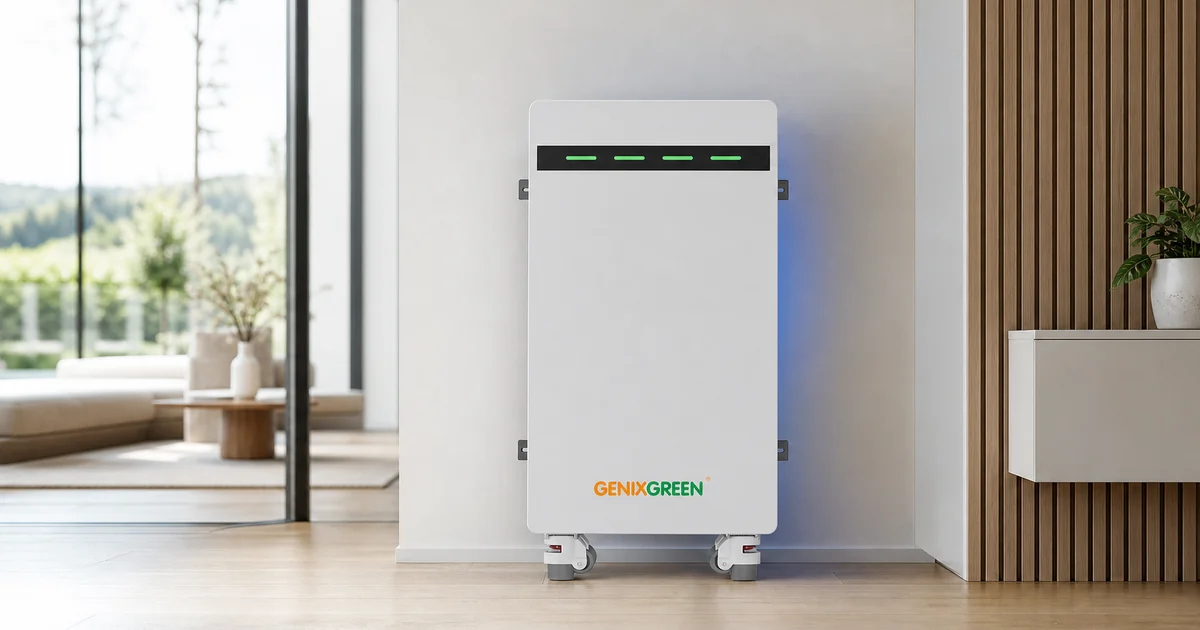
Ukraine’s grid now runs under conditions no other European country faces at this scale. Scheduled outages of several hours a day are a routine part of life for millions of households, which has turned a home battery from a green-energy nice-to-have into basic infrastructure. The market that has grown up around this need is full of impressive-looking numbers that fall apart under scrutiny: self-declared certifications, cycle-life claims tested in conditions that have nothing to do with a Ukrainian winter, and capacity figures quoted to flatter the price. This guide cuts through that. It explains the chemistry, the six numbers that actually decide whether a battery is good, how to size one for daily blackouts, and what to demand in writing before you buy. Genixgreen has manufactured LiFePO4 storage systems in its own factory since 2011 and supplies distributors in 100+ countries, and the aim here is a guide a dealer can hand straight to a customer.
The short answer
For a Ukrainian home facing daily multi-hour outages, lithium iron phosphate (LiFePO4) is the right battery chemistry: it is the safest lithium type for indoor use, it delivers 80 to 95 percent of its rated capacity as usable energy, and it lasts thousands of daily cycles, far longer than lead-acid. The six specifications that decide quality are usable capacity, depth of discharge, cycle life, C-rate, system voltage (48 V), and round-trip efficiency. Size the battery to cover your longest expected outage window with a margin, keep it certified (IEC 62619:2022, UN 38.3, CE) and indoors in winter, and have any hardwired part of the system installed by a qualified electrician.
What LiFePO4 is and why it became the standard
LiFePO4 stands for lithium iron phosphate, a lithium-ion chemistry that uses an iron-phosphate cathode instead of the cobalt-bearing compounds found in phone and electric-vehicle cells. That single change has large consequences for safety, lifespan, and cost. The iron-phosphate bond stays chemically stable under stress: when a cell is overheated, punctured, or overcharged, the cathode does not release oxygen, and oxygen release is the mechanism that turns a lithium-cell failure into a self-sustaining fire, as Battery University (BU-205) explains. Removing that mechanism is why LiFePO4 has become the default chemistry for home storage.
In practical terms, LiFePO4 reaches thermal-runaway onset at a much higher temperature than nickel-based lithium (NMC), lasts several thousand full cycles before capacity falls to 80 percent of its original value, delivers far more usable energy than lead-acid, needs no maintenance, and contains no cobalt. Reputable manufacturers have moved their residential ranges to this chemistry across the board. The market has already decided; this guide explains why, and what separates a good unit from a weak one.
Six specifications every buyer must understand
Buying a battery without these six numbers is like buying a car without knowing the engine power or the tank size. Sellers rely on that confusion, so these definitions remove the advantage.
Usable capacity (kWh)
Nameplate capacity is the total energy stored. Usable capacity is what you can actually draw before the battery management system stops discharge to protect the cells. The relationship is simple: usable kWh equals nameplate kWh times depth of discharge. A 10 kWh battery at 80 percent depth of discharge gives 8 kWh of usable energy. Most LiFePO4 systems run at 80 to 95 percent, so a “10 kWh” unit genuinely delivers roughly 8 to 9.5 kWh, against about 50 percent for lead-acid. Always confirm whether a seller is quoting nominal or usable capacity before you compare two products.
Depth of discharge (DoD)
Depth of discharge is the share of total capacity you can safely use in one cycle.
| Chemistry | Recommended DoD | Usable energy from a 100 Ah cell |
|---|---|---|
| LiFePO4 | 80 to 95% | 80 to 95 Ah |
| NMC lithium | 80 to 90% | 80 to 90 Ah |
| Lead-acid (AGM) | 50% | 50 Ah |
To get 10 kWh of usable energy from lead-acid, you have to buy roughly 20 kWh of nominal capacity, which erases its apparent price advantage before cycle life is even considered. For daily blackout cycling, running LiFePO4 at about 80 percent depth of discharge is the sweet spot: it preserves most of the usable energy while extending service life, as Battery University (BU-808) sets out.
Cycle life
One cycle is one full charge plus one full discharge. Cycle life is the number of cycles before capacity degrades to 80 percent of the original rating, the industry-standard end-of-life point.
| Chemistry | Cycles to 80% capacity | Daily-cycling lifespan |
|---|---|---|
| LiFePO4 | 3,000 to 10,000 | many years |
| NMC lithium | 1,500 to 3,000 | fewer years |
| Lead-acid (AGM) | 300 to 500 | under 2 years |
The upper end of that range applies to premium cells run at a shallow depth of discharge; a typical quality unit in daily use sits in the lower-to-middle of the range, which is still many years of service. Ukrainian households typically cycle once or twice a day: charge during available power, discharge during the outage. At that rate a quality LiFePO4 battery takes many years to reach its 80 percent threshold, and it keeps working past that point, simply storing less. One warning about spec sheets: cycle life is normally tested at 25 °C, a moderate charge rate, and a stated depth of discharge. If a data sheet shows cycle life measured at 50 percent DoD or a very low charge rate, the number looks better but does not reflect daily use. Ask for the test conditions in writing.
C-rate
C-rate describes how fast a battery charges or discharges relative to its capacity. A 0.5C rating on a 10 kWh battery means 5 kW of continuous output; 1C means 10 kW. Most homes are served comfortably by a 0.5C to 1C continuous rating: a 10 kWh battery at 0.5C runs a refrigerator, lighting, a router, a laptop, and a gas-boiler pump at the same time. Undersizing the C-rate causes voltage sag and BMS cutoffs when several heavy loads run together, so match the continuous rating to your realistic peak load.
System voltage: 48 V (51.2 V nominal)
Home storage has standardised on 48 V nominal, which for LiFePO4 is 51.2 V (16 cells in series at 3.2 V each). Higher voltage means lower current for the same power, so a 5 kW load draws around 104 A at 48 V instead of the very high current a 12 V system would need, which keeps cabling smaller, cheaper, and more efficient. Every major hybrid inverter brand is built for 48 V battery banks, and modules can be paralleled to add capacity, so a 5.12 kWh module pairs to 10.24 kWh, and so on.
Round-trip efficiency
Round-trip efficiency is the energy you get out divided by the energy you put in. LiFePO4 cells typically return 92 to 97 percent, against 70 to 85 percent for lead-acid, per NREL; a full system including inverter conversion losses usually lands a few points lower. Over thousands of cycles that gap is large: a LiFePO4 system needs noticeably less solar or grid input to deliver the same usable energy.
Three form factors: which one fits your situation
LiFePO4 batteries come in three physical configurations, and the right choice depends on space, target capacity, and whether you expect to expand.
Wall-mount
A wall-mount battery is a single enclosed unit (typically 5 to 15 kWh) bolted to a structural wall and connected to a separate hybrid inverter. It saves floor space, installs cleanly, and works with all major inverter brands, but its scalability is limited (a handful of units in parallel) and the wall must bear the weight. It is the most common residential choice, and a single 10 to 15 kWh unit covers most 4 to 8 hour apartment or small-house outages. It can sit in a utility room, hallway, or heated garage.
Rack-mount
Rack-mount systems use individual modules (typically 2.5 to 5 kWh each) in a 19-inch cabinet, with modules added as needs grow. They scale with no practical ceiling, simplify servicing through front-access swaps, and suit larger homes targeting 20 kWh or more, at the cost of floor space and a higher up-front infrastructure cost (cabinet, busbars, DC breakers). They suit a house with a basement or utility room, and buyers who want to start at 10 kWh and grow to 20 to 30 kWh without replacing the system.
All-in-one
An all-in-one integrates the battery, inverter, BMS, and monitoring into one unit, so installation is close to plug-and-play. It is the fastest to set up and avoids inverter-compatibility questions, which suits renters or buildings that restrict electrical work, but it ties you to one ecosystem and usually costs more per kWh. The trade-off is convenience now against flexibility and cost later.
| Your situation | Recommended format |
|---|---|
| Apartment, 4 to 8 hour outages, 5 to 15 kWh | Wall-mount |
| House, planning to expand, 10 to 30 kWh | Rack-mount |
| Renter, minimal installation, simplicity first | All-in-one |
| Large house or off-grid, 20+ kWh | Rack-mount cabinet |
A deeper walk-through of matching capacity and format to your home is in our companion guide on how to choose a LiFePO4 battery.
Safety and certifications: what to demand in writing
LiFePO4 is the safest mainstream lithium chemistry for indoor use because the iron-phosphate cathode stays stable under abuse and does not release oxygen, so a cell failure does not feed a self-sustaining fire the way nickel-based chemistries can, as Battery University (BU-205) notes. Even in an extreme fault, LiFePO4 produces less heat and does not propagate from cell to cell as readily. That makes it suitable for a utility room or hallway, but only when the product is genuinely certified.
| Certification | What it covers | Why it matters |
|---|---|---|
| IEC 62619:2022 | System-level safety: overcharge, over-discharge, short circuit, thermal abuse, BMS protection, thermal-runaway propagation | The primary international standard for stationary home storage. The 2022 edition added mandatory thermal-propagation testing, so ask for the 2022 edition and the test report (IEC) |
| UN 38.3 | Transport safety testing for lithium batteries | Mandatory for international shipping; its absence suggests uncertified cells (UNECE) |
| CE with Declaration of Conformity | EU electrical safety and EMC | Required for legal sale; a self-declared CE mark with no signed Declaration of Conformity is meaningless, so request the document |
| Independent third-party mark | Genuine independent verification | Evidence the testing was not manufacturer self-certification |
Treat these as red flags that stop a purchase: a CE mark with no Declaration of Conformity on request, IEC 62619 in the 2017 edition only, no UN 38.3 report, or cycle-life data quoted at an easy depth of discharge or charge rate.
The BMS is the safety brain
Every LiFePO4 battery includes a battery management system, the single most important safety component. A capable BMS blocks charging above and discharge below the safe per-cell voltage, hard-cuts charging below 0 °C to prevent lithium plating, disconnects on overcurrent and short circuit within milliseconds, balances the cells, tracks state of health, and talks to the inverter over CAN or RS485. That last point matters: closed-loop communication lets the inverter adjust charge and discharge to the battery’s real-time state, which both extends life and prevents faults. Confirm the BMS communication protocol matches your inverter before you order.
Cold-weather operation: the factor that matters most in Ukraine
Ukrainian winters regularly reach minus 10 to minus 25 °C in many regions, so cold behaviour is not a footnote here, it is often the deciding specification.
The hard rule is that a standard LiFePO4 battery must not be charged below 0 °C. Below freezing, lithium ions cannot insert properly into the anode and instead plate as metallic lithium on its surface, which permanently cuts capacity, accumulates with every cold-charge event, and in severe cases forms dendrites that can short a cell internally, as Battery University (BU-410) explains. Discharge is far less restricted: most LiFePO4 batteries discharge down to around minus 20 °C with reduced capacity, so the battery will keep your home running on a freezing night. Charging simply has to wait until the cells are above 0 °C.
| Ambient temperature | Discharge capacity | Charging |
|---|---|---|
| +25 °C | 100% (rated) | Normal |
| 0 °C | 90 to 95% | Minimum safe temperature |
| -10 °C | 55 to 65% | BMS blocks charging |
| -20 °C | 30 to 50% | BMS blocks charging |
The practical answer for most buyers is to install the battery in a heated indoor space: a utility room, hallway, or heated basement that stays above about 5 °C needs no extra cold-weather measures, and LiFePO4 is safe indoors because it produces no hydrogen or toxic fumes in normal operation. If the only location is an unheated garage or an outdoor enclosure that drops below 0 °C, then a battery with an integrated self-heating circuit (the BMS warms the cells before allowing charge) or a thermostat-controlled heating pad in an insulated enclosure becomes necessary. The rule for Ukraine is simple: heated space, standard battery is fine; unheated space, self-heating is mandatory.
How to size a battery for daily blackouts
The goal is to store enough energy to cover your longest expected outage window, with the grid or solar recharging during the power periods.
First, list only the loads that must run during an outage and estimate their daily energy. A typical apartment lands around 3 to 5 kWh per day; a house with gas heating, around 5 to 10 kWh.
| Appliance | Typical wattage | Notes |
|---|---|---|
| Refrigerator | 100 to 150 W | cycles on and off |
| LED lighting (several rooms) | around 50 W | |
| Router and modem | 20 to 30 W | runs continuously |
| Laptop and phone charging | around 100 W | |
| Gas-boiler circulation pump | 85 to 150 W | critical for heating |
Then size the battery with this method, which avoids trusting a box rating:
Nominal capacity (kWh) = (average load kW x outage hours) / DoD (0.80) / round-trip efficiency (0.95)For an apartment drawing 500 W average over an 8-hour outage, that is 4 kWh consumed, which works out to about 5.3 kWh nominal; adding a 20 to 30 percent margin lands near 7 kWh, so two 5.12 kWh modules give comfortable coverage. As a rule of thumb, an apartment with gas heating facing 8-hour outages needs roughly 10 kWh, and a house with gas heating needs 15 to 20 kWh as a practical minimum.
| Household | Critical load | Outage | Battery size |
|---|---|---|---|
| 1-bed apartment | 300 to 500 W | 4 to 6 h | 5 to 8 kWh |
| 2-bed apartment | 500 to 800 W | 6 to 8 h | 8 to 12 kWh |
| Small house (gas heat) | 600 W to 1 kW | 8 to 12 h | 10 to 15 kWh |
| Medium house (gas heat) | 1 to 1.5 kW | 8 to 12 h | 15 to 20 kWh |
| House with electric heating | 2 to 4 kW | 8 to 12 h | 25 to 40 kWh |
Pairing solar panels with the battery lets it recharge during daylight even when the grid is down, which extends backup through long or repeated outages. We cover whole-system sizing in the whole-home backup power guide, and the runtime of specific battery sizes in our companion guide on how many hours a 5, 10, or 16 kWh battery lasts.
LiFePO4 vs NMC vs lead-acid
| Parameter | LiFePO4 | NMC lithium | Lead-acid (AGM) |
|---|---|---|---|
| Cycle life | 3,000 to 10,000 | 1,500 to 3,000 | 300 to 500 |
| Usable DoD | 80 to 95% | 80 to 90% | 50% |
| Round-trip efficiency | 92 to 97% | 85 to 92% | 70 to 85% |
| Thermal-runaway onset | high | lower | gassing risk instead |
| Cold charge limit | 0 °C (lower with self-heating) | 0 °C | works below 0 °C, reduced capacity |
| Maintenance | none | none | watering, equalization |
| Service life, daily cycling | many years | fewer years | 1 to 2 years |
NMC’s one real advantage is energy density: it is lighter and more compact for the same capacity, which matters in an electric vehicle but is largely irrelevant for a battery bolted to a wall. For stationary home storage, LiFePO4 wins on cycle life, indoor safety, and cobalt-free supply, so new residential ranges from reputable makers use it. NMC is not recommended for home storage; if you are offered second-hand equipment, confirm the chemistry first. The full LiFePO4 vs ordinary lithium-ion comparison is in our LiFePO4 vs lithium-ion guide.
Lead-acid looks cheap up front, but the economics collapse under daily cycling. Its 50 percent usable depth means you must buy roughly double the nominal capacity; its 300 to 500 cycles mean replacement in well under two years of daily use; it is heavy, it needs maintenance, and flooded types vent hydrogen and cannot go in an enclosed space without ventilation. Across a decade of daily cycling, lead-acid costs substantially more per unit of delivered energy than LiFePO4, so its only honest use case is rare, short outages with no daily cycling. The full chemistry comparison is in our LiFePO4 vs lead-acid guide.
A practical buying checklist for Ukraine
Ask for documentation on every item; a reputable supplier provides it without hesitation.
- Certifications: IEC 62619:2022 (request the test report, not just a certificate image), UN 38.3, and CE with a signed Declaration of Conformity.
- BMS: closed-loop CAN or RS485 communication confirmed compatible with your inverter brand.
- Specifications: cycle-life test conditions stated (depth of discharge, charge rate, temperature); confirm whether quoted capacity is nominal or usable.
- Cold weather: if the battery will sit anywhere that drops below 0 °C, self-heating is required; ask for the discharge-capacity figures at minus 10 and minus 20 °C.
- Sizing: average critical load times outage hours, divided by 0.80 and 0.95, plus a 20 to 30 percent margin; confirm the inverter’s continuous output meets your peak simultaneous load.
- Warranty and service: confirm the warranty terms (both years and cycle count) and that service is available inside Ukraine, in writing.
- Installation: any hardwired connection to your home’s mains must be carried out by a qualified electrician; plug-in all-in-one units are user-safe.
Frequently asked questions
What is the best battery chemistry for a home in Ukraine?
LiFePO4 (lithium iron phosphate). It is the safest mainstream lithium chemistry for indoor use, delivers 80 to 95 percent of its rated capacity as usable energy, and lasts several thousand daily cycles, far more than lead-acid. For a home cycling every day through scheduled outages, it is the only chemistry whose lifespan and safety profile fit the job.
How many kWh of battery do I need?
Size it from your load, not a box rating: average critical load in kW times your longest outage in hours, divided by 0.80 for depth of discharge and 0.95 for efficiency, plus a 20 to 30 percent margin. As a rule of thumb, an apartment with gas heating facing 8-hour outages needs roughly 10 kWh, and a house with gas heating needs 15 to 20 kWh.
Is a LiFePO4 battery safe to install indoors?
Yes, when it is certified. LiFePO4 does not release oxygen under abuse and does not feed a self-sustaining fire the way nickel-based lithium can, and it produces no hydrogen or toxic fumes in normal operation. Buy a unit with IEC 62619, UN 38.3, and a real CE Declaration of Conformity, and keep it in a ventilated indoor space.
Can I keep the battery in an unheated garage in winter?
Only if it has self-heating. A standard LiFePO4 battery must not be charged below 0 °C, because charging below freezing causes permanent lithium plating. It will discharge in the cold, but charging has to happen above 0 °C. For an unheated location, choose a battery with an integrated heating circuit or use a thermostat-controlled heating pad in an insulated enclosure; otherwise keep the battery in a heated indoor room.
Why is lead-acid cheaper, and is it worth it?
Lead-acid has a lower purchase price but a much higher lifetime cost under daily cycling: you must buy about double the nominal capacity for the same usable energy, and it lasts only a few hundred cycles, so it needs replacing within about two years of daily use. For daily scheduled blackouts it is a false economy. It only makes sense for rare, short outages with no daily cycling.
Do I need an electrician to install a home battery?
Any hardwired system connected to your home’s mains wiring, which includes most wall-mount and rack-mount installations, must be installed by a qualified electrician, both for safety and to meet local electrical rules. Plug-in all-in-one units are user-safe and need no electrical work.
The right next step
Choosing a home battery comes down to matching a certified LiFePO4 unit to your load, your space, and your winter. To see the range, including the 5 kWh systems we hold in our Odesa-region warehouse for fast local supply, visit our product range. For the wider backup picture, start with our home backup power hub or the whole-home backup guide, and for chemistry detail see LiFePO4 vs lead-acid. If you are a dealer or installer serving customers in Ukraine, our partners page explains how to work with us.
