
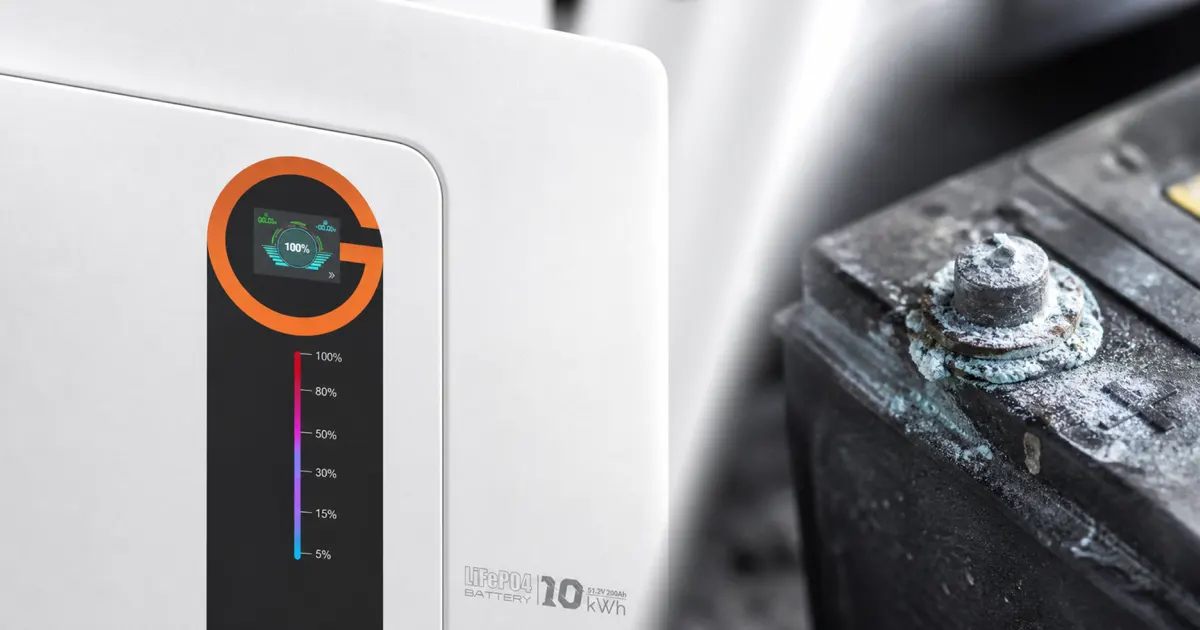
For home backup cycled through regular blackouts, choose LiFePO4. Gel or AGM makes more sense only when the upfront budget is fixed or the battery will be used rarely; an unheated installation needs separate manufacturer approval for charging limits, temperature compensation, and ventilation. LiFePO4 provides more usable capacity, far more cycles, and lower lifetime cost for frequent use. Genixgreen has built LiFePO4 energy-storage systems in its own factory since 2011. For the wider chemistry comparison, see our LiFePO4 vs. lead-acid guide.
The short answer
For a home backup battery cycled regularly, LiFePO4 is usually the better choice despite the higher purchase price. It provides deeper usable capacity and far more cycles, which lowers lifetime cost. Gel or AGM remains reasonable for a fixed upfront budget, rare standby use, or a properly ventilated unheated installation where the manufacturer approves the charger and reduced-temperature charging. For repeated blackout use, LiFePO4 is the default, provided its charger profile and low-temperature protection match the battery maker’s requirements.
What gel and AGM batteries actually are
Gel and AGM are not two different chemistries. Both are lead-acid batteries, and both belong to the same sub-family, valve-regulated lead-acid, or VRLA, which was designed to make the older flooded lead-acid battery maintenance-free so you never have to top up the water. The difference is only in how each one immobilizes its acid.
Gel, AGM and flooded: the lead-acid family
A gel battery turns its liquid electrolyte into a stiff paste with silica, while an AGM battery holds the same acid in an absorbent glass mat pressed between the plates. That small design choice changes their strengths. Gel batteries move heat outward better and generally last longer, and they hold up well at high ambient temperatures, but they need their charge and float voltages set correctly or they degrade quickly. AGM batteries deliver higher current more easily, perform better in the cold, and cost less, which is why the two are often marketed at slightly different buyers. Flooded lead-acid, the third member of the family, is cheaper still but needs ventilation and periodic watering, so it rarely suits an indoor home battery. For backup use, the honest way to read gel and AGM is as two refinements of the same century-old chemistry, competing against a fundamentally newer one.
Gel/AGM vs. LiFePO4, head to head
The two families diverge most on the numbers that decide long-term value: how many times you can cycle them, how deep you can drain them, and how they behave in a Ukrainian winter.
Cycle life and depth of discharge
A cycle is one meaningful discharge and recharge, and it is the single most useful number for a battery you plan to use daily. A deep-cycle lead-acid battery, gel or AGM, delivers roughly 200 to 300 cycles in normal use, and the figure collapses if you drain it hard: at full discharge it manages only about 150 to 200 cycles, at 50 percent depth of discharge it reaches 400 to 500, and only when kept to shallow 30 percent draws does it stretch past a thousand. That is why installers size lead-acid banks around a 50 percent depth of discharge: draining them deeper to use their full label capacity simply wears them out faster.
LiFePO4 changes the arithmetic. It is rated for far more cycles, commonly two thousand and higher, and it tolerates deep discharges that would destroy lead-acid: cycled to 80 percent depth it still delivers on the order of 900 cycles, and kept to gentler 40 to 60 percent draws it reaches several thousand. Put plainly, a LiFePO4 battery gives you more cycles and lets you use more of each charge, so a smaller nameplate LiFePO4 pack can deliver more usable energy over its life than a larger lead-acid one.
Cold-weather charging and ventilation
This is where a Ukrainian winter matters. Lithium chemistry has one hard rule: it must not be charged below 0 degrees Celsius, because charging a cold lithium cell plates metallic lithium onto the anode and permanently damages it. A quality LiFePO4 home battery handles this with a battery management system that blocks charging until the cells warm up, which is one reason these batteries are meant to live indoors in a heated space. Lead-acid is more forgiving of cold charging, accepting a charge at a reduced rate down to around minus 20 degrees Celsius, which is a genuine advantage in an unheated garage or shed.
Gel and AGM carry their own handling rule that their “sealed, maintenance-free” label hides. Even a valve-regulated battery can vent hydrogen and oxygen if it is overcharged, so manufacturer guidance is explicit that VRLA batteries must never be installed in a fully sealed container or enclosure. Neither family, in short, is a box you can bury in an airtight cupboard.
Efficiency, weight and maintenance
Two smaller differences add up over years. LiFePO4 wastes less energy on every charge and holds far more energy per kilogram, so a lithium pack is a fraction of the weight of a lead-acid bank of the same usable capacity, which matters for a wall mount or an apartment floor. And where a gel or AGM battery slowly loses capacity and eventually needs replacing, LiFePO4 is designed to be an appliance you can largely forget about for years. LiFePO4 is also the most thermally stable of the common lithium chemistries, with a thermal-runaway onset around 270 degrees Celsius, well above other lithium types, which is part of why it is the chemistry of choice for a battery living inside a home. Its safety for stationary use is covered by the international IEC 62619 standard.
Cost over the life of the battery, not just the sticker
A gel or AGM battery wins on the price tag and loses on the bill. The fair way to compare is cost per cycle: divide what you pay by the number of usable cycles you will actually get out of it, counting only the share of the battery you can safely use. A lead-acid battery you drain to 50 percent and replace after roughly 400 to 500 cycles is doing far less work per hryvnia than a LiFePO4 battery you drain to 80 percent across two thousand or more cycles. Over the years a backup battery is expected to serve, the cheaper-to-buy option often means buying two or three lead-acid banks against a single LiFePO4 one, plus the labor to swap each. This is a method, not a promise: run your own local prices through it, because the ranking, not the exact figure, is the point.
When a gel or AGM battery still makes sense
None of this makes lead-acid obsolete, and it is worth being honest about that. A gel or AGM battery is a reasonable choice in three situations. First, when the upfront budget is genuinely fixed and a smaller emergency reserve now beats a bigger system later. Second, when the battery must live in a properly ventilated unheated space, the manufacturer approves the charger and reduced-rate cold charging, and no suitable LiFePO4 option has approved heating or low-temperature charge protection. Lead-acid can accept a reduced-rate charge at lower temperatures than lithium, but that does not remove the manufacturer’s charging and ventilation requirements. Third, when the battery will sit as a rarely-used standby rather than cycle daily, because at a handful of cycles a year, lead-acid’s limited cycle life is never the binding constraint. Outside those cases, the long-run math favors LiFePO4.
Upgrading from gel/AGM to LiFePO4: what changes
If you already run a gel or AGM battery and are moving to LiFePO4, two things change, and getting them wrong is how people damage a new battery on day one.
Your charger and inverter settings
A lead-acid charger and a LiFePO4 battery do not speak the same language. Both charge to a voltage limit, but a lead-acid charger then holds the battery at a float voltage to offset self-discharge, and lithium chemistry cannot tolerate that continuous float: the charge current has to switch off once the battery is full. Leaving a lead-acid charge profile on a LiFePO4 pack shortens its life and, on some systems, compromises safety. An upgrade therefore requires a charger or inverter charge profile explicitly approved by the battery manufacturer. The BMS remains a second protection layer; it does not make an incompatible lead-acid charger safe.
Sizing: you need fewer usable kWh than you think
Because a LiFePO4 battery lets you use far more of its rated capacity than lead-acid does, a like-for-like swap by label capacity overbuys. A 200 Ah lead-acid battery you only drained to 50 percent gave you about 100 Ah of usable energy; a LiFePO4 battery you can drain to 80 or 90 percent reaches the same usable figure at a smaller nameplate size. Size the new battery on the usable energy you actually need, read from your real loads, not on matching the old label number. Our battery runtime guide walks through that calculation, and our guide to choosing a LiFePO4 battery covers the rest of the selection.
Frequently asked questions
Is a gel battery better than a LiFePO4 battery?
For most home backup use, no. A gel battery costs less to buy and can accept reduced-rate charging at lower temperatures, but it delivers far fewer cycles and should only be drained about halfway, so over its life it usually costs more per usable kilowatt-hour than LiFePO4. Gel keeps an edge only for a tight budget, rare standby use, or a properly ventilated unheated installation with manufacturer-approved charging settings.
What is the difference between gel and AGM batteries?
Both are valve-regulated lead-acid (VRLA) batteries. A gel battery sets its acid into a paste, lasts a little longer and handles heat well but needs precise charge voltages; an AGM battery holds its acid in a glass mat, delivers higher current, performs better in the cold and costs less. Against LiFePO4, they behave similarly enough that the gel-versus-AGM choice matters less than the lead-acid-versus-lithium one.
Can I replace my gel battery with a LiFePO4 battery using the same charger?
Not safely without checking. A lead-acid charger applies a continuous float charge that LiFePO4 cannot tolerate. You need a charger or inverter charge profile explicitly approved by the LiFePO4 battery manufacturer. The BMS is a protection layer, not a substitute for charger compatibility. Confirm the settings before connecting the battery.
Can a LiFePO4 battery be charged in the cold like a lead-acid one?
No, unless the battery manufacturer explicitly provides approved heating or low-temperature charging protection. A standard LiFePO4 battery must not be charged below 0 degrees Celsius. Lead-acid may accept reduced-rate charging at lower temperatures, but only with manufacturer-approved settings and the required ventilation.
Do gel and AGM batteries need ventilation if they are sealed?
Yes. Even sealed valve-regulated batteries can vent gas if overcharged, and manufacturer guidance is explicit that they must not be installed in a fully sealed enclosure. Give any battery, lead-acid or lithium, the airflow its maker specifies.
Which lasts longer, gel/AGM or LiFePO4?
LiFePO4, by a wide margin in cycle terms. A deep-cycle lead-acid battery delivers a few hundred cycles at a moderate depth of discharge, while LiFePO4 is rated for two thousand and higher and can be drained deeper, so it serves far more years of regular cycling before it needs replacing.
The right next step
Choosing a home backup battery is really a choice between paying less now and paying less over time. A gel or AGM battery has a place: a fixed budget, rare standby use, or a properly ventilated unheated installation with manufacturer-approved charging settings. For a battery you will cycle through blackout after blackout, LiFePO4 wins on cycles, usable capacity, weight, and cost spread across its life, as long as you match the charger to it and size it on usable energy rather than the old label. Read our LiFePO4 vs. lead-acid guide for the wider comparison, or browse our home battery range to see the LiFePO4 options. Dealers and installers in Ukraine can find how to work with us on our partners page.