
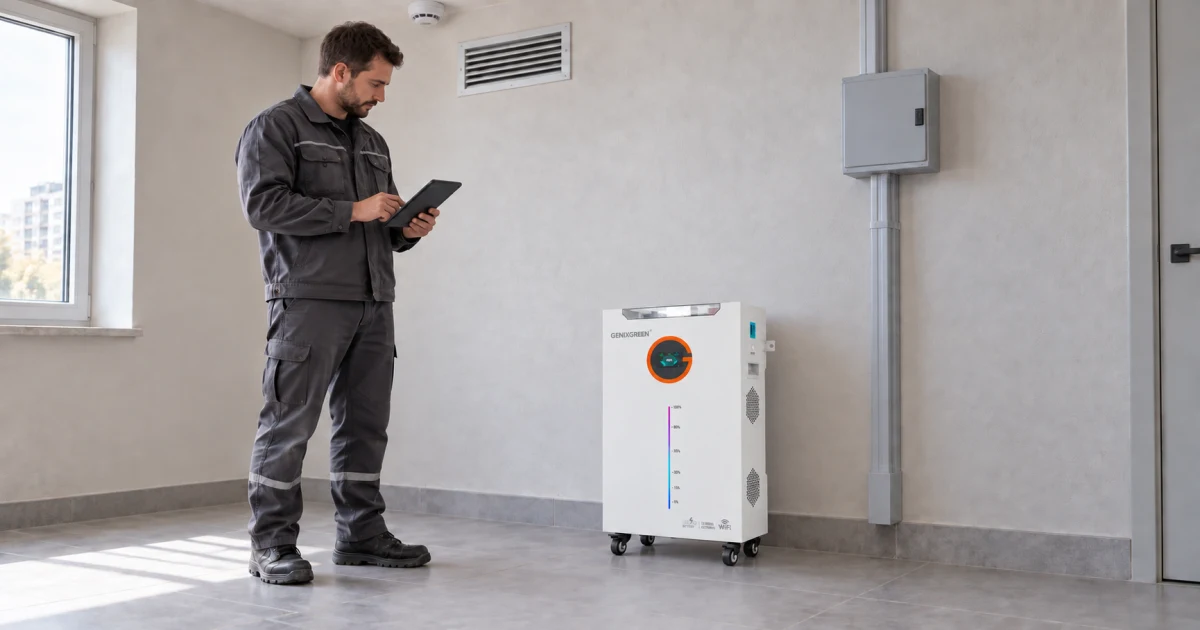
An apartment battery needs a permitted location, clear escape routes, manufacturer-specified ventilation and temperature control, and a professionally designed electrical connection. Check building and local fire requirements before buying. A suitable battery chemistry does not make every room or cupboard an acceptable installation location. Genixgreen has built LiFePO4 energy-storage systems in its own factory since 2011, and this guide sets out the safety principles for installing a home battery in an apartment: where it can go, why ventilation and temperature matter, and why the electrical connection itself is always a licensed electrician’s job. Local fire and electrical regulations always take precedence, so treat this as the reasoning behind the rules, not a substitute for your own qualified installer. For how a full system fits together, see our guide to how a home backup system works.
The short answer
Ask a qualified installer to assess the location, escape routes, clearances, ventilation, operating temperatures, and electrical protection before work starts. Follow the exact equipment instructions and local requirements; a general checklist is not approval for a particular apartment. Never backfeed a wall socket or make hardwired connections yourself.
Choosing equipment is a separate step from approving its location. Use our apartment and home backup kit checklist to prepare the purchase requirements, and the inverter connection safety guide to understand the professional handoff.
Where a battery can (and cannot) go in an apartment
Habitable rooms are not suitable installation spaces
The single most important safety decision is location, and codes are strict about it for good reason. Guidance from the Building America program, run by Pacific Northwest National Laboratory, states plainly that stationary storage battery systems “shall not be installed within the habitable space of a dwelling unit”. In practice that means a utility space, a service closet, or a similar non-living area rather than a bedroom or living room.
Keep exits and shared routes clear
Fire-safety standards go further on exactly where a unit may sit. The energy-storage standard NFPA 855 permits residential systems only in defined locations: attached or detached garages, utility and storage spaces, and on exterior walls or outdoors kept at least 3 feet (about 914 mm) away from doors and windows, with unfinished walls and ceilings around the unit given a fire-rated covering. Two principles carry across to a Ukrainian apartment even where the exact code differs: keep the battery clear of the rooms people sleep in, and never place it where it could block a hallway, a doorway, or your route out in a fire. Your building’s rules and your local fire regulations may add their own limits, and in a rented apartment the landlord’s permission is part of the process, not an afterthought.
Ventilation: never seal a battery in an airtight space
A battery needs to breathe, and sealing one into an airtight cupboard to hide it is a genuine hazard. Even sealed valve-regulated lead-acid batteries can vent gas if overcharged, which is why manufacturer guidance is explicit that they must not be installed in a fully sealed container or enclosure. Lithium batteries carry their own version of the concern: in a fault, a lithium cell can enter thermal runaway and release gases, and safety standards for energy storage are built around venting and containing that event rather than trapping it. Whatever the chemistry, follow the airflow and clearance the manufacturer specifies, keep the space unobstructed, and do not box the battery into a tight, unventilated void. If a cupboard is the only option, it has to be one the manufacturer approves for the purpose, with the clearances they require.
Temperature: keep it indoors and above freezing
Ukraine’s winters make temperature a safety issue, not just a performance one. A lithium battery must not be charged below 0 degrees Celsius: charging a cold cell plates metallic lithium onto the anode and causes permanent damage to performance and safety. A quality LiFePO4 battery protects itself with a battery management system that blocks charging until it is warm enough, but the practical conclusion is the same: the battery belongs indoors in a heated space, with a healthy operating range roughly between 0 and 45 degrees Celsius. This is why an unheated balcony, a common instinct in an apartment, is the wrong place for a lithium battery through winter. Keep it out of direct sun and away from heat sources at the other extreme, too, since sustained heat above about 30 degrees Celsius stresses the cells and shortens their life.
The electrical connection is an electrician’s job
This is the line that must not be crossed: the electrical connection of a home battery is work for a qualified, licensed electrician, never a do-it-yourself project. The United States Department of Energy puts the principle simply, advising homeowners to “identify quality products and utilize properly licensed installers to ensure the safety of these systems,” and warning that they “can fail due to poor installation techniques, poor maintenance, or misuse”. Energy storage is significant enough that dedicated electrical code exists for it: the 2017 edition of the US National Electrical Code added Article 706, governing installation, disconnection, shutdown, and safety labeling for energy storage systems.
A proper installation includes the right circuit protection, correctly rated cabling, a clearly labeled means of disconnection, and a connection that respects polarity and grounding. None of that is a weekend job, and getting it wrong risks fire, electric shock, and a system that fails when you finally need it. Whatever the local rules in Ukraine, engage a licensed electrician to design and make the connection, and keep their documentation. A reputable supplier will insist on professional installation, not talk you out of it.
Fire safety and thermal runaway
The failure mode people worry about with any lithium battery is thermal runaway, a self-sustaining overheating that can lead to fire, and it is worth understanding rather than fearing. It matters first because chemistry is not equal: LiFePO4, the chemistry in a quality home battery, is the most thermally stable of the common lithium types, with a thermal-runaway onset around 270 degrees Celsius, described by Battery University as “very safe even if fully charged,” against roughly 210 degrees for NMC and 150 degrees for cobalt-based cells. Choosing LiFePO4 is itself a safety decision.
Beyond chemistry, layered precautions keep the risk low. Fire-safety standards call for smoke detection where a battery is installed; NFPA 855 requires that a home with an energy storage system have interconnected smoke alarms throughout, with a heat detector where a smoke alarm cannot be fitted. Certified batteries are tested for how a fire would spread: UL 9540A is the recognized test method for evaluating thermal-runaway fire propagation in battery energy storage systems, assessing separation distances and, for indoor systems, the effectiveness of building fire protection. And homeowners should know one response fact from the fire service: even after a lithium-ion battery fire is put out, there is a risk of reignition, which is why keeping combustibles away from the unit and maintaining detection nearby matters. In an apartment, the practical takeaway is to give the battery clearance, keep flammable storage away from it, ensure working smoke and heat detection, and know your building’s escape routes.
What to look for in the battery itself
Much of the safety is decided before installation, in the battery you choose. Look for a unit certified to a recognized stationary-storage safety standard: LiFePO4 batteries for stationary use are covered internationally by IEC 62619, and in North America by UL 1973. Both test for the failure modes that matter indoors, overcharge, over-discharge, over-current, and thermal faults. A certified unit is telling you those protections have been tested rather than merely claimed.
Certification goes hand in hand with a proper battery management system, the electronics that keep every cell inside its safe limits and, crucially in a cold climate, block charging when the battery is too cold. A home battery without a real BMS is not safe to install indoors regardless of where you put it. Our BMS guide explains what that system does, and our guide to choosing a LiFePO4 battery covers the rest of what to check. A certified LiFePO4 battery with a built-in BMS, installed by a licensed electrician in the right place, is the combination that makes home storage genuinely low-risk.
A short do-not list
The safest installs avoid a handful of specific mistakes:
- Do not put the battery outdoors, on an open balcony, or anywhere exposed to rain and the elements; it belongs indoors within its rated temperature range.
- Do not seal it into an airtight cupboard or cover its vents; give it the airflow the manufacturer specifies.
- Do not install or charge it in an unheated space in winter, where a lithium battery cannot safely charge below freezing.
- Do not place it in a bedroom, a space opening into one, or anywhere that blocks a doorway or escape route.
- Do not store flammable materials next to it, and do keep working smoke or heat detection nearby.
- Do not make the electrical connection yourself; that is a licensed electrician’s work.
- Do not buy an uncertified battery or one without a proper BMS to save money.
Frequently asked questions
Can I install a home battery on my apartment balcony?
Not on an open, unheated balcony. A lithium battery must not be charged below 0 degrees Celsius, and it should not be exposed to rain or direct sun, so it belongs indoors within its rated temperature range. An enclosed, heated, and ventilated indoor location that meets your local fire rules is the right place; an open balcony is not.
Do I need an electrician to install a home battery?
Yes. The electrical connection of a home battery is work for a qualified, licensed electrician, not a do-it-yourself job. Proper circuit protection, cabling, disconnection, and grounding are required for safety, and dedicated electrical code exists for energy storage. Use a licensed installer and keep their documentation.
Where should a home battery not be installed in an apartment?
Not in a bedroom or a space that opens into one, not where it blocks a doorway or escape route, not sealed inside an airtight cupboard, and not outdoors or on an unheated balcony. Keep it in a ventilated, heated indoor utility space, clear of living and sleeping areas and of anything flammable.
Is a home battery a fire risk in an apartment?
The risk is low when the battery is certified, has a proper BMS, and is installed correctly. LiFePO4 is the most thermally stable common lithium chemistry, with a thermal-runaway onset around 270 degrees Celsius. Interconnected smoke and heat detection, clearance from combustibles, and professional installation keep the risk low; an uncertified battery or a bad install raises it.
Does the battery need ventilation if it is a sealed unit?
Yes. Even sealed batteries can vent gas in a fault or overcharge, and manufacturer guidance is explicit that they must not be installed in a fully sealed enclosure. Follow the airflow and clearances the manufacturer specifies and never box the unit into an unventilated space.
What certification should a home battery have?
Look for a stationary-storage safety certification such as IEC 62619 internationally or UL 1973 in North America. These test a battery for overcharge, over-discharge, over-current, and thermal faults, and a certified unit should also have a proper battery management system built in.
The right next step
A home battery earns its place in an apartment when it is treated as what it is: a store of energy that needs the right room, real ventilation, a warm indoor spot, a professional electrical connection, and a certification you can check. None of that is difficult, and most of it is decided before anything is mounted, by choosing a certified LiFePO4 battery with a proper BMS and insisting on a licensed electrician for the connection. Follow your local fire and electrical regulations, and lean on your installer’s expertise. Read our BMS guide and our guide to choosing a LiFePO4 battery before you buy, browse our home battery range, and if you are a dealer or installer in Ukraine, find how to work with us on our partners page.