
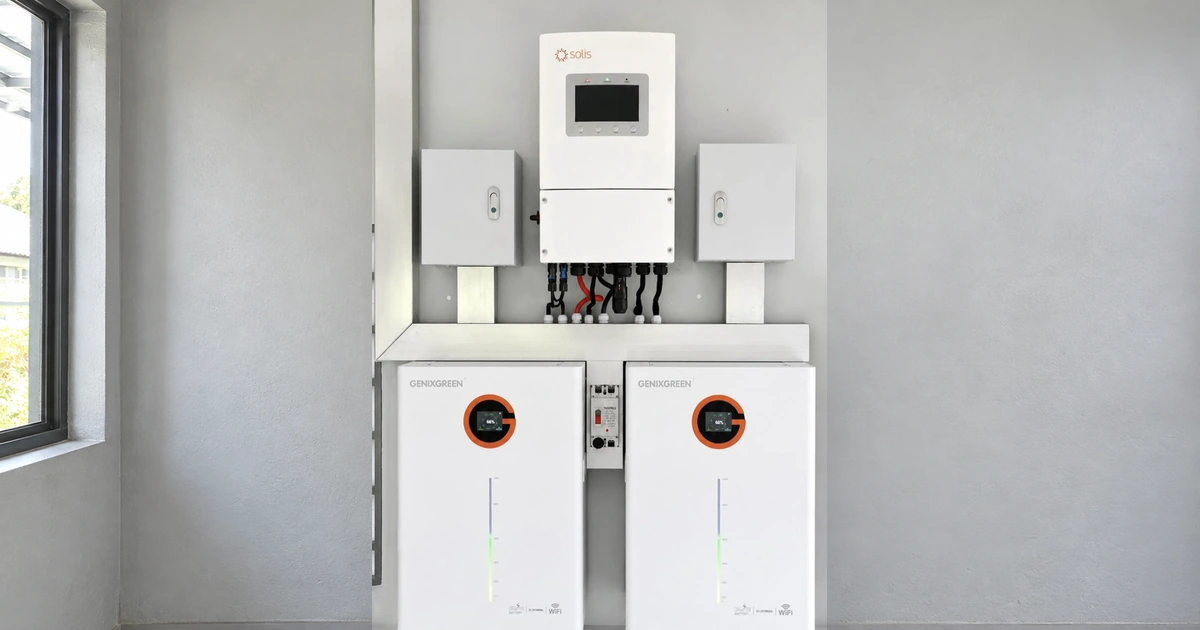
Before buying a hybrid inverter, confirm its continuous and startup output, backup capability, battery voltage range, BMS compatibility, and installation requirements. Then check the exact model’s documentation and current availability. A matching power label alone does not establish compatibility or guarantee that your appliances will stay on during a blackout. Genixgreen has built LiFePO4 energy-storage systems in its own factory since 2011, and this guide is the short version of what our team checks with buyers before they choose: how to size it, why the waveform matters, which type suits a home, and how the inverter has to match your battery. When you want the exact size decision, our 3 kW vs 5 kW inverter guide covers it, and you can see what we actually stock on our product page.
The short answer: what to check before you buy
Before you buy a hybrid inverter, start with your measured loads and their startup demand. Confirm the output waveform required by those appliances, the model’s backup function, the exact battery voltage range, and the supported BMS profile. A 48 V-class battery is one system type, not a universal requirement for every home. Ask the installer for a written compatibility and protection plan.
For system selection, use our home inverter guide. Before ordering a battery, check the battery-to-inverter matching guide.
Size it to your real loads, not a round number
The most common buying mistake is picking an inverter by a round number (“I will get a 5 kW”) instead of by what the home actually runs. An inverter has to be rated for the total continuous power of everything switched on at once, so the honest way to size one is to add up your real loads: lights, a fridge, a router, a television, a water pump, a gas boiler’s pump and controls. Our inverter sizing guide walks through that calculation step by step, and it is worth doing before you shop.
Continuous power vs. surge (startup) power
Here is the number most buyers miss. An inverter has two power ratings, and both matter. Continuous power is what it can supply indefinitely; surge power is the brief, much larger draw that motor-driven appliances pull the instant they start. A fridge compressor or a water pump can demand several times its running wattage for a fraction of a second at startup, which is a well-documented property of electric motors. An inverter sized only to the running watts will trip when the compressor kicks in. This is why a quality hybrid inverter is built with surge headroom above its continuous rating, and why you size to the surge, not just the average. One more subtlety worth knowing: appliance labels often show power in volt-amperes (VA), which is not the same as real watts once power factor is taken into account, so leave margin rather than sizing to the last watt.
Why surge margin matters
Surge margin keeps the system stable when a motor starts while other household loads are already running. Treat it as operating headroom, not unused capacity.
Pure sine wave: non-negotiable for a home
Not all inverters produce the same shape of power. A pure sine wave is the clean, smooth waveform the grid delivers, and it is what motors, compressors, and sensitive electronics are designed to run on. Cheaper “modified” or square-wave inverters approximate it, and that approximation can make motors run hot and noisy or upset electronics and controls. For a home that runs a fridge, a water pump, or a gas boiler, check whether the exact inverter offers the waveform those appliances require. Our gas boiler backup guide explains the separate boiler-use case. Confirm the waveform from the current model data sheet rather than assuming it from the product category.
Hybrid, off-grid or grid-tie: which type
Inverters come in types built for different jobs, and the label on the box matters. A grid-tie inverter feeds solar into the grid but gives you nothing in a blackout. An off-grid inverter runs a standalone battery system but ignores the grid. A hybrid inverter does both: it runs solar, charges and draws from a battery, and uses the grid, all from one unit, and it switches to battery backup when the grid fails. For a Ukrainian home whose main goal is riding through outages while making use of solar and cheaper tariff hours, the hybrid is almost always the right type. Our inverter types guide compares them in full. Whichever you buy, it must be certified to safely disconnect from the grid during an outage so it never back-feeds a dead line, a behavior defined by grid-interconnection standards and verified in recognized distributed-energy-resource testing.
Match the inverter to your 48 V battery
An inverter and a battery are a matched pair, not two separate purchases. A modern LiFePO4 home battery works at a nominal 48 V, so the inverter has to be a 48 V hybrid unit to pair with it. Buying an inverter without checking the battery voltage it supports is how people end up with two boxes that cannot talk to each other. Our home batteries run at 48 V (51.2 V nominal) and are designed to pair with single-phase hybrid inverters, so the two are sold to work together. Because the battery is LiFePO4, it also needs to live indoors in a heated space, since lithium chemistry must not be charged below freezing, which is worth planning for when you choose where the whole system goes.
What we stock, and how to buy
Our hybrid inverter range is deliberately focused: single-phase 230 V units from 5.5 to 8 kW, all matched to our 48 V LiFePO4 batteries. There is a 5.5 kW unit with a built-in MPPT solar charger, an 8 kW unit with dual MPPT for larger solar arrays, and an 8 kW unit with a generator input for homes that want a generator as a second backup layer. If you are weighing a smaller or larger size, our 3 kW inverter guide and 5 kW inverter guide walk through what each power class runs and which of these units fits. To see current specifications and get a quote, visit our product page; dealers and installers in Ukraine can find how to work with us on our partners page.
Frequently asked questions
Which inverter should I buy for my home?
Buy the smallest hybrid inverter that comfortably covers your continuous load plus surge headroom for motor startups, outputs a true pure sine wave, and matches your battery voltage (48 V for a modern LiFePO4 system). Size it to your actual appliances rather than a round number, and lean toward a little headroom rather than sizing to the last watt.
What size hybrid inverter do I need?
Add up the continuous watts of everything you would run at once, then allow extra for the surge a fridge or pump draws at startup. Our inverter sizing guide gives the full calculation. As a starting point, a smaller home running essentials needs less than one running a pump, air conditioning, or several large appliances together.
Do I need a pure sine wave inverter?
Check the appliance and inverter documentation. Motors, compressors, and sensitive electronics may require a pure sine-wave output, while modified or square-wave output can be unsuitable. Confirm the waveform from the current model data sheet rather than assuming it from the product category.
What is the difference between a hybrid and an off-grid inverter?
A hybrid inverter runs solar, battery and grid together and switches to battery backup when the grid fails, while an off-grid inverter runs a standalone battery system and ignores the grid. Most Ukrainian homes wanting blackout backup plus solar want the hybrid type.
Does the inverter have to match my battery?
Yes. A modern LiFePO4 home battery runs at a nominal 48 V, so you need a 48 V hybrid inverter to pair with it. Confirm the battery voltage before buying, or buy the inverter and battery as a matched set designed to work together.
Where can I buy a hybrid inverter in Ukraine?
You can see our current single-phase hybrid inverters, from 5.5 to 8 kW, on our product page and request a quote there. We supply from stock in Ukraine, and dealers and installers can find partnership terms on our partners page.
The right next step
Buying a hybrid inverter comes down to matching it to your loads, your waveform needs, and your battery, rather than chasing a wattage on a label. Size it to your real continuous and surge power, insist on a pure sine wave, choose the hybrid type for backup plus solar, and make sure it pairs with a 48 V battery. When you are ready to pick a size, read our 3 kW vs 5 kW guide or our 3 kW and 5 kW guides, see the units on our product page, and if you sell or install in Ukraine, find how to work with us on our partners page.