
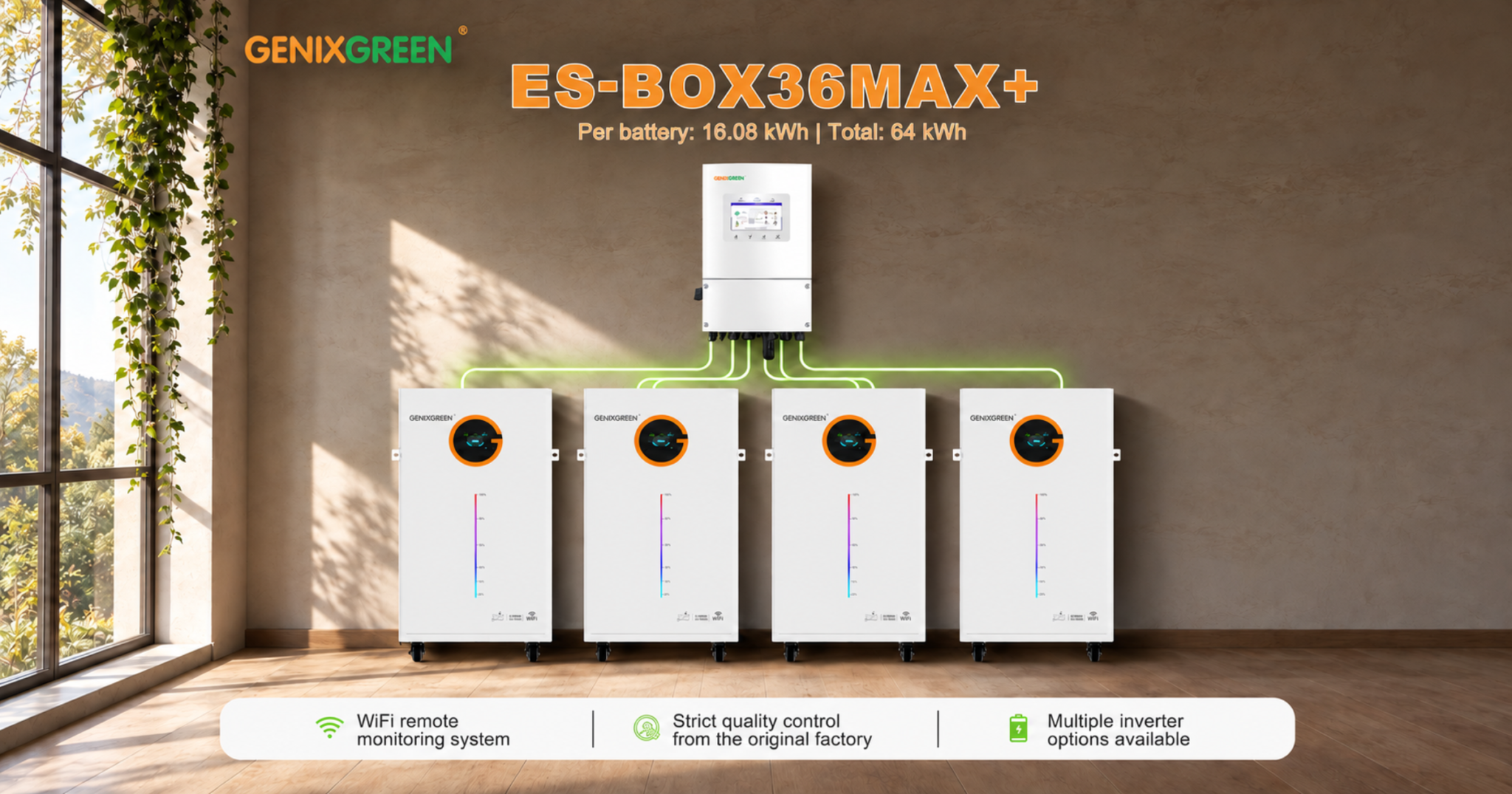
The ES-BOX36 Series gives home-backup projects four 51.2 V LFP options: 5.12, 10.24, 14.34 and 16.08 kWh. The right choice follows the critical-load profile, required backup window, inverter current limit, communication settings and installation conditions, not capacity alone. Genixgreen has operated since 2011, as stated on its About page, and this guide turns those checks into a clear shortlist. Start with the wider Genixgreen battery range if you are still comparing battery formats.
The short answer
Choose ES-BOX36 by answering three questions in order: how much energy critical loads require, whether the inverter can accept the battery current and communication protocol, and whether the installation site supports the battery’s weight and temperature range. The supplied B00 datasheet lists all four models at 51.2 V, with maximum charge and discharge current from 100 A to 200 A. It also specifies charging from 0 to 55°C. Source
Compare the four ES-BOX36 configurations
The product decision starts with nominal energy, but a site survey should also include current, dimensions and weight. The B00 datasheet lists LFP cells, USB, RS485 and CAN interfaces, and wall-mounted or floor-standing installation for the series.
Electrical and mechanical specifications
The four models step up in stored energy and mass. The bracket and wheel notes in the datasheet matter when measuring the final installation space.
Nominal energy, current, dimensions and weight
| Model | Nominal energy | Nominal capacity | Max. charge/discharge current | Dimensions | Net weight |
|---|---|---|---|---|---|
| ES-BOX36 | 5.12 kWh | 100 Ah | 100 A | 450 × 620 × 160 mm | 51 kg |
| ES-BOX36 PLUS | 10.24 kWh | 200 Ah | 150 A | 480 × 650 × 245 mm | 92 kg |
| ES-BOX36 MAX | 14.34 kWh | 280 Ah | 200 A | 460 × 880 × 245 mm | 122 kg |
| ES-BOX36 MAX+ | 16.08 kWh | 314 Ah | 200 A | 460 × 880 × 245 mm | 122 kg |
The ES-BOX36 and PLUS dimensions exclude wall brackets. The MAX and MAX+ dimensions exclude wheels. Use the listed figures as layout inputs, then have the installer verify clearances and access.
Build a shortlist from load and backup duration
Capacity changes the energy available to a project, while current and physical size also increase across the range. That makes the four configurations useful planning steps, but it does not justify assigning any model to a particular apartment or house without measured loads.
A four-model decision matrix keeps the choice evidence-bounded
| Model | What changes from the previous step | Decision value | Check before selecting |
|---|---|---|---|
| ES-BOX36, 5.12 kWh | Entry energy level, 100 Ah and 100 A | A starting point for a compact critical-load plan | Target duration and 100 A current limit |
| ES-BOX36 PLUS, 10.24 kWh | Doubled nominal energy, 200 Ah and 150 A | More stored energy with a larger enclosure | Mounting surface, inverter current and space |
| ES-BOX36 MAX, 14.34 kWh | Higher nominal energy, 280 Ah and 200 A | Adds energy and current headroom in the same 122 kg class | Access route, support and protective design |
| ES-BOX36 MAX+, 16.08 kWh | Highest listed nominal energy, 314 Ah and 200 A | Largest single-unit energy option in this datasheet | Actual critical-load profile, inverter fit and live inventory |
The matrix compares declared product attributes, not expected home autonomy. The installed inverter, the allowed usable-energy setting and the load pattern decide how much of each nameplate value becomes backup time.
Ukraine stock needs a current confirmation
The ES-BOX36 Series was confirmed as available from Ukraine stock on 21 August 2026. That confirmation applies to the series, not to every model or quantity.
Confirm model and quantity before ordering
Ask for the exact model name and available quantity before committing a project. A dated stock statement is useful for an initial enquiry, but current inventory must win over a historic article.
Use a runtime estimate without turning it into a promise
The appropriate formula starts from usable battery energy, not simply the number printed on the enclosure. It must also include inverter efficiency and the average critical load during the outage.
Estimated hours depend on usable energy, efficiency and average load
Estimated hours = usable battery energy (kWh) × inverter efficiency ÷ average critical load (kW)
Usable battery energy must be confirmed for the commissioned configuration. Inverter efficiency and average critical load also vary by project, so the result is an estimate, not a fixed runtime. Enter measured or reasonable design values in the battery sizing calculator, then validate the final system with the installer.
Use the display and monitoring options as operating inputs
The B00 datasheet lists an RGB LED and touchscreen display across the series. It lists a 3.2-inch LCD touchscreen for ES-BOX36 and ES-BOX36 PLUS, and a 4.3-inch LCD touchscreen for ES-BOX36 MAX and MAX+. Optional WiFi remote monitoring is also listed. Source
LCD size, RGB LED and optional WiFi do not establish a monitoring feature set
These entries confirm that the product datasheet lists local display hardware and an optional remote-monitoring item. They do not identify the WiFi module, app, portal, displayed values, alert rules or remote-control functions. Confirm the exact monitoring package and its availability with the offered configuration.
Check inverter fit before selecting a battery
Battery energy in kWh and battery current in amps solve different parts of the same design problem. Use the battery sizing calculator to estimate energy from actual loads, then have a qualified installer verify electrical limits and protection.
Energy and current answer different questions
The B00 datasheet gives 51.2 V nominal voltage and a maximum charge and discharge current for each model. Multiplying them gives a nominal DC-side reference, not an AC output promise or a complete system rating.
Nominal DC-side reference values are 5.12 to 10.24 kW
| Model | Nominal calculation | DC-side reference |
|---|---|---|
| ES-BOX36 | 51.2 V × 100 A | 5.12 kW |
| ES-BOX36 PLUS | 51.2 V × 150 A | 7.68 kW |
| ES-BOX36 MAX | 51.2 V × 200 A | 10.24 kW |
| ES-BOX36 MAX+ | 51.2 V × 200 A | 10.24 kW |
State of charge, operating voltage, BMS limits, cables, protective devices, temperature and inverter settings all affect the commissioned system. The figures above are engineering references derived from nominal voltage and maximum current, not guaranteed AC power. Source
Communication must match the exact inverter
The ES-BOX36 datasheet lists CAN and RS485. A connector alone does not establish compatibility, because inverter model, firmware and protocol mapping have to align.
CAN and RS485 require protocol and firmware confirmation
Send the exact inverter model, firmware version, intended battery quantity, critical-load list and installation location for a pre-check. If protocol documentation is available, include it. The BMS guide explains why this verification matters for safe charge and discharge control. Do not infer universal inverter compatibility from an interface label.
Plan the installation around the datasheet boundaries
The selected model must fit the physical space as well as the electrical plan. This is especially important for the two 122 kg models.
Weight and mounting require a site assessment
The B00 datasheet allows wall-mounted or floor-standing installation, but this does not replace structural, electrical or local-rule checks.
The MAX and MAX+ each list a net weight of 122 kg
Have a qualified installer assess the supporting surface, access route, fastening method, cabling and DC protection. Do not treat a wall-mount label as approval to use an unverified wall.
Charging has a 0°C specified lower limit
The datasheet specifies charging at 0 to 55°C and discharging at -20 to 55°C. It does not list an IP rating, an integrated heater or a below-freezing charging mode.
Do not infer outdoor, heated or below-freezing charging capability
Plan a dry, protected location that remains inside the stated charging range. If the site may fall below 0°C, request written guidance for the exact design before charging. Charging lithium batteries at low temperature can cause lithium plating and permanent cell damage. Source
Review standards and lifecycle claims with their conditions attached
The B00 datasheet lists IEC 62619, UL 1973 by Intertek, UN 38.3 and other marks or documents. These entries are valuable procurement prompts, but they do not independently verify the applicable certificate for a supplied unit.
Request documents for the offered configuration
IEC 62619 specifies safety requirements for industrial secondary lithium cells and batteries, including stationary applications. Source Ask for documents that match the offered model, their scope and their date before confirming a project.
Datasheet listings are not independently verified certificates
The safe procurement step is to verify the applicable paperwork rather than treating a datasheet line as a complete project-compliance conclusion.
Read cycle-life figures with temperature, C-rate and DoD
Cycle-life data means little when its conditions are removed. The B00 datasheet keeps those conditions visible, and this article does the same.
The stated results use 25°C and 90% DoD
For ES-BOX36 and ES-BOX36 PLUS, the datasheet lists more than 8,000 cycles at 25°C ±2°C, 0.5C, 90% DoD and 65% EOL. For ES-BOX36 MAX and MAX+, it lists more than 10,000 cycles at 25°C ±2°C, 0.35C, 90% DoD and 65% EOL. These are stated test conditions, not a fixed service-life or warranty promise. Source
For generic chemistry and lifecycle context, read LiFePO4 home batteries. For the whole sizing method, use how to choose a LiFePO4 battery.
Frequently asked questions
Is ES-BOX36 available from Ukraine stock?
Yes, the series was confirmed as available from Ukraine stock on 21 August 2026. Confirm the exact variant and quantity at the time of enquiry or order.
Can ES-BOX36 work with my inverter?
The datasheet lists CAN and RS485 interfaces, but compatibility requires the exact inverter model, firmware and protocol confirmation.
Can ES-BOX36 charge below freezing?
The supplied datasheet specifies charging from 0°C to 55°C. It does not document below-freezing charging or an integrated heater.
How many hours will a 10.24 or 16.08 kWh unit run?
Runtime depends on average and peak critical load, permitted usable energy, temperature and inverter losses. A nameplate capacity alone cannot support a fixed-hour promise.
The right next step
Send a complete brief through the Genixgreen contact page rather than a capacity-only request. That gives the technical team enough information to check current Ukraine-stock availability, physical fit and the communication questions that need answering before order.
Send a complete pre-enquiry checklist
The most useful first enquiry combines electrical, operational and site information. It also makes it clear which points are still assumptions.
Inverter, loads, site and stock request create a usable technical brief
- Exact inverter brand, model and firmware version.
- Battery-menu settings, plus CAN or RS485 information if available.
- Critical loads, their watts and the desired backup duration.
- Expected average and peak load, including any motor or heating-pump startup demand.
- Installation room, lowest expected temperature, access route and supporting surface.
- Preferred ES-BOX36 capacity and whether wall-mounted or floor-standing placement is planned.
- Request for the current Ukraine-stock model and quantity, applicable documents and monitoring option.
The article is an information guide, not a completed design or a substitute for qualified installation. Human technical and commercial review remains a deployment gate for this draft.
Sources
- ES-BOX36 Series B00 datasheet: model parameters, dimensions, temperature range, communications and stated cycle-test conditions. ES-BOX36 B00 (PDF)
- IEC 62619:2022 publication page: scope of the stationary lithium-battery safety standard. https://webstore.iec.ch/en/publication/64073
- Battery University BU-410: background on low-temperature charging risk. https://batteryuniversity.com/article/bu-410-charging-at-high-and-low-temperatures
- Genixenergy About page: Genixgreen’s Since 2011 company-history statement. https://genixenergy.com.ua/ua/about/