
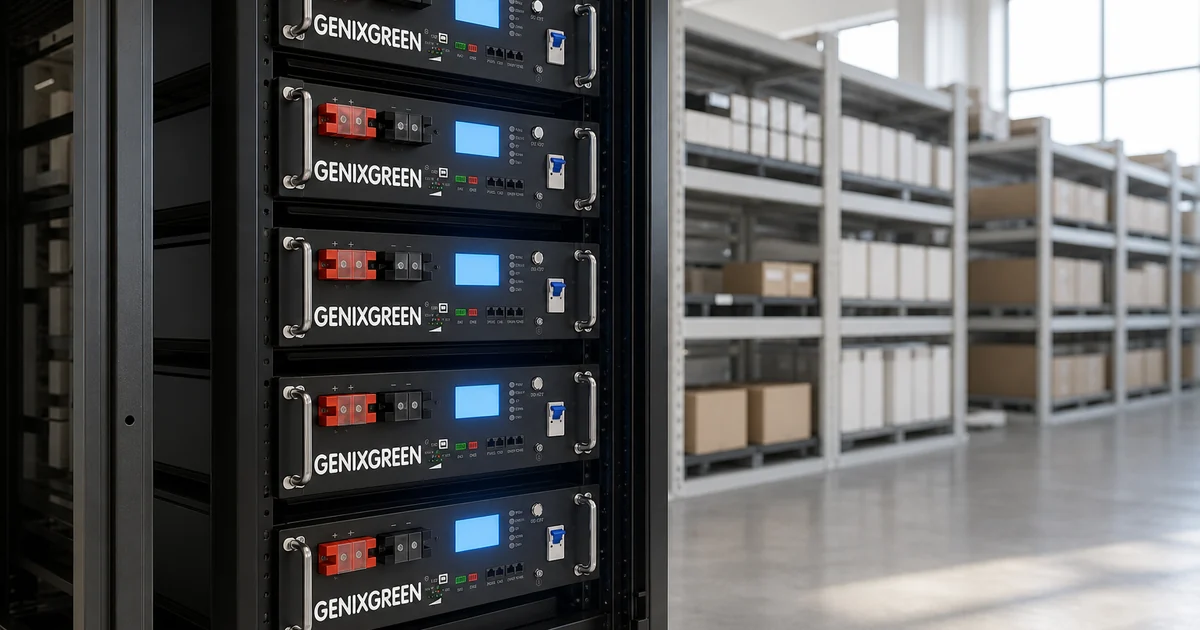
For a Ukrainian dealer, the battery supplier you sign with this year decides whether you can fill orders next winter. Demand is no longer seasonal: in 2024 the country lost roughly 9 GW of generating capacity, close to half its peak winter demand, and by November 2025 the grid operator was scheduling outages of 8 to 16 hours across most regions. That makes home battery storage a structural market, and resellers who lock in a dependable supply partner now will own their region for years.
This guide is written for dealers, installers, and wholesalers who resell batteries, not for end customers. It covers why the Ukrainian market is structural, the six things to check in any battery supplier, how the supply stack differs between local distributors, factory-direct manufacturers, and trading houses, which certifications and documents to demand, how pricing and payment terms usually work, and how to get stock into the country without surprises. Genixgreen is a manufacturer (not a trader) that has built LiFePO4 systems in its own 12,000 m² factory since 2011, with 300+ in-house staff and shipments to dealers in 100+ countries.
Ukraine’s battery market for resellers in 2026
For resellers, the opportunity is structural rather than a spike. Ukraine’s grid damage is permanent, not seasonal, so home and small-business demand for LiFePO4 storage recurs every quarter regardless of weather. With roughly 9 GW of capacity lost in 2024, about half of peak winter consumption, outages of 8–16 hours have become a planning constant, which keeps the resale pipeline full and turns “home battery wholesale Ukraine” into a year-round category, not a winter promotion.
Why demand is structural, not seasonal
Repeated strikes on generation and substations have left a permanent capacity gap, so the grid operator schedules outages year-round rather than only in cold snaps. In the summer of 2024, generation fell 2.3 GW below a peak demand of about 12 GW: proof that the shortfall is not a winter-only problem. For a reseller, that means repeat demand and replacement cycles, not a one-off rush.
What this means for a dealer’s product mix
A structural market rewards a focused range over a sprawling catalogue. Most household buyers ask for an essentials backup in the single-family range, while small businesses and farms want larger systems. The practical takeaway for a reseller: stock a small number of proven LiFePO4 systems that cover the common load cases, confirm inverter compatibility on each, and rely on a supplier who can restock fast, so your shelf depth, not your catalogue width, becomes the selling point.
The six things to check in a battery supplier
Evaluate every supplier on six points: manufacturing control, certification and documentation, inverter compatibility, in-country warranty service, lead time and stock reliability, and after-sales support. The hardware spec sheet is the easy part: these six decide whether a fault in January is a phone call or a stranded container. Score each supplier on all six before you commit, because a gap in any one of them lands on you, the reseller, in front of your own customer.
The checklist at a glance
Use this table as a scoring grid when you compare two or three suppliers side by side.
| # | What to check | Why it matters to a reseller |
|---|---|---|
| 1 | Manufacturing control (own factory vs reseller) | A real manufacturer controls cell grade, BMS, and consistency batch to batch |
| 2 | Certifications and documents | UN 38.3 · CE · IEC 62619 prove safety and legal import |
| 3 | Inverter compatibility | The battery must communicate with common inverters over CAN/RS485 |
| 4 | In-country warranty service | Claims handled inside Ukraine, not shipped back to China |
| 5 | Lead time and stock reliability | A quoted date and fast restock keep your sales pipeline alive |
| 6 | After-sales and technical support | Sizing help, manuals, and a person to call when a customer asks |
How to weight the six for your market
Not every point carries equal weight for every reseller. If you sell mostly to homeowners through installers, weight inverter compatibility and after-sales support highest, because those drive your support load. If you sell larger systems to businesses and farms, weight manufacturing control and certifications, because the buyers there demand documentation. Whatever your mix, treat in-country warranty service as a pass/fail gate: a supplier who cannot service a fault inside Ukraine pushes that cost onto you.
Manufacturing control: manufacturer vs reseller
The first question to ask any supplier is whether they actually make the battery. A manufacturer controls cell grade, BMS design, and assembly, so quality stays consistent from one batch to the next and they can answer engineering questions directly. A reseller who buys from several factories cannot guarantee that the unit you receive next quarter matches the one you tested this quarter. As a dealer reselling under your own reputation, batch-to-batch consistency is what protects you from silent quality drift.
Local distributor vs factory-direct manufacturer vs trading house
Three kinds of supplier serve the Ukrainian market, and each suits a different reseller. Local distributors hold stock inside the country and deliver fast but mark up the price; factory-direct manufacturers give you the source, consistency, and engineering access but ship on a production lead time; trading houses aggregate brands and offer choice but add a layer between you and the people who build the product. There is no single best answer: match the channel to your volume and how fast you need stock.
The supply stack compared
This is the supply stack a “LiFePO4 battery wholesale Ukraine” buyer chooses from. The categories are generic: the point is the trade-offs, not any one company.
| Supplier type | Strength | Trade-off | Fits a reseller who… |
|---|---|---|---|
| Local distributor | Stock in-country, fast delivery | Added margin layer, limited range | Needs units this week, low volume |
| Factory-direct manufacturer | Source quality, consistency, engineering access | Ships on a production lead time | Wants stable supply and to build a brand |
| Trading house | Many brands in one order | Extra layer between you and the maker | Wants variety over depth |
Where Genixgreen sits in the stack
Genixgreen is a factory-direct manufacturer, not a trading house: we design and build LiFePO4 systems in our own factory rather than reselling other people’s. For a Ukrainian dealer that means consistent quality batch to batch, direct access to our engineers for sizing and compatibility questions, and a supply relationship you can build a local brand on. The aim is efficiency for the reseller: local stock and fast restock so you sell from a shelf, not from a 45-day production queue.
A note on what “factory-direct” should and should not mean
Factory-direct is about source quality and consistency, not a promise to bypass every partner in your market. A good manufacturer supports the local distribution that resellers and installers rely on, and adds value through faster restock and engineering access rather than by cutting people out. When a supplier pitches “factory-direct” purely as a way to remove the middleman, read it as a price story; when they pitch it as consistency plus local stock plus support, read it as a supply story. The second is what keeps a reseller stocked.
Certifications and documentation to require
Require three certifications on every LiFePO4 system before you place an order: UN 38.3 for transport safety, CE for EU-market conformity, and IEC 62619 for industrial lithium battery safety. These are the baseline a serious product clears, and missing any one of them is a reason to walk away. As the reseller of record you carry the import and liability exposure, so ask for the full certificate pack, not a marketing claim, before money changes hands.
What each document proves
Match the certificate to what it actually demonstrates, and check the document names the product you are buying.
| Standard | What it proves | Reseller risk if missing |
|---|---|---|
| UN 38.3 | The battery passed the tests required to ship lithium cells safely | Goods should not legally ship; customs and carrier risk |
| CE marking | The product meets EU health, safety, and environmental requirements for sale | Cannot lawfully sell into EU-aligned markets |
| IEC 62619 | The cells meet international safety requirements for industrial lithium batteries | No third-party proof the cells are safe under stress |
Documents to collect for your own file
Beyond the three certificates, ask the supplier for the test reports behind them, the datasheet for each system, the BMS protection list (over-charge, over-discharge, over-temperature, short-circuit), and the warranty terms in writing. Keep this pack on file for every batch you import. If a customer or a regulator ever questions a unit, a complete document file is what protects you as the reseller, and a supplier who hesitates to provide it is telling you something.
Pricing, minimum order, and payment terms
Expect pricing, minimum order, and payment terms to be negotiable bands, not fixed numbers, and never accept a quote without the document pack behind it. A real manufacturer will give you a quote against your spec and volume rather than a public price list, because B2B pricing moves with order size, configuration, and logistics. The honest answer to “what does it cost” is contact for a quote; the honest answer to “what’s the minimum” is a starting order that fits your market.
How B2B pricing usually works
LiFePO4 wholesale pricing is quoted per project, not from a shelf tag. Price moves with volume, system size, inverter pairing, shipping method, and current cell-market conditions, so any figure you see online is a rough public range rather than your price. The practical move for a reseller is to send your target spec and expected volume and ask for a written quote, then compare quotes on total landed cost and the six-point checklist, not on headline price alone.
Minimum order and growing into volume
Treat the first order as a market test, not a warehouse fill. A sensible starting order is one that fits your market: enough to prove demand and learn your customers’ load cases without tying up cash in stock you cannot move. A good manufacturer will start you at a workable first order and scale terms as your volume grows, so you build depth in the systems that actually sell rather than committing to a large mixed batch up front.
Payment terms and protecting your cash
Payment terms are a risk conversation, not just a price one. Common B2B practice is a deposit with the balance against shipping documents or delivery, and the terms a supplier offers tell you how confident they are in their own product. Be cautious of any supplier who demands full payment up front before you have verified certifications and references: staged payment protects your cash and keeps the supplier accountable through to delivery. Agree the terms in writing before you commit.
Getting stock into Ukraine: warehouse, lead time, logistics
Plan your supply on lead time and restock speed, because in this market the dealer with stock wins. A direct factory order from China typically runs around 45 days including production and shipping, while stock held inside the region can deliver and replenish in days. That gap is the difference between selling now and losing the customer, so the warehouse model behind your supplier is not a detail, it is the core of whether you can keep your shelf full through a demand spike.
Lead time and the cost of waiting
A 45-day lead time is manageable when you plan ahead and a problem when demand jumps. If a cold snap or a new outage schedule triggers a rush, a supplier shipping only from China leaves you 45 days behind your customers, while a supplier holding regional stock restocks you in days. The reseller takeaway: judge a supplier as much on restock speed as on first-order lead time, because repeat availability is what builds your local reputation.
The Odesa stock timing gate: an honest answer
Here is the honest position, because a reseller deserves one. Genixgreen is opening its own Odesa warehouse in 2026 to hold stock inside Ukraine; until that stock lands we ship factory-direct with a clear lead time quoted up front, so you always know when an order will arrive. We will not claim local stock is already sitting in Odesa when it is not. The point of the warehouse is efficiency for our partners: local availability and fast restock against the roughly 45-day factory order, and we will say so plainly the day the stock lands.
Logistics and import practicalities
Lithium batteries are classed as dangerous goods, so logistics is part of the supply decision, not an afterthought. Confirm that the supplier ships with valid UN 38.3 documentation, understands hazardous-goods handling, and can support the paperwork your customs broker needs. A supplier who treats import documentation as your problem alone will cost you time at the border; one who supports it as part of the supply is the partner you want for repeat orders.
Red flags to walk away from
Some warning signs are worth ending a conversation over. As the reseller, every one of these eventually lands in front of your own customer, so screen for them before the first order rather than after the first complaint.
Product and documentation red flags
- Grade-B cells sold as Grade-A. Quality drops invisibly and shortens lifespan; insist on consistent cell sourcing and batch records.
- Missing or mismatched UN 38.3 documentation. The goods should not have shipped, and the names on the paperwork must match the product.
- No-name BMS with no protection list. A battery without documented over-charge, over-discharge, over-temperature, and short-circuit protection is a safety and liability risk.
- No CE or IEC 62619 evidence. Without third-party proof, you are taking the supplier’s word on safety.
Commercial and service red flags
- No warranty presence inside Ukraine. A supplier who sends faults back to China leaves you carrying the customer.
- Full payment demanded up front, before verification. Staged payment protects your cash; refusal to stage is a signal.
- Guaranteed runtime hours in the sales pitch. Real autonomy depends on the loads a customer actually runs, so any vendor promising exact backup hours without asking about loads is selling, not advising, and that overpromise becomes your returned unit.
- No engineer to talk to. If no one can answer a sizing or compatibility question, you will be the one explaining failures to your customers.
FAQ: choosing a LiFePO4 supplier for Ukraine
What is the minimum order for home battery wholesale in Ukraine?
There is no universal number: a sensible first order is one that fits your market, enough to prove demand and learn your customers’ load cases without tying up cash. A good manufacturer starts you at a workable order and scales terms as your volume grows, so contact the supplier with your target spec and expected volume for a quote rather than expecting a fixed minimum online.
How do I verify a Chinese battery manufacturer before becoming a dealer?
Check the six points: confirm they own a factory rather than reselling, ask for the full UN 38.3, CE, and IEC 62619 document pack, verify inverter compatibility, confirm in-country warranty service, get a written lead time, and test after-sales response with real questions. Place a market-test first order before committing to volume, and keep every certificate on file.
What certifications must a LiFePO4 battery have to import into Ukraine?
Require UN 38.3 for transport safety, CE for EU-market conformity, and IEC 62619 for industrial lithium battery safety, and make sure the documents name the exact product you are buying. As the reseller of record you carry the import and liability exposure, so collect the test reports and datasheets behind the certificates, not just a marketing claim.
How long does delivery take, and can I restock quickly?
A direct factory order from China typically runs around 45 days including production and shipping, while stock held inside the region can deliver and replenish in days. Judge a supplier on restock speed as much as first-order lead time. Genixgreen is opening its own Odesa warehouse in 2026; until that stock lands we ship factory-direct with a clear lead time quoted up front.
What payment terms are normal for battery wholesale?
Common B2B practice is a deposit with the balance against shipping documents or delivery, agreed in writing. Be cautious of any supplier demanding full payment up front before you have verified certifications and references: staged payment protects your cash and keeps the supplier accountable through to delivery. Warranty terms are confirmed per product and order, with larger volumes agreed separately.
Become a Genixgreen partner in Ukraine
Genixgreen designs and builds LiFePO4 battery systems in its own factory and supplies dealers, installers, and wholesalers across Ukraine, as a manufacturer, not a trading house. If you resell batteries and want a supply partner with consistent quality, full certification, engineering support, and a clear restock plan, become a partner and we will help you stock the right mix for your market. To see the range, explore our LiFePO4 energy storage products; for the homeowner-facing background your customers ask about, read our backup power systems guide for Ukraine or browse the FAQ page.