
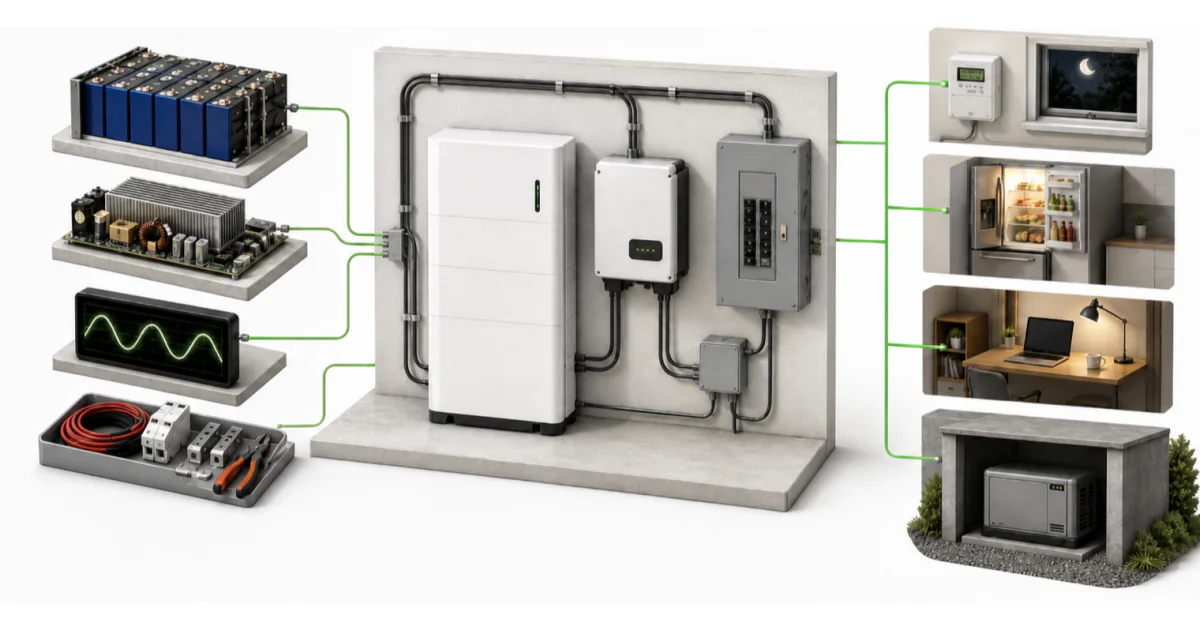
There is no single price for a home backup system, and anyone who quotes one without asking questions is guessing. The cost depends almost entirely on two numbers you choose: how much energy you want to store, and how much power you need to run at once. Payback in Ukraine can come from two places: shifting some consumption into cheaper night-rate hours when the home has a time-of-use meter, and preventing losses such as spoiled food, a ruined work day, or generator fuel. Genixgreen has built LiFePO4 energy-storage systems in its own factory since 2011, and this guide explains what actually drives the cost, why the cheapest system is often the most expensive over time, and how to estimate your own payback with your own numbers. For the sizing side, start with our battery runtime guide.
The short answer
A home backup system’s cost is set mostly by the size of the battery (measured in kilowatt-hours of storage) and the power rating of the inverter (measured in kilowatts), with the pure-sine-wave quality of that inverter and the installation labor adding to it. Because those are choices, the honest answer to “how much does it cost” is a range, and the way to narrow it is to size the system to your real needs rather than to a round number. Payback combines any verified saving from charging at the night rate with losses avoided during outages: food that does not spoil, income you do not lose when you cannot work, and generator fuel you do not buy. Spread across the years a good LiFePO4 system lasts, those benefits add up to a return, which is why the durable, longer-life option usually pays back better than the cheap one that has to be replaced.
What actually drives the cost
Four things move the price of a home backup system, and knowing which is the biggest lever helps you spend where it matters.
Battery capacity, inverter power, and installation
The largest single driver is battery capacity. How many kilowatt-hours you store determines how long you can run through a blackout, and storage is the most expensive part of the system, so doubling your desired runtime moves the total cost far more than any other choice. The second driver is inverter power: the inverter has to be rated for the peak wattage of everything you want to run at the same time, and a system that must start a pump or a fridge compressor needs more headroom than one running only lights and a router. The third is power quality. A backup device that will run sensitive electronics, a gas boiler, a modern fridge, needs to output a genuine pure sine wave, which our gas boiler backup guide explains in detail, and that is a real cost floor you should not undercut. The fourth is installation: mounting, cabling, and the electrical connection, which for anything hardwired to your mains is a licensed electrician’s job, not a place to save money.
Compare function before brand
Notice what is not on that list: brand shininess. Two systems with the same usable kilowatt-hours, the same pure-sine inverter rating, and the same safety certification are doing the same job, whatever the label.
Upfront price vs. cost over the life of the system
The cheapest system to buy is often the most expensive to own, and batteries are where that gap opens widest. A lead-acid battery costs less upfront but delivers only a few hundred cycles, roughly 200 to 300 for a deep-cycle unit, and should only be drained about halfway to reach even that. A LiFePO4 battery costs more to buy but is rated for thousands of cycles and can be drained deeper, delivering on the order of 3,000 cycles at a moderate 40 percent depth of discharge.
The fair way to compare is cost per usable cycle: take the purchase price and divide it by the number of times you will actually cycle the battery across its life, counting only the share you can safely use. On that measure a longer-life LiFePO4 battery usually wins, because the cheaper lead-acid battery has to be bought two or three times, with the labor to swap each, over the same span. Run this with your own local prices; the ranking, not the exact figure, is the point, and it is covered further in our gel and AGM vs. LiFePO4 guide.
What “payback” means for home backup
Ukraine does have a time-of-use spread for households with the matching meter. The regulator states that a two-zone meter applies a 0.5 coefficient from 23:00 to 07:00 and the full fixed price at other times; a three-zone meter applies 0.4 at night and 1.5 during defined peak periods. A battery can therefore create tariff savings by charging during the cheaper window and serving loads later, but only if the household has the right meter and the saving exceeds round-trip losses and battery wear. Resilience is the second source of return: the value of losses avoided when the grid fails. A 2026 analysis by Oak Ridge National Laboratory found that major power outages cost United States electricity customers an average of about 67 billion dollars a year, and it models the household share as customers’ willingness to pay to avoid an outage, measuring “tangible costs such as relocation, buying extra supplies or being unable to work from home”. The exact figures are American and will differ in Ukraine, but the method transfers directly: put a number on what an outage costs your household, then add any verified tariff-shifting savings.
Avoided losses: spoiled food, lost income, generator fuel
Three avoided losses are concrete enough to estimate. The first is food. A refrigerator keeps food safe for only about four hours without power, after which perishable items like meat, poultry, fish, eggs, and leftovers must be discarded. Multiply the value of a full fridge and freezer by how many long outages you have in a year, and you have a real annual figure. The second is income: if anyone in the home works remotely, every blackout hour that stops that work has a cost, which is exactly the “unable to work from home” loss the Oak Ridge model counts. The third is fuel. If your current backup is a fuel generator, its running cost is real and ongoing: fuel consumption multiplied by the local fuel price multiplied by the hours you run it, using the consumption figure from the generator’s own spec sheet. A battery that displaces those generator hours converts an ongoing fuel bill into a one-time cost.
A simple way to estimate your own payback
You can size the payback yourself with numbers only you have. The method is straightforward:
Annual avoided losses = (food loss per long outage x long outages per year)
                        + (lost income per outage hour x outage hours per year)
                        + (generator fuel cost avoided per year)

Annual tariff savings = (energy delivered from battery per year x day rate)
                        - (charging energy purchased per year x night rate)

Rough payback (years) = system cost
                        / (annual avoided losses + annual tariff savings)
Every input is local. Use your own fridge and freezer value, your own outage frequency, your own income-per-hour if you work from home, and your own fuel prices. The system cost belongs in the numerator once, spread against the losses it prevents every year it operates, which is why a durable LiFePO4 system with a long service life tends to reach payback and keep delivering value long after. One caution worth pricing in: a LiFePO4 battery has to live indoors in a heated space, because it must not be charged below 0 degrees Celsius, so an install that keeps it warm is part of protecting the investment. To run these numbers against a real system size, use our backup power calculator.
Frequently asked questions
How much does a home backup power system cost in Ukraine?
There is no single price, because the cost is driven by how much energy you store (kilowatt-hours) and how much power you need at once (kilowatts), plus the pure-sine-wave inverter quality and installation. The way to get a real figure is to size the system to your actual loads and runtime, then price that specific configuration, rather than starting from a round number.
Does a home battery pay for itself?
It can, through a combination of tariff shifting and avoided outage losses. With a two-zone meter, Ukraine’s night coefficient is 0.5 from 23:00 to 07:00, so charging at night and using that energy later can save money after efficiency losses. Add that to food, work, and generator-fuel losses avoided each year, then compare the total with the installed system cost.
Is LiFePO4 worth the higher price over lead-acid?
Over the life of the system, usually yes. Lead-acid is cheaper to buy but delivers only a few hundred cycles and has to be replaced repeatedly; LiFePO4 delivers thousands of cycles, so its cost per usable cycle is typically lower even though it costs more upfront.
What is the biggest cost in a backup system?
The battery. Storage capacity, measured in kilowatt-hours, is the most expensive component, so your desired runtime moves the total cost more than any other single choice. The inverter’s power rating and pure-sine-wave quality come next.
How do I calculate the payback on my own system?
Add up the losses a backup system prevents each year, food spoilage, lost remote-work income, and generator fuel avoided, using your own local numbers, then divide the system’s cost by that annual figure for a rough payback in years. Our backup power calculator helps you size the system those numbers apply to.
Can I lower the cost by choosing a cheaper battery?
You can lower the upfront price, but often not the total cost of ownership. A cheaper lead-acid battery bought two or three times over the same period, plus the labor to replace it, frequently costs more than one longer-life LiFePO4 battery. Compare cost per usable cycle, not just the sticker.
The right next step
The cost of a home backup system is a range you control by sizing it to your real needs, and its payback is mostly the losses it spares you rather than a bill it shrinks. The most expensive mistake is buying on upfront price alone and paying for it again in replacements and spoiled food. Estimate your own avoided losses, compare batteries on cost per usable cycle, and size the system to your actual loads. Use our backup power calculator to model a configuration, browse our product range to see the options, and if you are a dealer or installer in Ukraine, find how to work with us on our partners page.